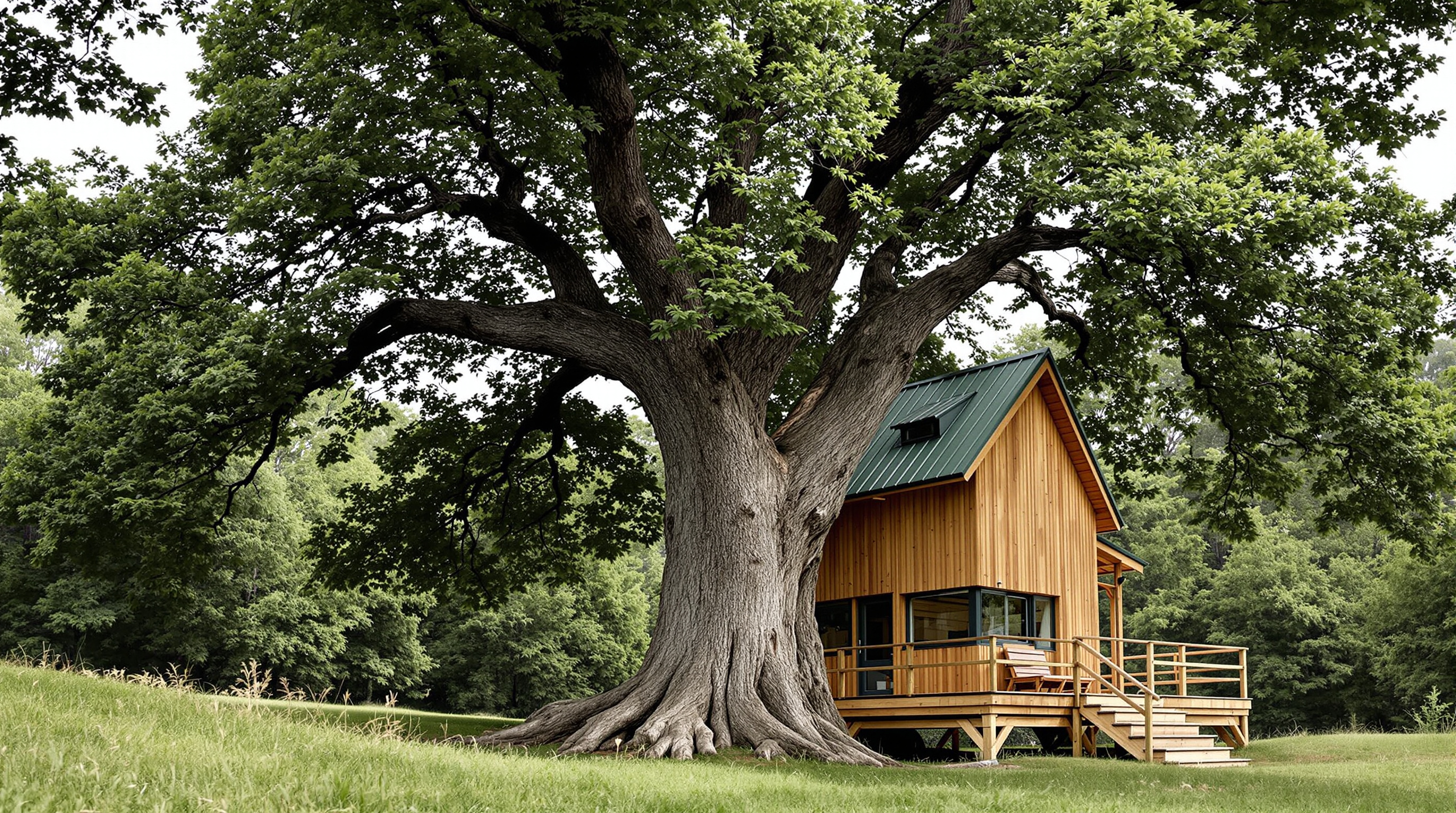
A photoreal architectural photo of a honey-cedar treehouse with a dark green metal gable roof, a wraparound black corner window, porthole, and teal-blue Dutch door, on a rope-railed deck in a huge old oak, with a rope swing and timber stairs in a sunny summer meadow. Example output of the Treehouse Retreat Concept Brief Builder (step 1).
Photoreal architectural photograph of a small timber treehouse retreat built into a single huge old oak tree, standing in a sloping summer meadow at the edge of a beech forest, seen from the meadow at the front left, camera at standing eye level (1.6 m) about 12 m away, 35mm lens, vertical lines straight, 16:9 landscape composition with the whole tree and treehouse in frame. The oak has a massive grey, deeply furrowed trunk about 1.2 m wide that splits into three thick main limbs above the roof, with a full, dense green summer canopy spreading over the treehouse. A square timber deck about 3.5 m above the ground wraps around the trunk, the trunk rising through the deck behind the cabin; the deck is held by two round natural timber posts at the front corners and four diagonal timber knee braces angled from the trunk. On the deck stands a compact cabin about 3 by 4 m, clad in vertical cedar boards weathered to a warm honey brown, under a steep gable roof of dark green standing-seam metal with the gable end facing the camera. Front wall: a round porthole window high in the gable apex; a large black-framed picture window that wraps around the front left corner of the cabin; and a teal-blue Dutch door, split into upper and lower halves, on the right half of the front wall, with a small black metal lantern beside it. A slim black stove chimney pipe rises from the right side of the roof. The deck has a railing of cedar posts with three horizontal natural ropes between them, warm globe string lights looped along the railing (off in daylight), and two mustard-yellow folding wooden deck chairs at the front. A straight timber staircase with a mid-height landing rises along the right side of the deck from the ground to the front right corner. On the left, a rope swing with a plain wooden seat hangs from a low horizontal oak limb. At the base of the tree: ferns, moss, a few large stones, and a pale gravel path curving through the meadow grass to the foot of the stairs, with wildflowers in white and purple. Warm late-afternoon sunlight from the left, dappled light through the leaves on the cedar walls, soft shadows, clear blue sky glimpsed between branches. Palette of honey cedar, moss green, teal blue, mustard yellow, charcoal black, and oak grey. Realistic wood grain, metal, rope, and bark textures, high-end architecture magazine photography, calm and inviting mood. No people, no text, no logos, no signs.
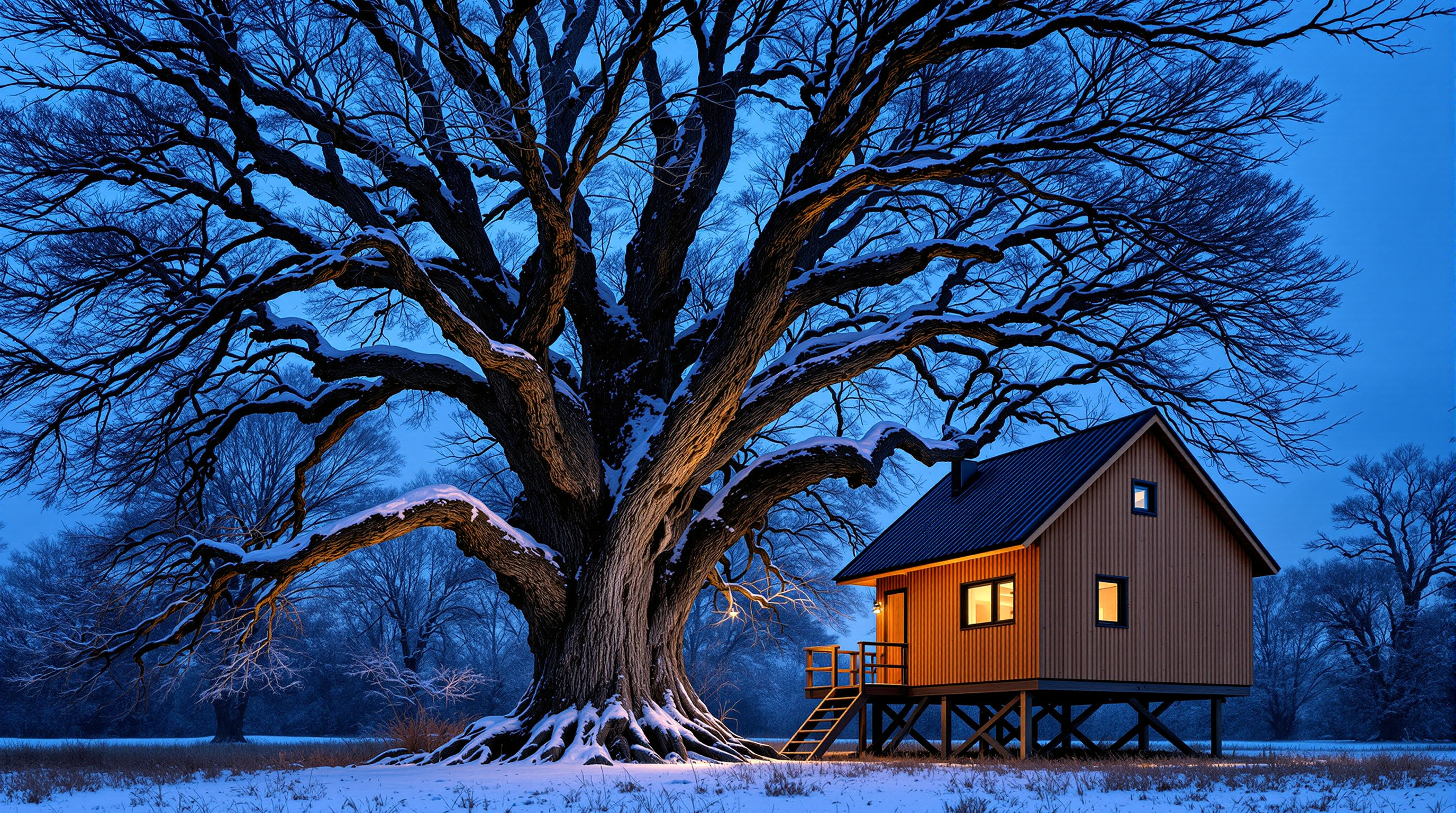
The same cedar treehouse cabin from step 2 on a snowy blue-hour evening, seen from the front right: the bare old oak lined with snow, glowing floor-to-ceiling windows and string lights on the deck, and snowy stairs with footprints in the foreground. Every fixed design detail is restated so the building stays identical.
Photoreal architectural photograph of the same small cedar treehouse cabin and old oak from step 2, now on a snowy winter evening at blue hour, seen from the meadow at the front right instead of from the left, camera at standing eye level (1.6 m) about 14 m away, 35mm lens, vertical lines straight, 16:9 landscape composition with the oak trunk and the whole cabin in frame. Keep every fixed design detail identical to step 2. Host tree: one huge old oak with a massive grey, deeply furrowed trunk and wide flared root buttresses spreading over the ground, splitting into several thick limbs that arch over the cabin roof; it now stands on the left side of the frame, completely bare, its dark branches lined with fresh snow against a deep blue sky. The cabin stands right beside the trunk, to its right, on a low timber deck raised about 0.6 m on short square timber posts. Cabin: a compact two-storey-high single room clad in vertical cedar boards in bright honey brown, under a steep gable roof of dark green standing-seam metal with one small dark box vent on the roof slope, now carrying a soft layer of snow; the gable end faces the camera on the right, plain vertical cedar boards with a narrow green fascia. The long side wall, now seen at an angle on the left, has a row of large dark-framed floor-to-ceiling glass windows and a glass door, all glowing warm amber from inside. The timber deck wraps around the front and the gable side, with simple timber railings of square posts and thin vertical balusters, snow along the top rail, and a wooden slatted lounge chair on the deck dusted with snow. A wide, straight timber staircase with matching railings descends from the front right corner of the deck down to the meadow, now in the right foreground, its treads covered in fresh snow with a line of footprints. Warm globe string lights hang along the deck railing, glowing. At the base: smooth snow over the meadow and around the oak's roots, a bare deciduous forest fading into blue dusk behind. Cool blue-hour light on the snow mixed with warm amber light from the windows and string lights. Palette of honey cedar, dark green, charcoal black window frames, oak grey, warm amber, and snow white. Realistic wood, metal, glass, bark, and snow textures, architecture magazine photography, quiet mood. No people, no text, no logos, no signs.
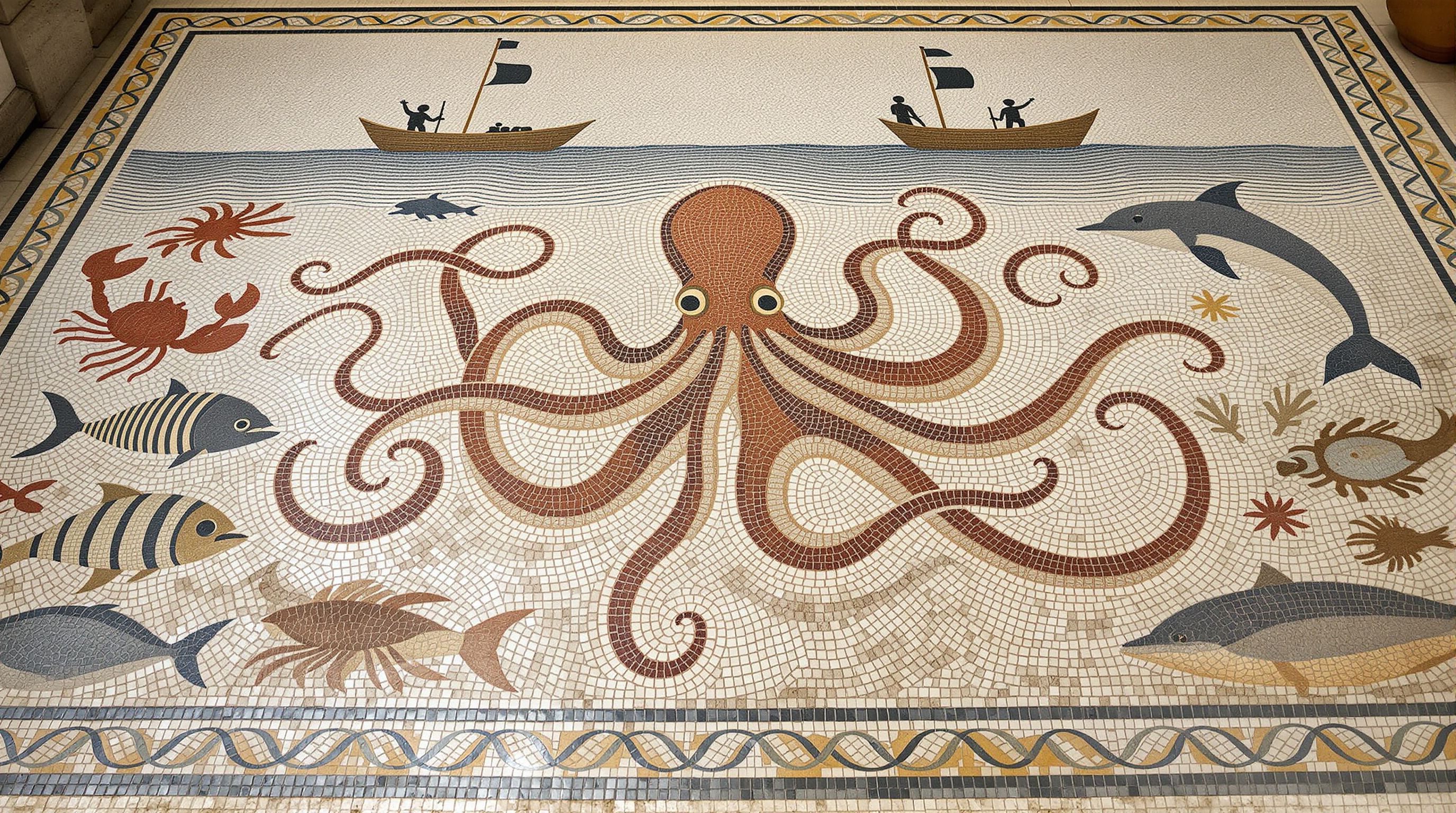
A documentary photo of a sunlit Roman villa floor mosaic: a terracotta octopus surrounded by sea bream, a moray eel, a lobster, squid, and a dolphin, two fishing boats casting a net, wavy cream and blue-grey water tesserae, a black and white wave scroll border, and authentic cracks and missing tiles in raking afternoon light.
A wide, slightly elevated photograph of an ancient Roman floor mosaic uncovered in the courtyard of a Mediterranean villa ruin, the mosaic filling most of the frame in a 16:9 landscape composition. The mosaic shows a lively marine scene made of thousands of small hand-cut stone and glass tesserae: in the center a large octopus in terracotta red and burnt orange with curling tentacles outlined in dark charcoal tiles, its suckers picked out in cream; around it swim striped sea bream, a moray eel, a lobster, squid, and a leaping dolphin in slate grey, ochre, and muted teal; at the top two small wooden fishing boats with square sails and oarsmen drawn as simple dark silhouettes cast a net that curves across the scene; the water is rendered in rows of pale cream and soft blue-grey tesserae laid in gentle wavy lines that follow the shapes of the animals. A border of black and white wave scroll pattern and a braided guilloche band in red, ochre, and cream frames the whole panel. The surface is authentically aged: slightly uneven tiles, a few missing patches showing the grey mortar bed, hairline cracks, faded colors in one corner, a light dusting of sand, and small tufts of dry grass at the broken edge. Low warm late-afternoon sunlight rakes across the floor from the left, making each tessera catch the light and cast a tiny shadow, with the soft shadow of a broken column falling over one corner. Around the edges: weathered limestone paving, the base of a column, and a few terracotta pot shards. Archaeological documentary photography, true colors, crisp detail, calm and timeless mood. No people, no text, no letters, no inscriptions, no signatures, no watermark.
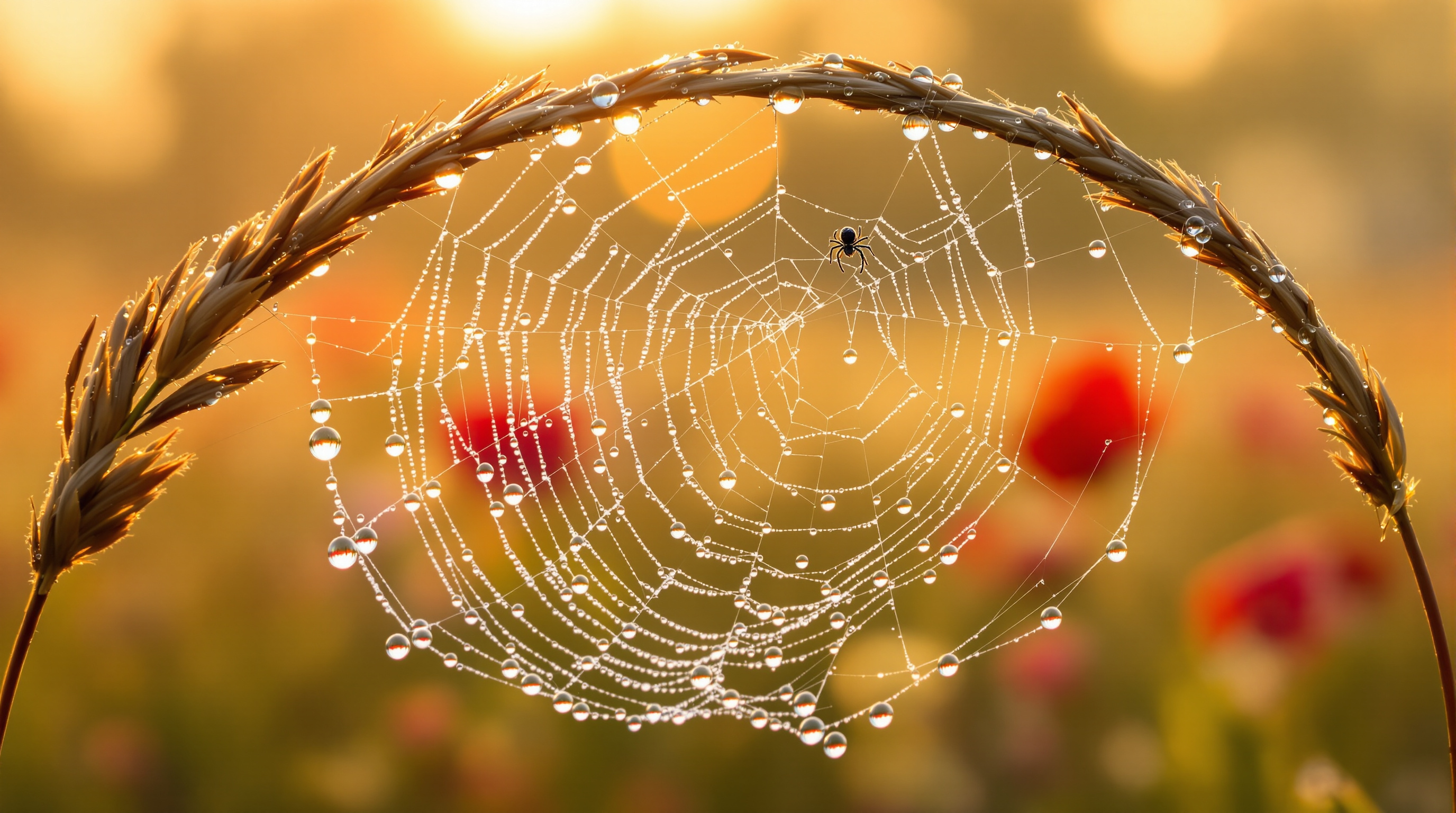
An extreme close-up nature photo of a dew-covered orb web between dry grass stems, where the sharpest drops each hold a tiny upside-down reflection of a golden sunrise meadow with poppies, with a razor-thin focus plane, rainbow refraction, and soft gold and green bokeh behind.
An extreme close-up macro photograph of an orb spider web covered in morning dew, stretched between two arching stems of dry meadow grass, composed as a wide 16:9 landscape. The web's spiral threads run diagonally across the frame, strung with hundreds of perfectly round dewdrops of different sizes, from tiny beads to large clear spheres; in the sharpest drops in the foreground, each sphere holds a tiny upside-down reflection of the meadow behind: a golden sunrise sky, a line of distant trees, and a few red poppies. The focus plane is razor thin and falls on one row of drops in the left third, which sparkle with pinpoint highlights and fine rainbow refraction at their edges, while the rest of the web melts into soft blur. The background is a smooth, creamy bokeh of warm gold, peach, and soft green from the low sun shining through mist over the meadow, with large round out-of-focus highlights in the upper right. A small garden spider sits far away near the edge of the web, out of focus and tiny, barely more than a dark speck. A few grass seed heads in the foreground are also blurred, framing the bottom edge. Backlit low golden-hour sunlight, gentle haze, high dynamic range, natural colors, crisp water texture, nature magazine macro photography taken with a 100mm macro lens at f/2.8, serene and delicate mood. No people, no text, no watermark.
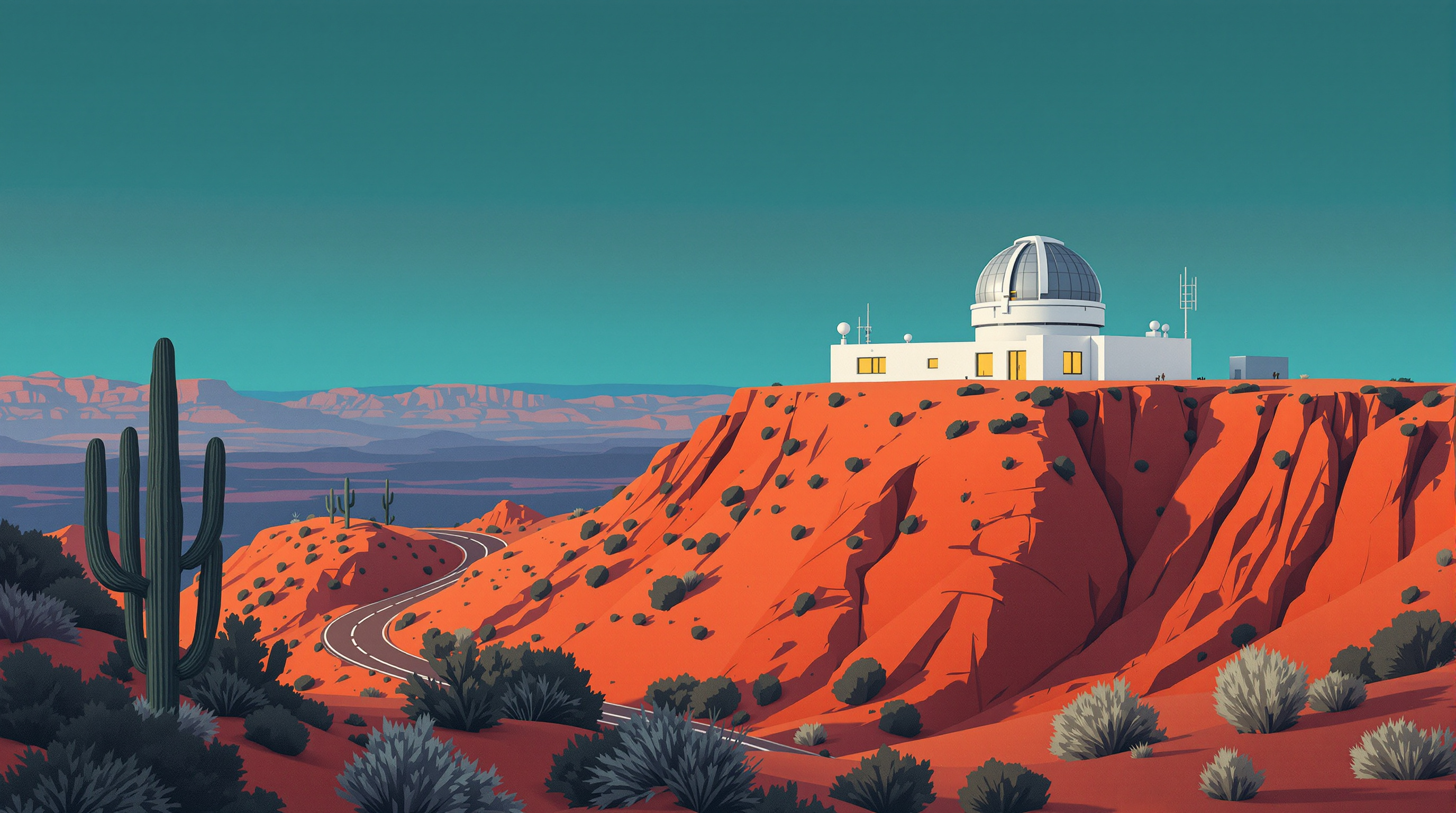
A flat, textured 1960s-style gouache painting of a white-domed observatory on a red rock mesa, with a winding switchback road, layered rust, pink, and ochre desert shapes, cactus silhouettes, and a teal-to-coral dusk sky with a crescent moon and a speckled Milky Way, in a limited retro palette.
A mid-century modern gouache illustration of a small mountaintop astronomical observatory in a red rock desert at dusk, wide 16:9 landscape composition, painted in flat, opaque gouache with visible brush texture and slightly chalky matte color. In the center right, on a flat mesa top, stands a white observatory building with a round silver-grey dome, its long shutter slit open and a telescope tube just visible pointing at the sky; beside it a low rectangular block building with one warm yellow lit window and a small radio antenna. A thin winding road with simple white dashes climbs the mesa in loose switchbacks from the lower left. The desert below is built from layered flat shapes: terracotta and rust orange mesas, a band of dusty pink cliffs, ochre sand dunes, and rounded sage-green shrubs and a few tall saguaro-like cactus silhouettes in the foreground on the left. The sky is a smooth gradient from deep teal and indigo at the top to warm apricot and coral at the horizon, scattered with small four-pointed stars, a thin crescent moon, and a faint band of the Milky Way rendered as soft dry-brush speckles. Long purple shadows stretch across the sand. Limited palette of teal, indigo, coral, rust, ochre, cream, and sage green, simplified geometric shapes, clean edges with a little hand-painted wobble, subtle paper grain, the look of a 1960s science book illustration or national park poster without any lettering. Calm, optimistic, wonder-filled mood. No people, no text, no letters, no logos, no border, no watermark.
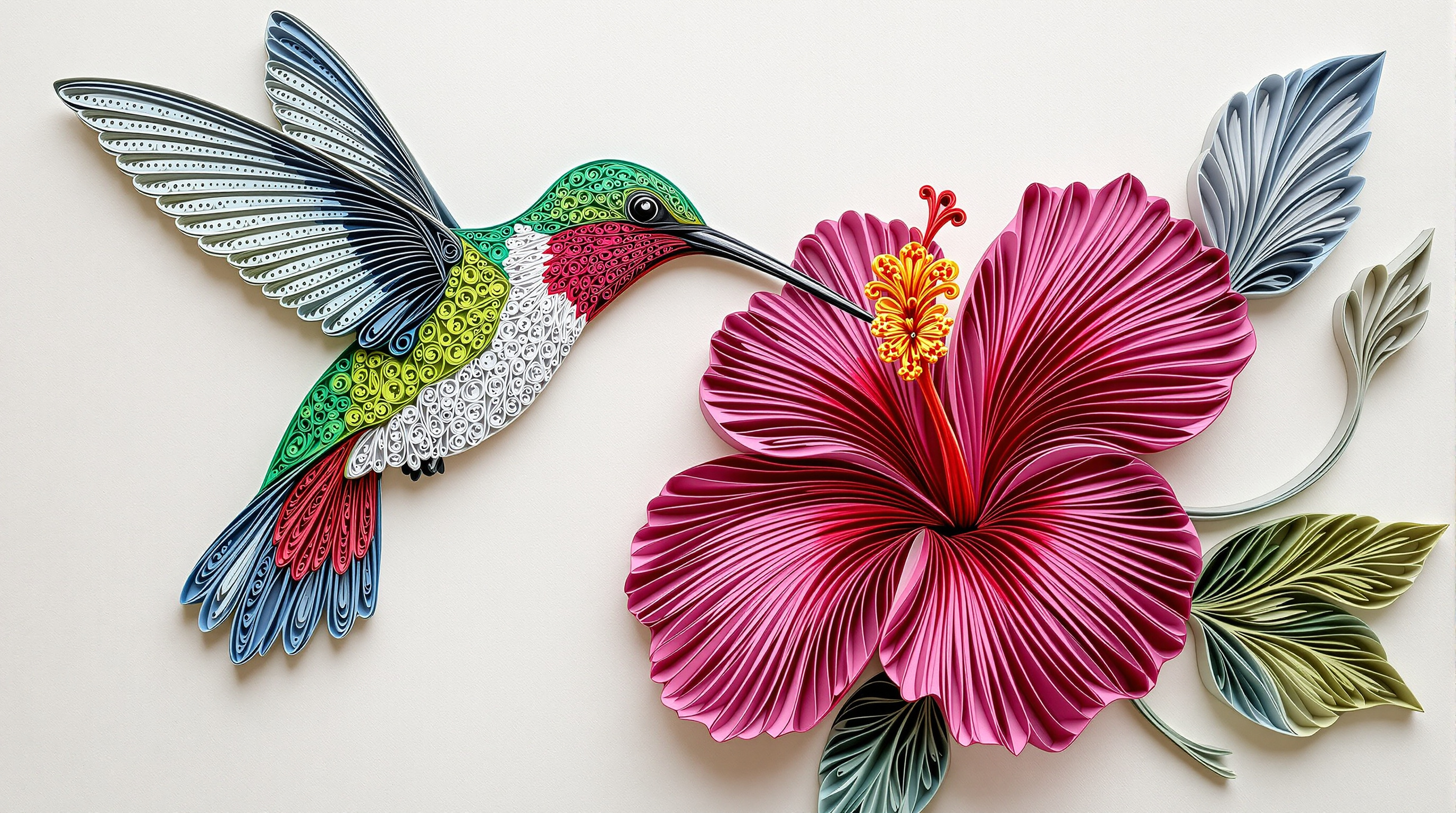
A photoreal close-up of a handmade paper quilling artwork on a craft table: an emerald and ruby hummingbird in mid-hover sipping from a magenta hibiscus, built from tightly coiled and scrolled paper strips standing on edge on a cream background, with soft window light, paper-edge shadows, and quilling tools blurred at the edge.
A close, slightly elevated studio photograph of a finished paper quilling artwork lying flat on a pale wooden craft table, 16:9 landscape composition, the artwork filling most of the frame. The piece shows a ruby-throated hummingbird in mid-hover on the left, its long thin beak dipping into a large open magenta hibiscus flower on the right. Everything is built from thousands of narrow paper strips, about 3 mm wide, rolled into tight coils, teardrops, marquise shapes, and open scrolls, glued on edge so the paper stands up from a soft cream cotton-paper background. The hummingbird's back and crown are tight coils in emerald and metallic-sheen green, its throat a patch of tiny ruby-red teardrop coils, its belly pale grey and white loose coils, its wings two fans of long fine strips in smoky grey-blue graded from dark at the base to light at the tips, suggesting motion; a small black coil for the eye with a single white dot. The hibiscus has five broad petals made of rows of magenta and hot pink strips shaped in waves, a deep crimson center, and a long yellow stamen column tipped with tiny orange coils; two glossy green leaves made of veined leaf-green strips, a curling stem, and one closed bud. A few loose spiral tendrils and three small lavender filigree flowers fill the background space. Real craft details: visible paper edges and layers, slight variations in coil tightness, tiny glue sheen at a few joints, and soft shadows cast by the raised strips onto the cream base. At the edge of the frame, out of focus: a slotted quilling tool, a small bundle of colored strips, and a pair of fine tweezers. Soft diffused window light from the upper left, gentle contact shadows, shallow depth of field with the hummingbird's head and the flower center sharpest, the far corners softly blurred. Photoreal product photography of handmade paper art, true colors, calm and delicate mood. Not a drawing or a painting of quilling: a real photographed paper object. No text, no letters, no signature, no watermark, no hands.
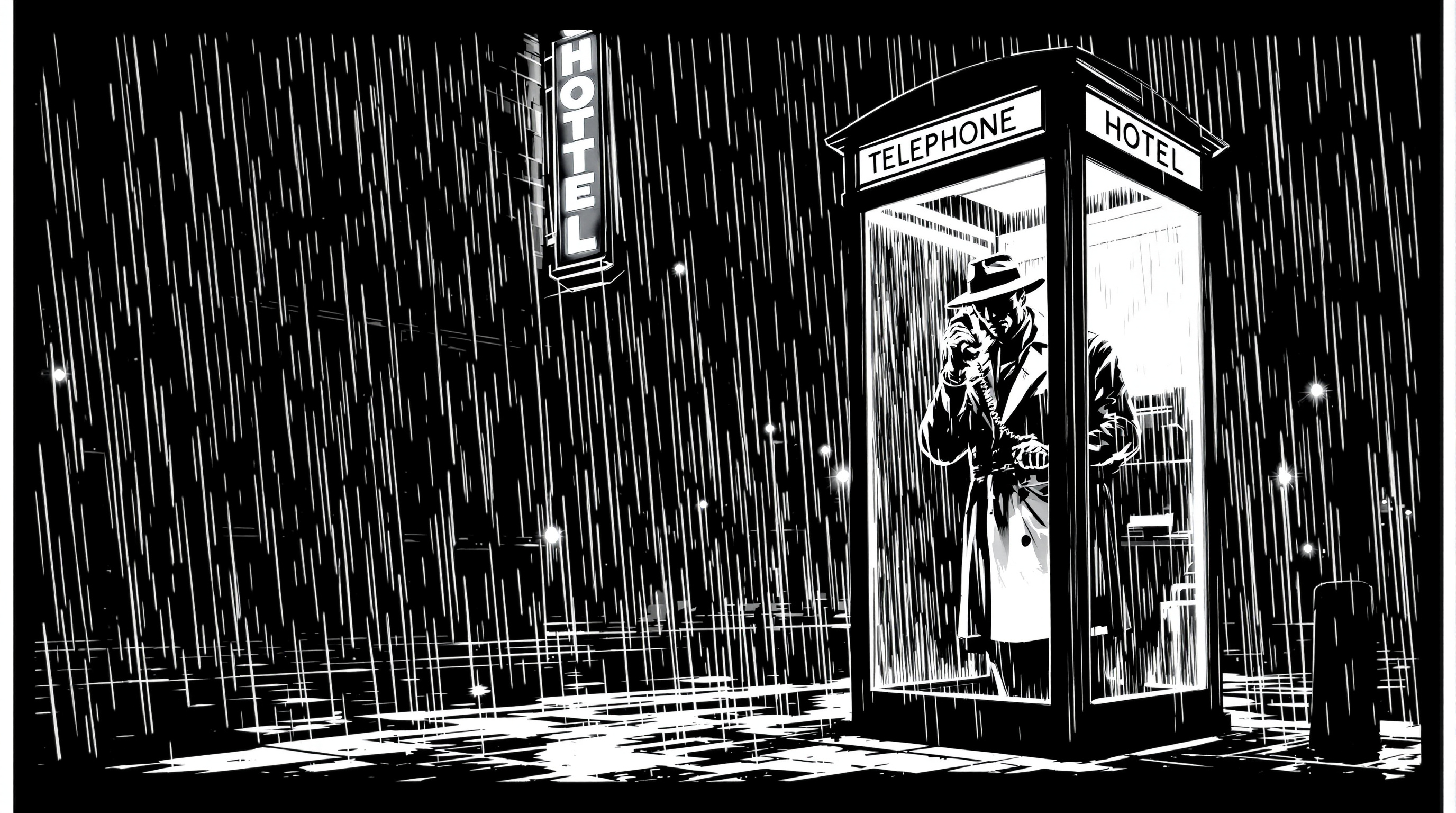
A single black-and-white crime comic panel with a thin black border: a trench coat detective in a glowing phone booth on a rainy night street, hard brush inking, zipatone dot-screen rain and shadows, a wordless neon hotel sign reflected in puddles, a silhouetted 1940s sedan, and dramatic chiaroscuro, with no speech balloons or text.
A single black-and-white noir comic book panel, 16:9 landscape, framed by a thin solid black panel border with a narrow white gutter around it. Night on an empty city street in heavy rain. Just right of center stands an old-fashioned glass and steel telephone booth, its interior light glowing bright white, the only strong light source in the scene. Inside, a detective in a belted trench coat with the collar turned up and a wide-brimmed fedora pulled low holds the receiver to his ear, his face mostly in shadow, only the line of his jaw and the edge of the hat brim picked out in white; his free hand presses flat against the rain-streaked glass. Water runs down the booth's panes in drawn streaks. Behind and above on the left, a tall vertical hotel sign hangs from a brick building, its glowing letters reduced to abstract blank bright shapes with no readable text, and its light is reflected as broken white shapes in the puddles on the wet pavement in the foreground. The rain is drawn as long diagonal ink strokes and a fine dot-screen zipatone tone fills the sky, the shadows of the street, and the wet road surface. Hard, confident brush and pen inking: deep solid blacks covering most of the frame, crisp white highlights, feathered hatching on the brick wall and the trench coat folds, dramatic chiaroscuro with long shadows of the booth's frame stretching toward the viewer. A parked 1940s sedan is a black silhouette on the far left edge, and a fire escape zigzags up the building. Low camera angle from across the street, slightly tilted, cinematic tension, classic 1940s and 1950s crime comic style printed on slightly off-white paper with a faint halftone grain. Strictly black, white, and grey tones only. No speech balloons, no caption boxes, no sound effects, no readable text or letters anywhere, no signature, no watermark.
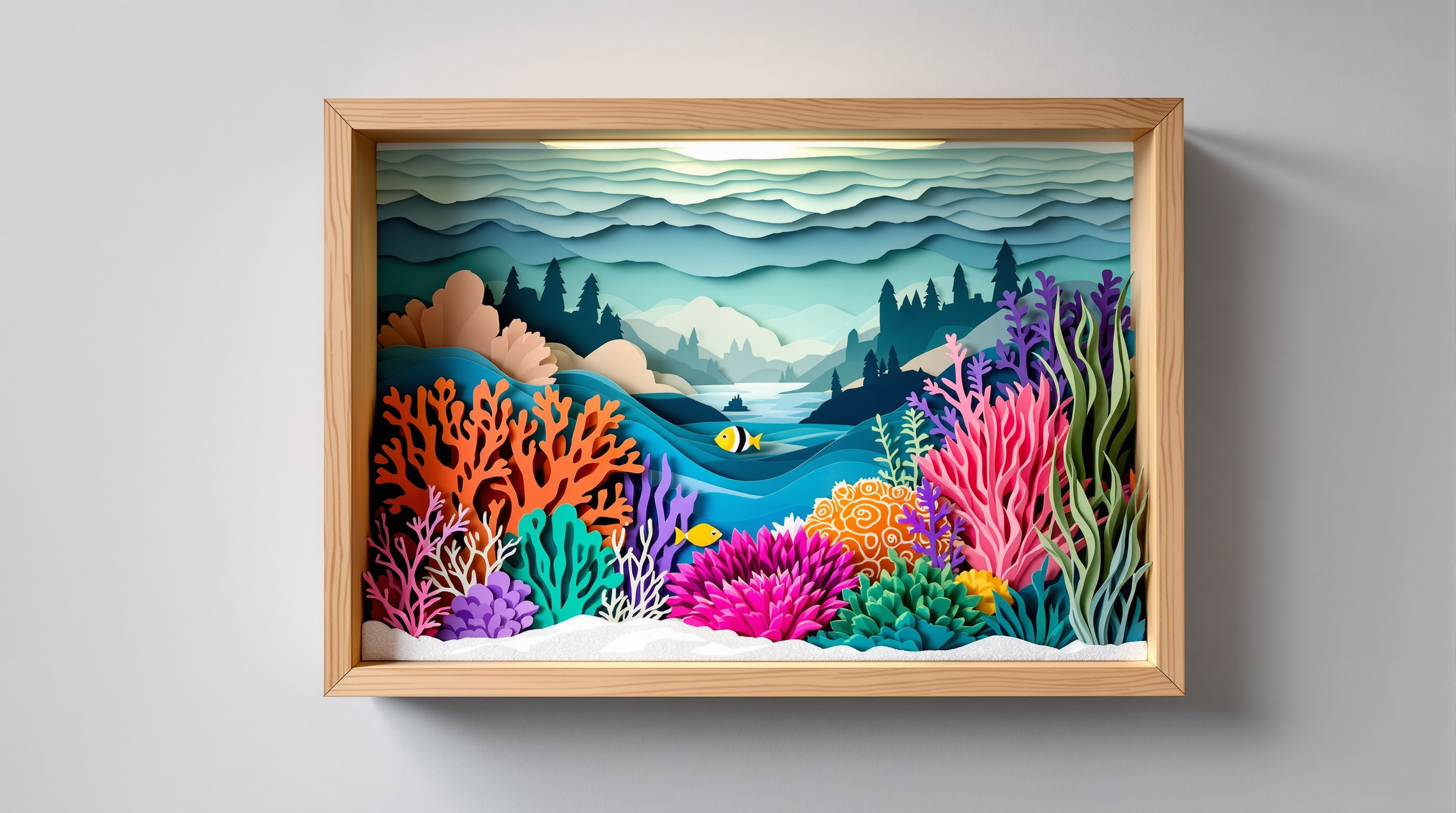
A gallery photo of a deep oak shadow box holding a layered cut-paper coral reef: turquoise water gradients, pink branching coral, an ochre brain coral, a violet lace fan coral, a magenta anemone, a small yellow fish, punched paper bubbles, and a cream sand floor, lit from the side so every paper layer casts a soft shadow.
A museum-quality photograph of a deep wooden shadow box hanging on a pale grey gallery wall, seen straight on at eye level, 16:9 landscape composition with the box filling most of the frame. Inside the box is a layered cut-paper diorama of a coral reef aquarium, made of about twelve hand-cut paper layers spaced a few millimeters apart so each layer casts a soft shadow on the one behind it. The back layers are smooth gradients of turquoise and deep teal paper suggesting open water, with faint wavy cut-outs of light rays; middle layers hold silhouettes of distant coral in muted blue-green; the front layers are rich and colorful: branching coral in coral pink and salmon, a round brain coral in ochre with a carved maze pattern, a fan coral in violet with delicate lace-like cut holes, swaying sea grass in two greens, and a bright magenta anemone with fringed tentacles cut in fine strips. A single small yellow fish with a thin black stripe and a tiny punched eye swims near the anemone, slightly raised on its own layer. Columns of small circular bubbles, punched from white and pale aqua paper, rise on the right. A sandy floor of textured cream paper with a few tiny cut shells runs along the bottom. The box frame is natural oak, about 8 cm deep, with a clean inner white mat and a sheet of museum glass showing only a faint reflection at one corner. Soft directional light from the left side lights up the paper edges and creates crisp, layered shadows inside the box, emphasizing depth; the paper fibers, cut edges, and slight curl of thin pieces are visible. Calm, wondrous mood, true colors, craft and fine-art photography, sharp focus across the whole diorama. No text, no letters, no labels, no signature, no watermark, no people.

A photoreal studio photo of a handmade needle-felted red panda sculpture on a moss-wrapped branch: rusty orange wool coat, cream muzzle, ringed tail, glass-bead eyes, soft window light, and felting tools blurred at the edge on a linen craft table.
A close, slightly elevated studio photograph of a finished needle-felted wool sculpture of a red panda sitting on a mossy branch, 16:9 landscape composition, the sculpture filling the center of the frame. The red panda is built entirely from densely poked wool fibers: rusty orange and cinnamon body, cream muzzle and ear linings, dark brown eye patches and legs, a ringed bushy tail curling around the branch. Tiny black glass bead eyes catch a soft highlight; whiskers are a few fine threads of dark wool; individual poked texture shows on the cheeks and paws so it reads as handmade felt, not fur photography. The branch is wrapped in real preserved sheet moss and a few dried fern fronds, resting on a pale linen cloth over a wooden craft table. Soft diffused window light from the upper left, gentle contact shadows under the paws, shallow depth of field with the face and front paws sharpest, the far end of the tail and table edge softly blurred. At the lower right corner, out of focus: a felting needle in a wooden handle and a small pile of dyed wool rovings in orange, cream, and brown. Photoreal product photography of handmade needle-felted fiber art, true colors, cozy and quiet mood. Not a drawing, not a painting, not a real animal: a real photographed wool sculpture. No readable text, no letters, no signature, no watermark, no hands.
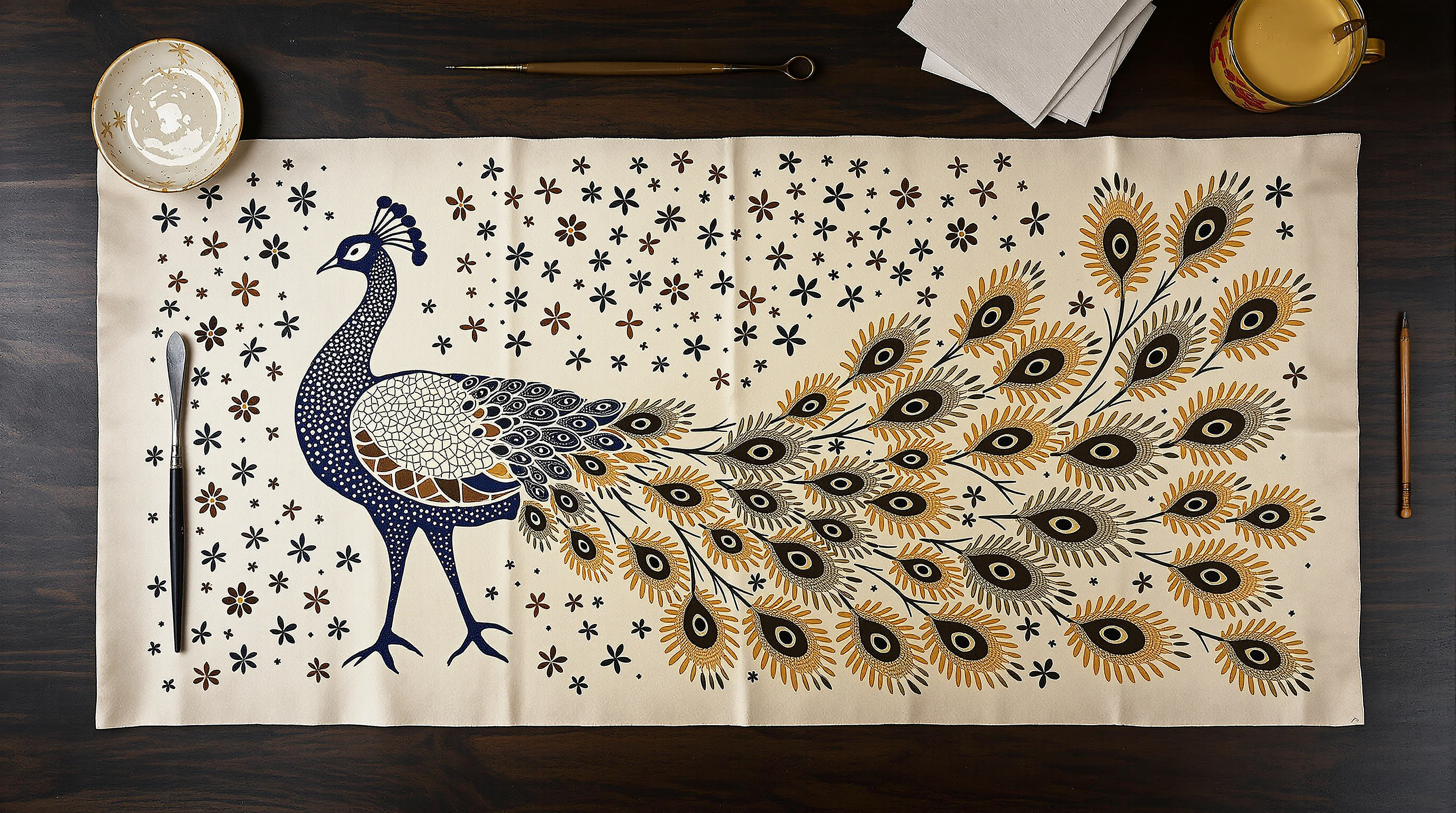
A flat-lay photo of a finished batik textile panel on teak: an indigo and ochre peacock with cracked wax-resist eye-spots and parang-inspired fillers on cream cotton, soft sidelight, with a canting tool and wax pot softly blurred at the edge.
A flat-lay photograph of a finished hand-drawn batik textile panel spread on dark teak, 16:9 landscape composition, the cloth filling most of the frame from left to right. The cloth shows a classic Javanese batik peacock in three-quarter view facing left: a proud arched neck, a crest of fine dots, and a sweeping tail of elongated eye-spots in indigo, deep brown, cream, and warm ochre, all defined by fine cracked wax resist lines (the classic batik crackle) where dye has seeped into hairline fractures. Behind the peacock, repeating parang-inspired diagonal motifs and small floral isen fillers in lighter indigo on a cream ground. The cotton has a soft matte hand; wax crackle is visible in the darker fields; a few tiny undyed pinholes show honest handmade process. Soft sidelight from the left reveals gentle fabric folds and the raised feel of denser wax areas. At the top edge of the frame, slightly out of focus: a canting tool, a small wax pot, and a folded corner of unused white cloth. Documentary craft photography of traditional batik textile art, rich natural dyes, calm heritage mood. Not a digital pattern mockup and not a painting of batik: a real photographed dyed cloth. No readable text, no letters, no logo, no watermark, no hands.
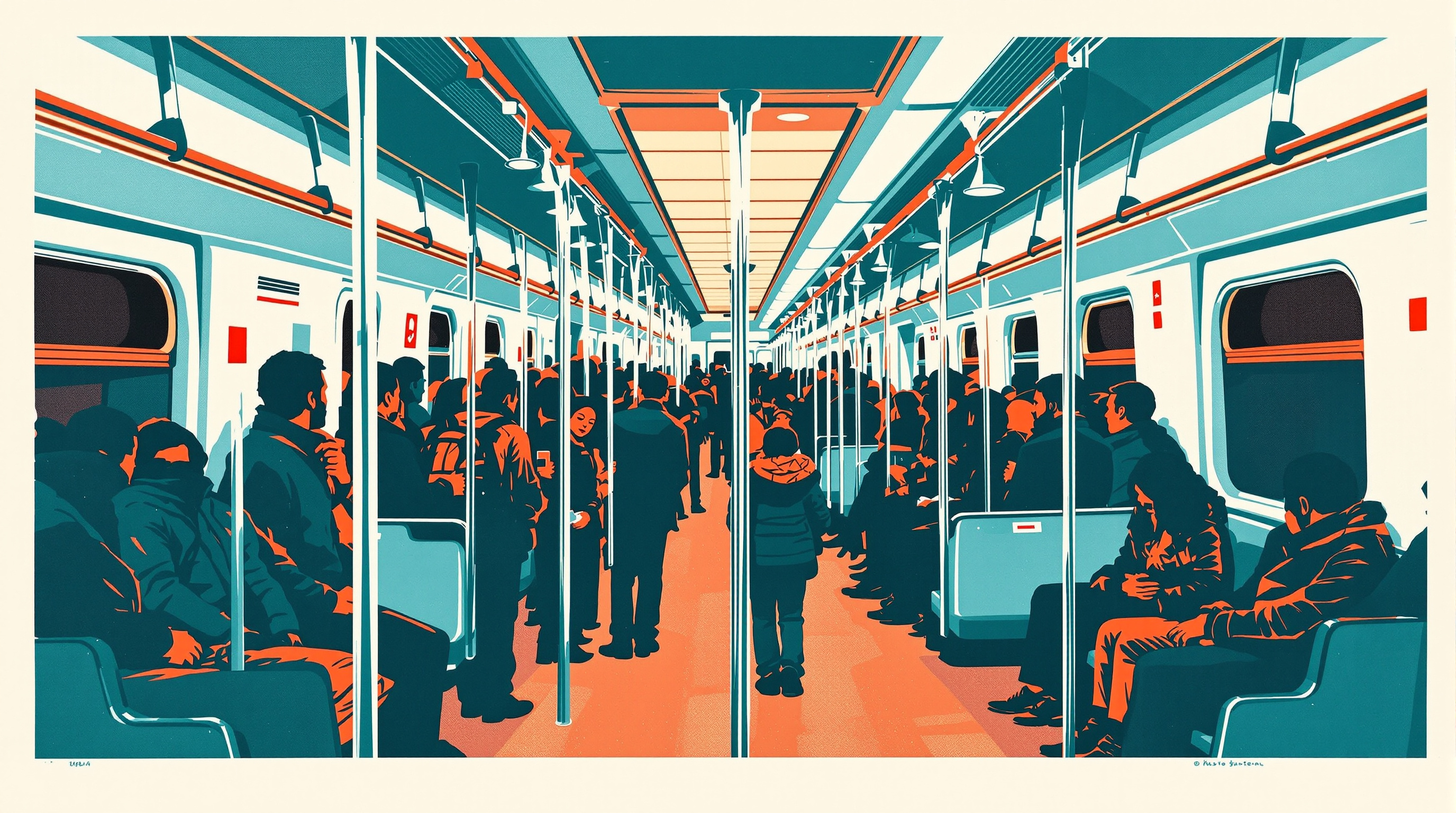
A two-color risograph print look of a packed subway carriage at night: fluorescent teal and warm red ink on cream paper, passengers as simplified shapes, overlapping misregistration, visible halftone dots, handrail reflections, and a quiet tired mood, framed as a finished print on a table.
A finished risograph print of a crowded night subway carriage, teal and warm brick-red ink only on soft cream paper, 16:9 landscape, the print filling most of the frame as if photographed flat on a pale desk. Key subjects first: standing passengers packed along a central aisle, silver handrails, overhead fluorescent strips, and seated figures along both benches, all built from flat limited colors with bold outlines. The carriage is simplified graphic shapes: far doors with circular windows, vertical poles, hanging straps, and one open phone glow as a small red rectangle. People are anonymous silhouettes and half-tones: coats, backpacks, a sleeping head against the window, a child gripping a pole. Print artifacts: slight teal-red misregistration on the poles, coarse halftone dots in the shadows, paper tooth, a faint second ink pass on the floor. Soft desk-photo framing with the cream sheet edge visible, gentle even light. Mood quiet and tired, late commute, graphic poster energy. Not photoreal, not 3D, not watercolor. No readable text, no logos, no watermark, no hands.
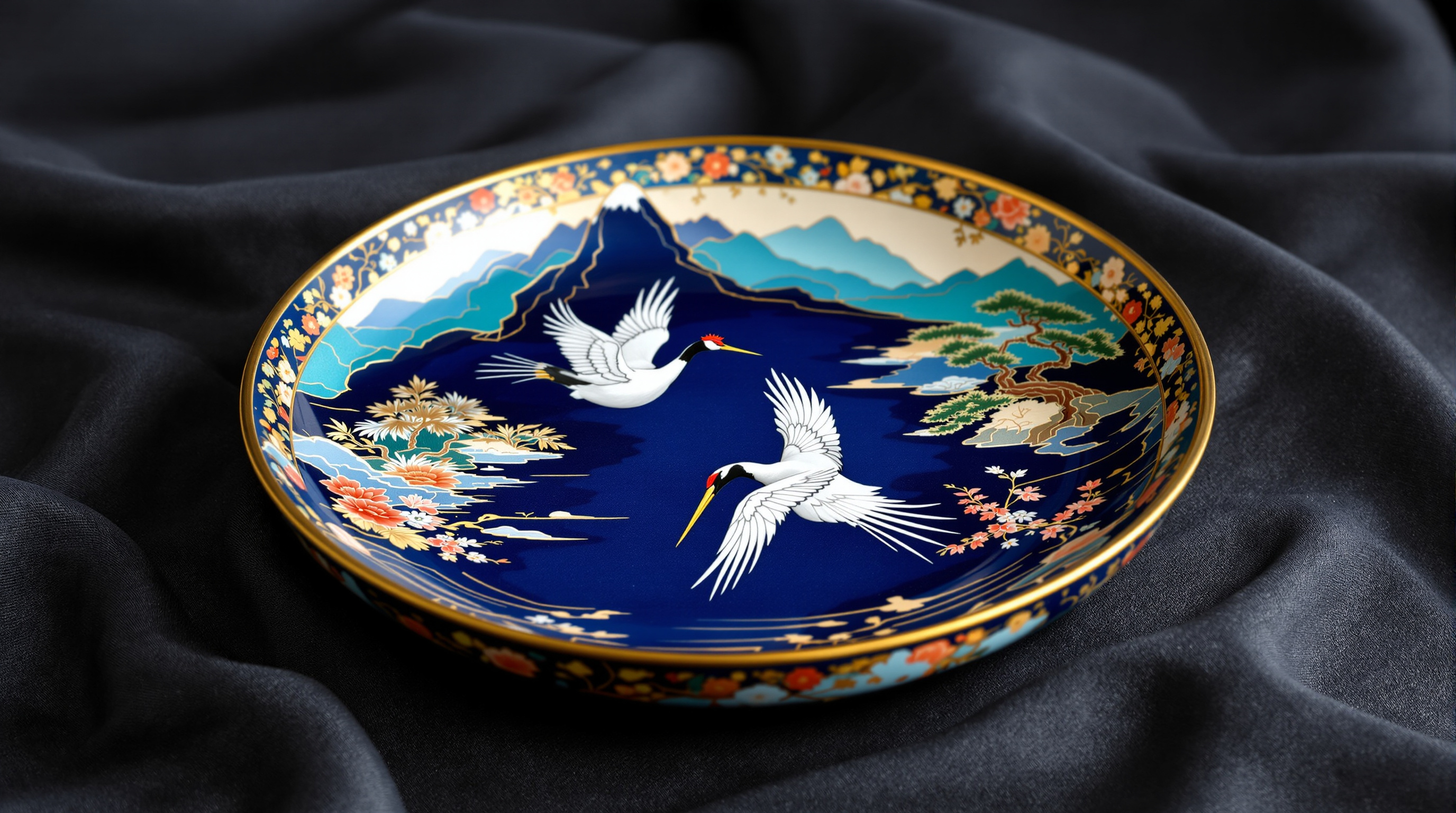
A photoreal studio shot of a round cloisonné enamel dish: two white and black cranes flying over a deep blue mountain lake, fine gold wire cells filled with saturated enamel, floral rim border, glossy kiln finish, on dark linen with soft side light.
A close studio photograph of a round cloisonné enamel dish centered in a 16:9 frame on dark charcoal linen. Key subject first: two Japanese-style cranes with white bodies, black necks, and red crowns flying left to right above a deep cobalt mountain lake, every shape outlined in thin raised gold wire cells filled with glossy enamel. Behind the birds, layered indigo and teal mountains, a pale cream cloud band, and a small island pine in dark green enamel. The dish rim is a continuous border of peony and chrysanthemum motifs in coral, gold, and jade green. Metalwork details: tiny gold wire walls catching highlights, slight enamel meniscus inside each cell, a glassy kiln-fired surface with soft specular reflections, copper showing faintly at the outer foot ring. Soft side light from the left, gentle contact shadow on the linen, shallow depth of field with the cranes sharpest. Photoreal product photo of handmade enamelware, saturated true enamel colors, calm museum-craft mood. Not a painting of enamel: a real photographed object. No text, no hallmark letters, no watermark, no hands.
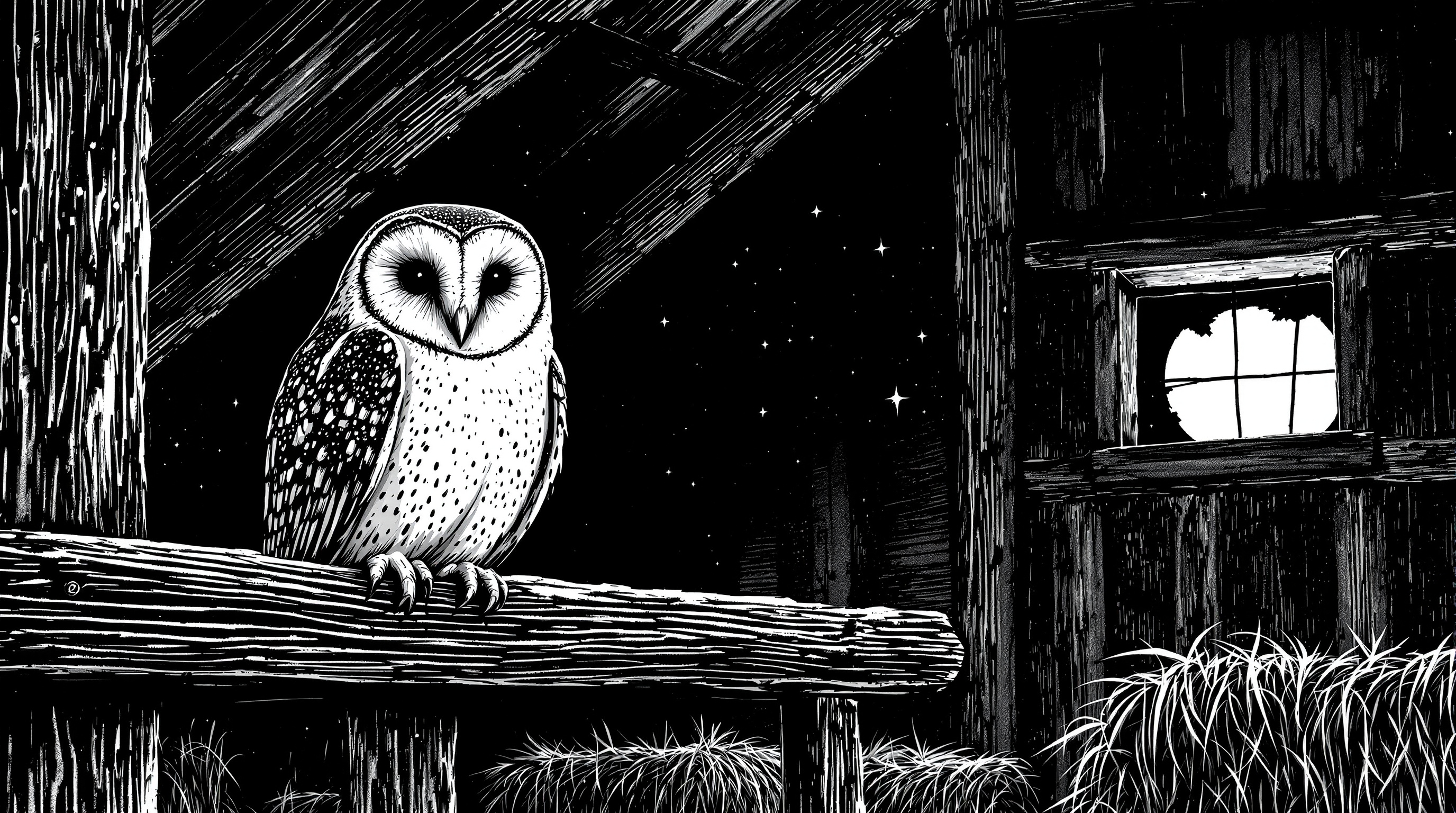
A black scratchboard illustration of a barn owl perched on a beam inside a moonlit barn: white scratched feathers against deep black ink, straw and rafters suggested with fine lines, a round moon through a broken loft window, high-contrast engraved look, no color.
A black scratchboard illustration of a barn owl perched on a rough wooden beam inside a quiet barn at night, 16:9 landscape, high-contrast white scratched lines on deep black ink board. Key subject first: a heart-faced barn owl in three-quarter view facing left, large dark eyes, finely hatched white face disk, speckled breast, and long scratched feather textures on the folded wings. Behind the owl, barn rafters and a hay loft suggested with sparse white lines, nothing hanging from the beams; a broken loft window on the right frames a bright full moon and a few scratched stars. Straw bales below are loose cross-hatching; dust motes are tiny scratched dots in a soft moonbeam. Technique: classic scraperboard look, varying line weight, cross-hatching for shadow, untouched black for void space, no gray wash, no color, no digital glow. Mood still, watchful, slightly eerie but calm. No text, no signature, no watermark, no color tint.
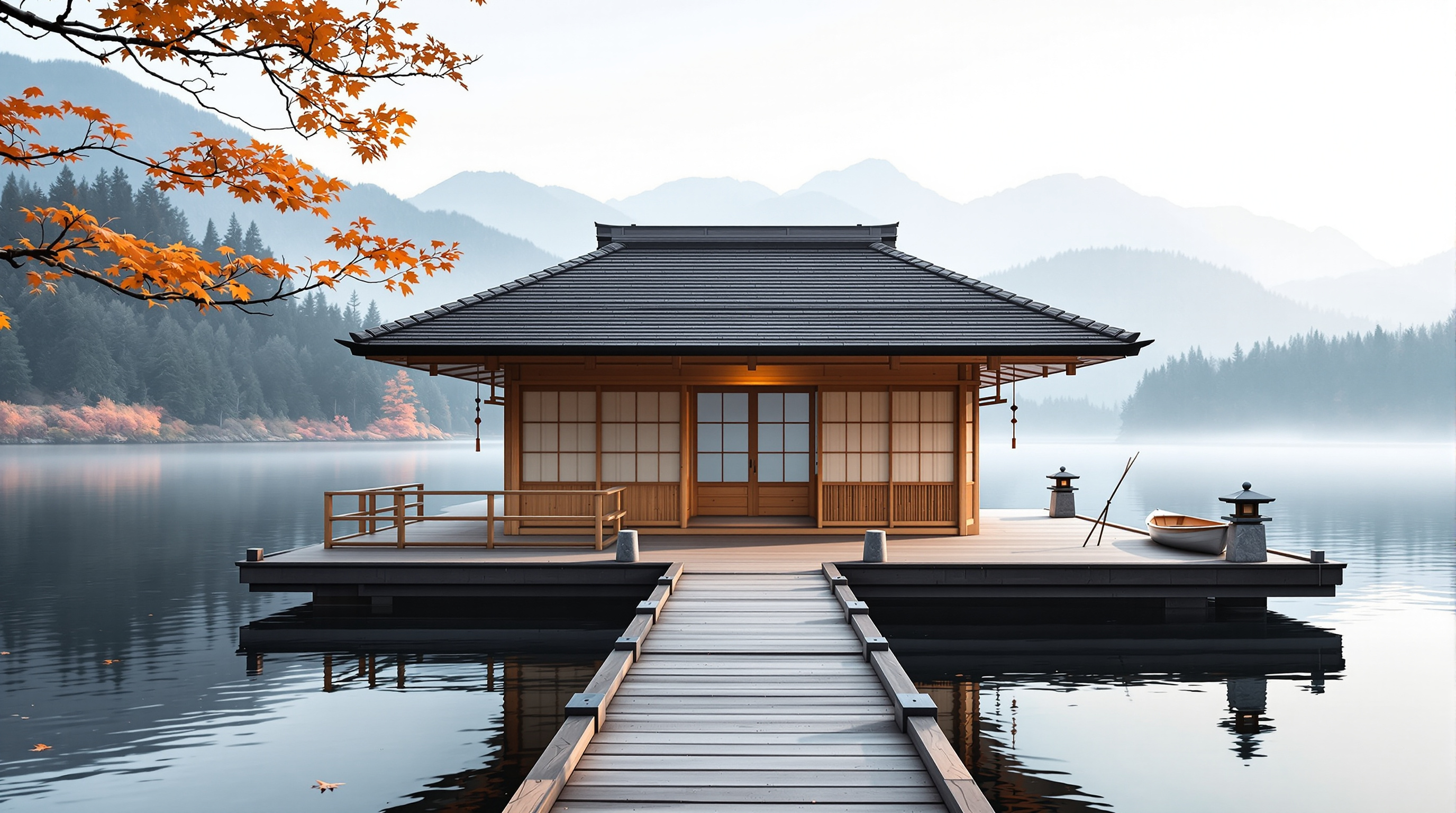
Photoreal view of a small floating cedar teahouse with a hipped shingle roof and shoji screens, approached from a shore path on a misty autumn morning, stone lanterns on the dock, a tied wooden boat, soft fog over still water, warm wood against cool blue-gray lake and mountains.
Photoreal architectural photograph of a small floating cedar teahouse on a still mountain lake in early autumn mist, 16:9 landscape, viewed from a wooden shore path approaching the dock. Key subjects first: a square one-room cedar teahouse with a dark weathered hipped shingle roof, four sliding shoji paper screens on the lake-facing side, a narrow engawa deck with simple vertical railings, two squat granite stone lanterns flanking the dock entrance, and a small tied wooden rowboat at the right side of the floating platform. The platform sits on dark timber pontoons just above the water; pale cedar walls show soft grain; copper rain chains hang at two corners. Behind the teahouse, layered blue-gray mountains fade into fog; pine forest lines the far shore; the water mirrors the roof as a soft blur. Light: low morning sun from the left, cool mist, warm wood highlights, quiet contemplative mood, crisp architectural detail, true colors. No people, no smoke plumes, no neon, no readable text, no watermark.
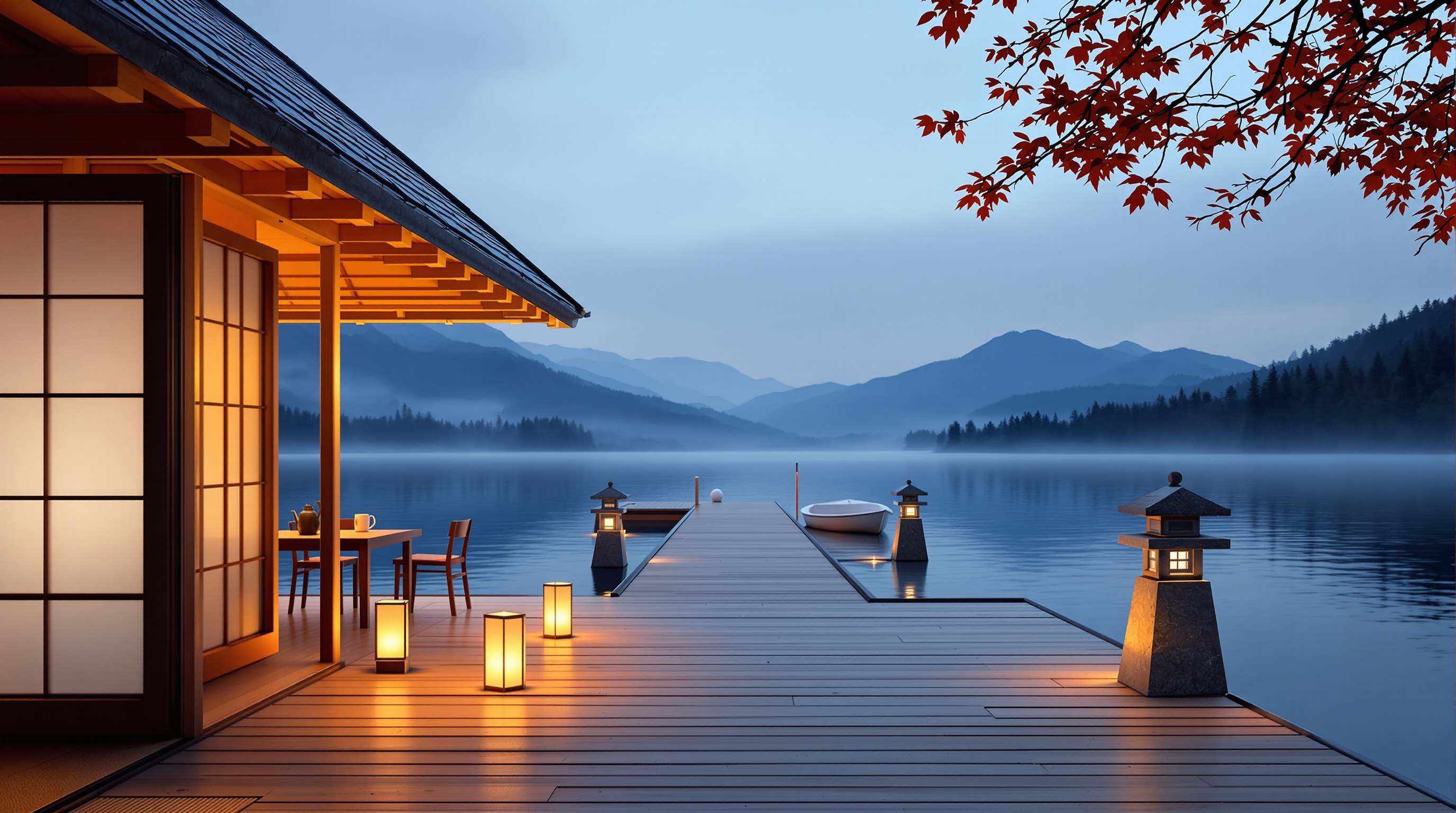
Photoreal dusk view from the deck of the same floating cedar teahouse: glowing shoji and dark tiled eaves on the left, paper and stone lanterns along the boards, a white rowboat, a long boardwalk over still blue-hour water, misty mountains and a red maple branch, restating the fixed design details of the morning view.
Photoreal photograph from the wide plank deck of a small floating cedar teahouse at lantern dusk, 16:9 landscape, camera at standing eye level beside the teahouse wall, looking out along the deck toward the lake. Key subjects first: the teahouse on the left edge with deep dark gray tiled eaves, warm honey-cedar posts and glowing pale shoji panels lit from inside, a low wooden table with two chairs on the deck, small paper lanterns glowing along the deck boards, two squat granite stone lanterns lit softly near the end of the deck, and a small white wooden rowboat resting on the far deck. Beyond, a long straight plank boardwalk runs out across still lake water at blue hour, reflecting the lantern glow, with layered blue-gray mountains in dusk silhouette, dark pine forest on the far shore, thin mist over the water, and a branch of red-orange autumn maple leaves at the upper edge. Same fixed design as the morning view: dark tiled hipped roof, cedar frame, shoji bays, stone lanterns, white rowboat, maple branch. Soft dusk light mixed with warm lantern glow, quiet contemplative mood, crisp wood grain, true colors. No people, no readable text, no neon, no watermark.
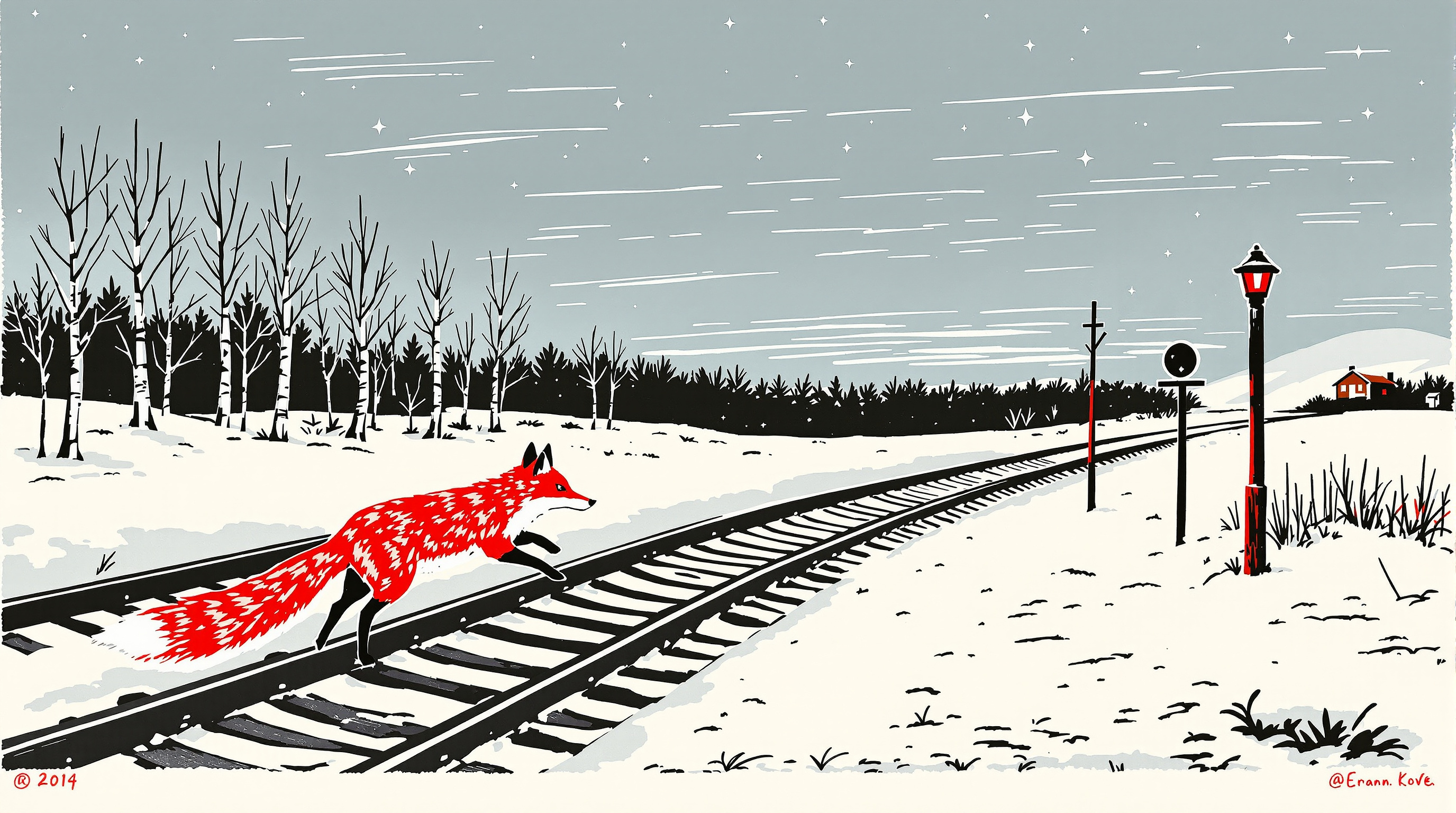
A three-color linocut print of a vermilion red fox stepping across snowy railway tracks at dusk, with bold black gouge-cut rails and sleepers, a lit signal lantern, bare birches, a slate-blue carved sky, slight registration offset, and cream printmaking paper texture.
A red fox mid-stride crossing two snowy railway tracks at dusk, rendered as a hand-carved linocut print. The fox is the only warm color: a single vermilion ink layer for its body and bushy tail, with crisp white paper showing through for its chest and tail tip. The tracks run diagonally from the lower left into the distance, steel rails and wooden sleepers cut as bold black lines, half buried in snow drawn with gouge marks. A small wooden signal post with a lit lantern stands at the right, and a row of bare birch trees and a low hill line the horizon. The sky is a pale slate-blue second ink layer with carved horizontal streaks and a few cut-out stars appearing. Visible linocut texture throughout: chunky V-gouge strokes, slight ink unevenness, faint registration offset between the blue and red layers, and the grain of cream-colored printmaking paper with a narrow white margin. Three-color limited palette (black, slate blue, vermilion). Quiet, cold, still mood. No text, no signature, no people.
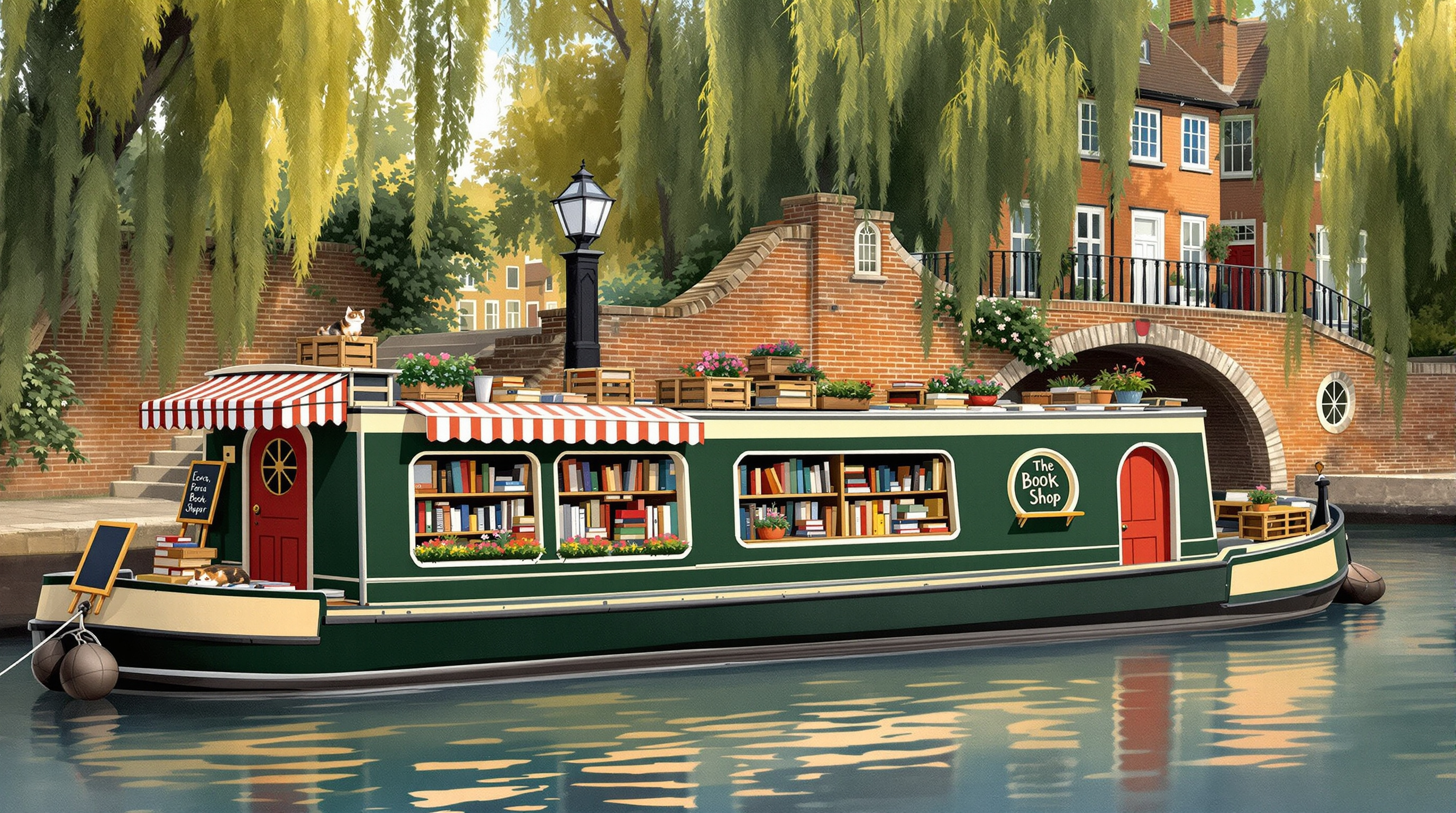
A cozy matte gouache painting of a forest-green canal barge turned bookshop, with book crates and geraniums on the roof, shelves visible through open hatches, a sleeping tabby on the bow, a brick footbridge, weeping willows, and calm late-afternoon reflections on still water.
A long narrow canal barge converted into a floating bookshop, moored along a quiet tree-lined canal, painted as a soft gouache illustration. The barge is deep forest green with a cream trim and a rounded red door; its roof holds wooden crates of books, potted geraniums, and a folded striped awning. Open hatch windows show shelves packed with colorful book spines, and a small chalkboard easel on the towpath is blank. A tabby cat sleeps on a stack of books at the bow. Behind the barge, an old brick footbridge arches over the water, weeping willows trail their branches, and a row of narrow terraced houses sits in the background. Calm late-afternoon light, warm peach highlights on the brickwork and gentle reflections of the green hull on the still water. Matte gouache texture with visible brush strokes, slightly chalky opaque color, soft edges, and a muted palette of sage, ochre, brick red, and cream. Cozy, unhurried, storybook mood. No legible text, no people.
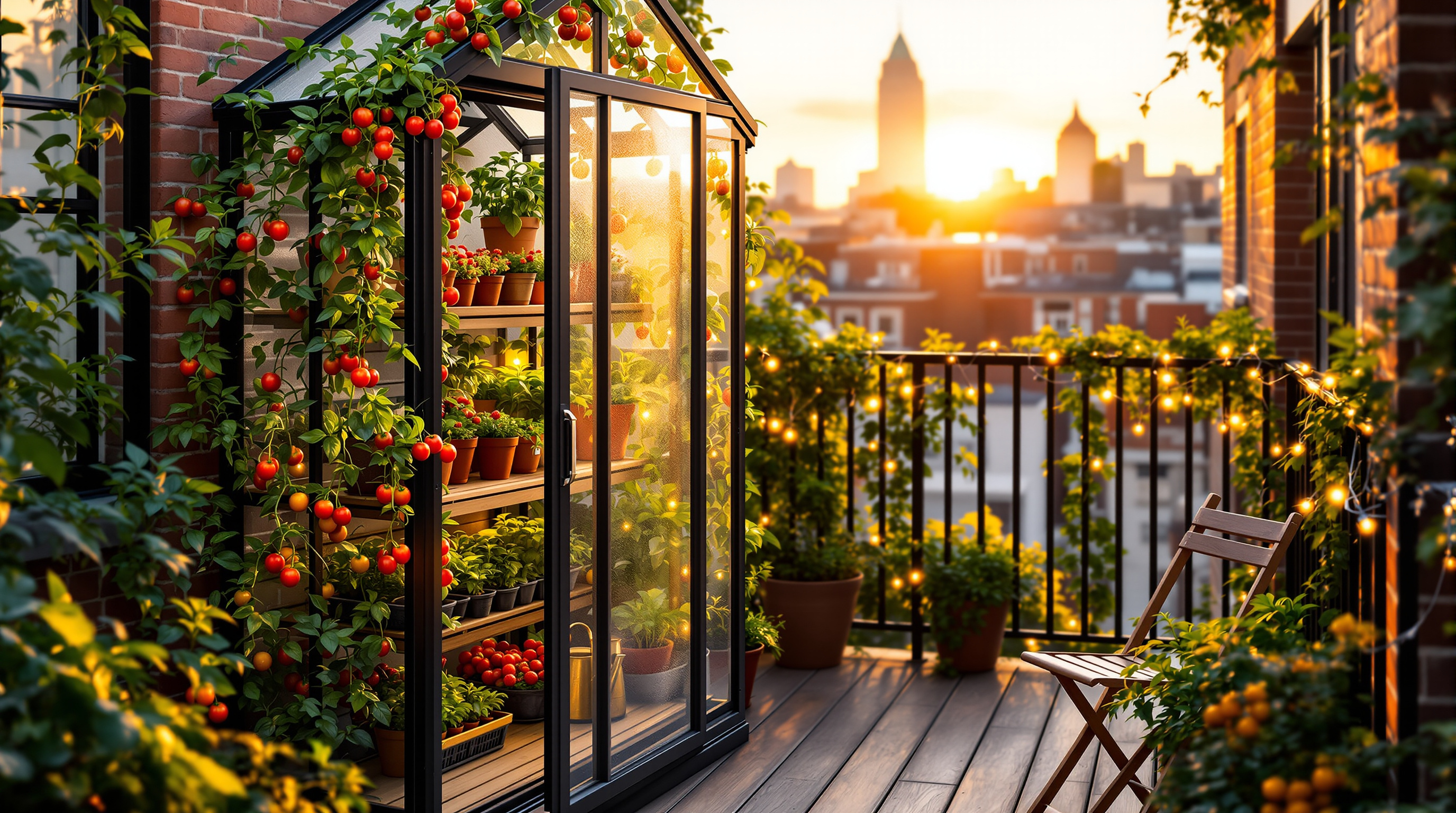
A photorealistic 35mm shot of a tiny glass lean-to greenhouse packed with cherry tomatoes, basil, chilies, strawberries, and seedlings on a narrow apartment balcony, with condensation on the glass, a teak floor, a bistro chair, and a soft-focus city skyline in golden backlight.
Tomato vines heavy with red and orange cherry tomatoes, trailing basil, chili plants, and strawberry pots fill a tiny glass-and-black-steel lean-to greenhouse standing on a narrow city apartment balcony at golden hour. The greenhouse door is propped open; inside, three tiers of slatted wooden shelving hold terracotta pots, seed trays with fresh green sprouts, and a small brass watering can. Condensation beads on the lower glass panels. Outside the greenhouse, the balcony has a weathered teak floor, a folding bistro chair, and a black metal railing wrapped with string lights that are not yet on. Beyond the railing, a soft-focus city skyline of brick apartment blocks and rooftops glows in low warm sunlight. Photorealistic, shot on a full-frame camera with a 35mm lens at f/2.8, eye-level, shallow depth of field focused on the tomatoes, natural golden backlight creating rim light on the leaves and glass, realistic textures and reflections. Calm, hopeful, lived-in mood. No people, no text, no logos.
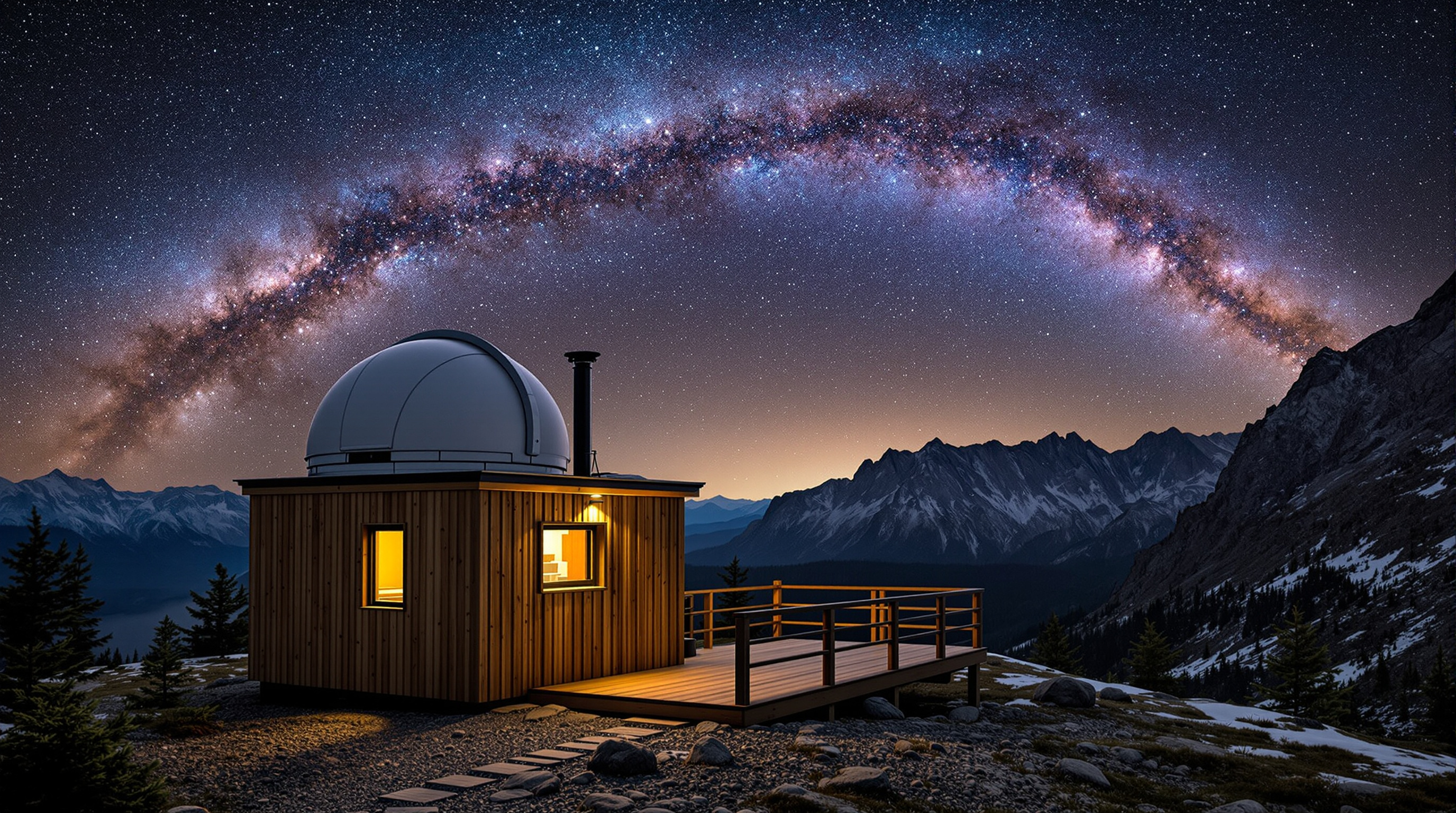
Photoreal long-exposure night view of a compact vertical-cedar cabin with a white telescope dome and steel stovepipe on a rocky mountain ridge, one warm amber window, a small deck, a stone-lined path, dwarf pines and old snow, under a vivid Milky Way core. Step 2 of the Mountain Observatory Cabin workflow.
A small cedar cabin with a white rotating telescope dome on its roof sits on a rocky mountain ridge under a vivid Milky Way arching across the night sky. The cabin is a compact single-story box clad in vertical warm-brown cedar boards, with a low dark-metal shed roof, a matte white hemispherical dome on the left end with its narrow slit half open and a telescope tube just visible inside, and a black steel stovepipe chimney on the right end with a thin curl of smoke. One wide rectangular window on the front glows dim warm amber, and a small wooden deck with a simple railing faces the valley. A narrow gravel path lined with flat stones leads up to the deck. Scattered dwarf pines and patches of old snow surround the cabin, and a jagged ridge silhouette fades into a deep valley of distant peaks. Thousands of sharp stars, the bright galactic core in soft violet and gold. Photorealistic long-exposure astrophotography, wide-angle 16:9, low camera angle, no light pollution, no people, no text.
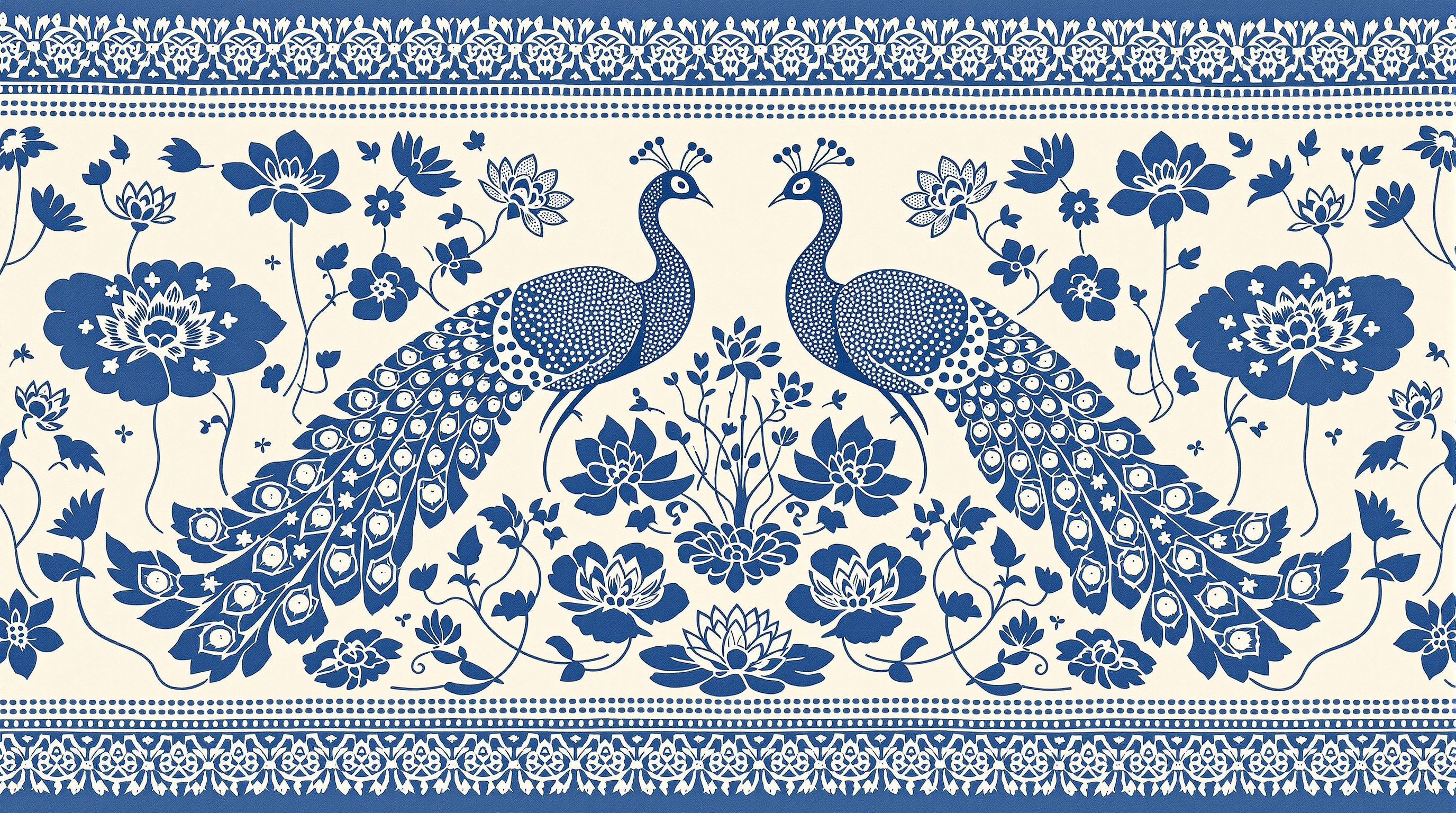
Indonesian batik textile pattern of mirrored twin peacocks beside lotus ponds in indigo and cream, with isen fills, kawung border, wax-resist crackle, and cloth weave texture. Flat ornamental fabric layout.
Twin peacocks facing each other beside lotus ponds, rendered as a traditional Indonesian batik textile pattern in indigo and cream. The peacocks fill the center with mirrored S-curved necks, fan tails filled with dotted isen motifs, and small floral medallions along the wings. Around them, oval lotus ponds hold blooming lotus flowers, pads, and tiny fish drawn as repeating geometric fills. A classic batik border frames the cloth: interlocking kawung and ceplok shapes with fine crackle lines from wax-resist dyeing. Palette limited to deep indigo blue, soft cream ground, and a few pale grey-blue washes. Hand-drawn irregularity in the lines, visible wax crackle texture, cloth weave grain, flat ornamental layout suitable for fabric. No people, no modern objects, no text, no signature.
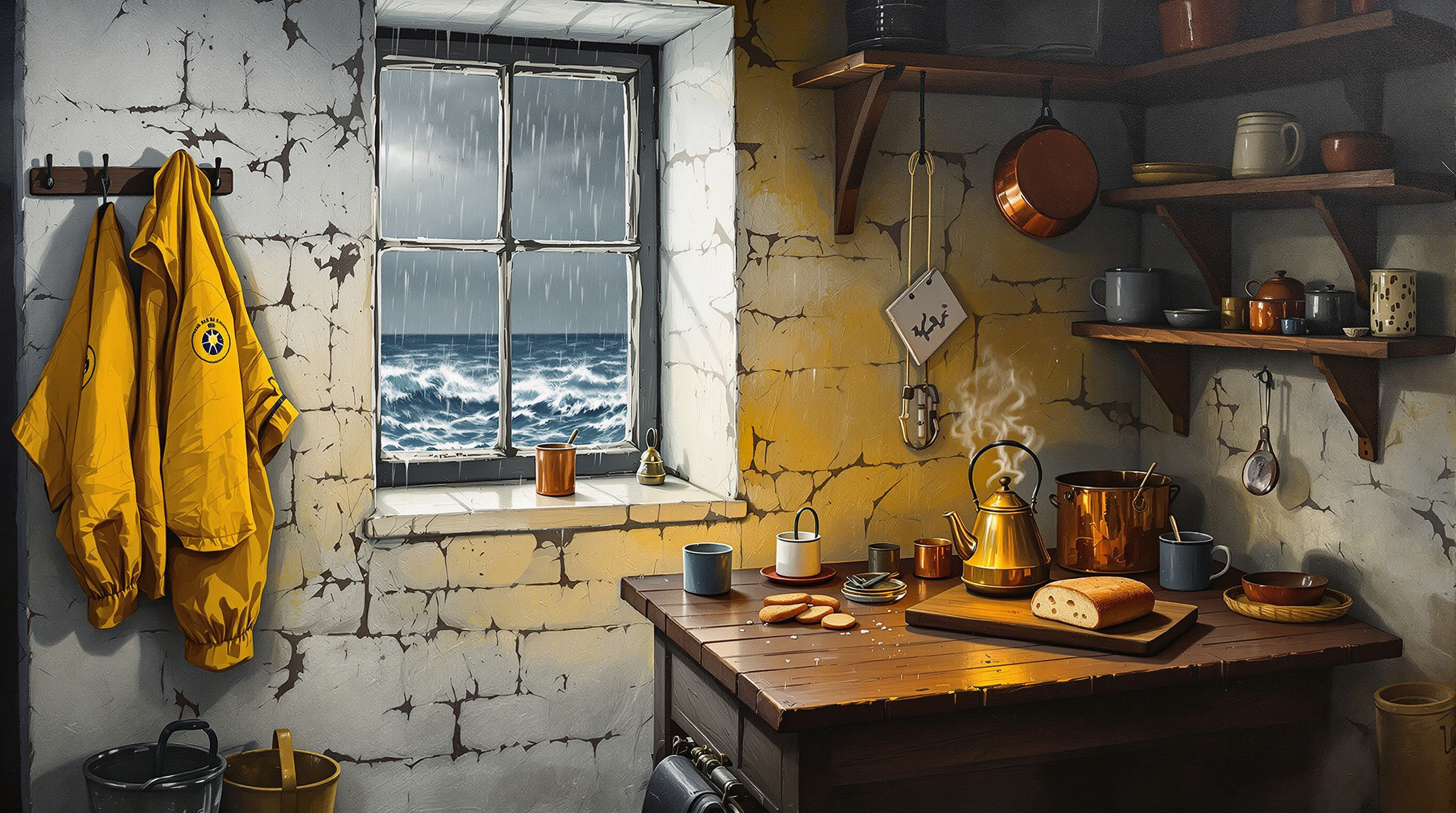
Warm oil painting of a lighthouse keeper's kitchen during a storm: brass kettle, oil lamp, wet oilskins by the door, rain-streaked window to a dark sea. Cozy amber interior versus cold spray outside; thick impasto brushwork.
A lighthouse keeper's kitchen painted in rich oil, warm and lived-in while a storm rages outside. Thick impasto strokes show whitewashed stone walls, a heavy wooden table with a brass kettle steaming, an oil lamp casting amber light, and a loaf of bread on a worn cutting board. Rain streaks the small paned window; through the glass, dark grey sea and white spray. Wet yellow oilskins and rubber boots hang dripping by the door. Copper pans and a enamel mug sit on open shelves. Cozy interior warmth contrasts with cold storm light at the window. Visible brushwork, muted ochres and deep blues, slight varnish sheen. No people, no text, no modern appliances.
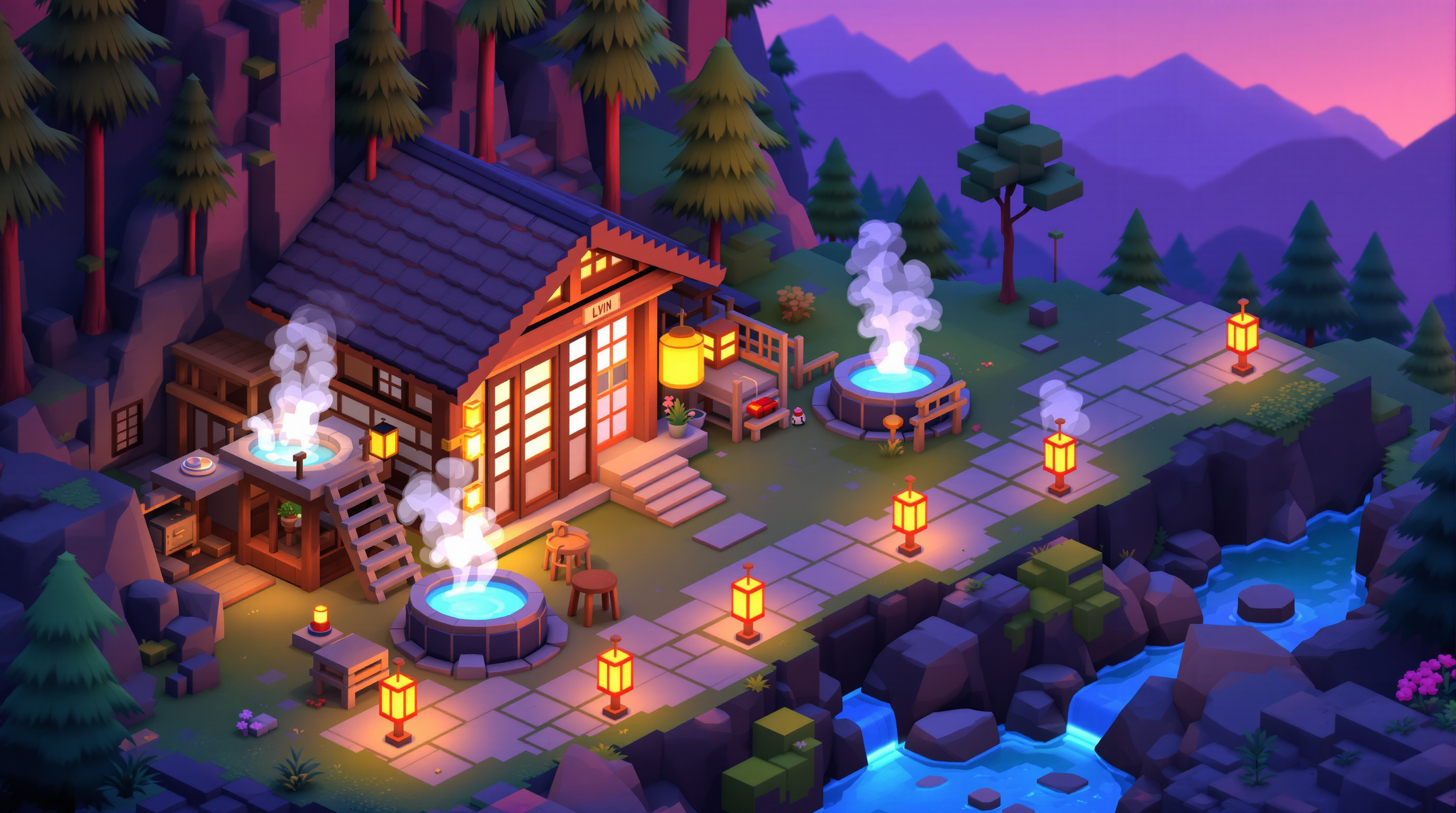
Colorful isometric voxel game scene of a wooden mountain onsen inn at dusk: steam from stone baths, pine trees, stone path, glowing paper lanterns, violet-blue sky. Clean blocky game art, no UI or characters.
An isometric voxel game scene of a mountain hot spring inn at dusk. Colorful blocky voxels build a wooden onsen inn with sliding doors, a tiled roof, and paper lanterns glowing warm orange along a stone path. Steam rises in soft white cubes from outdoor stone baths. Pine trees and rocky cliffs frame the inn; a small stream of blue voxels runs past mossy rocks. Lantern light pools on the path while the sky shifts violet to deep blue. Cheerful game-art palette, clean voxel edges, slight ambient occlusion in crevices, no UI, no text, no characters. Looking slightly down from a classic isometric angle.
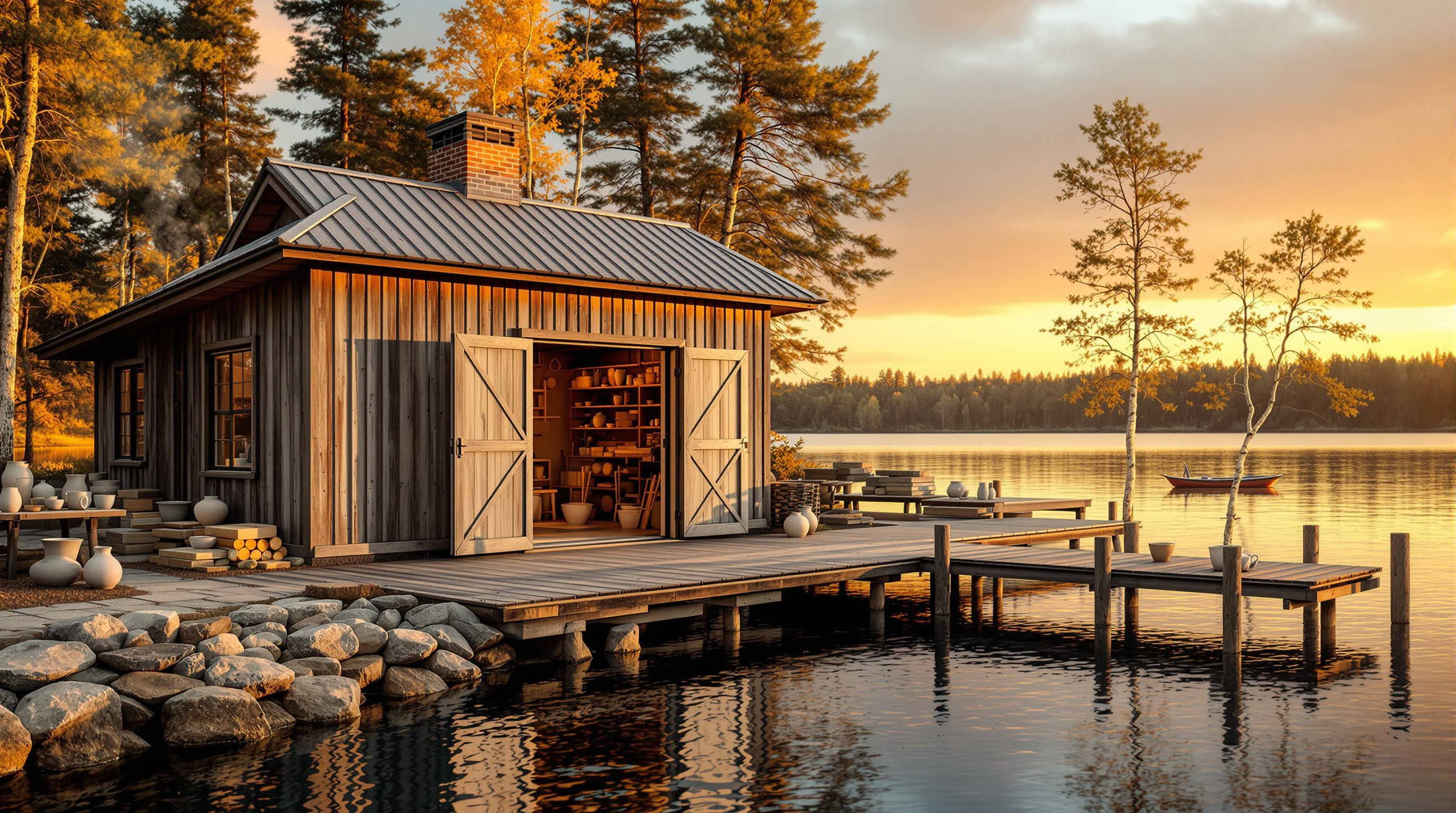
Photoreal golden-hour exterior of a weathered cedar pottery studio on a lake dock: open bay doors showing wheels, separate wood-fired kiln shed with brick chimney, stacked firewood, pines, calm water reflections. Step 2 of the Lakeside Pottery Studio workflow.
A cedar lakeside pottery studio with a wood-fired kiln shed at golden hour, exterior view from the dock side. Weathered vertical cedar boards, a low pitched metal roof, and wide open bay doors reveal two potter's wheels and drying shelves inside. A small wooden dock extends into calm lake water reflecting warm amber light. Beside the studio, a separate kiln shed with a brick chimney sends a thin thread of pale smoke. Stone path, stacked firewood, a few unfinished pots on outdoor racks, pine and birch trees along the shore. Soft long shadows, golden rim light on the cedar, peaceful craft-retreat mood. Photoreal, landscape 16:9. No people, no text, no cars.
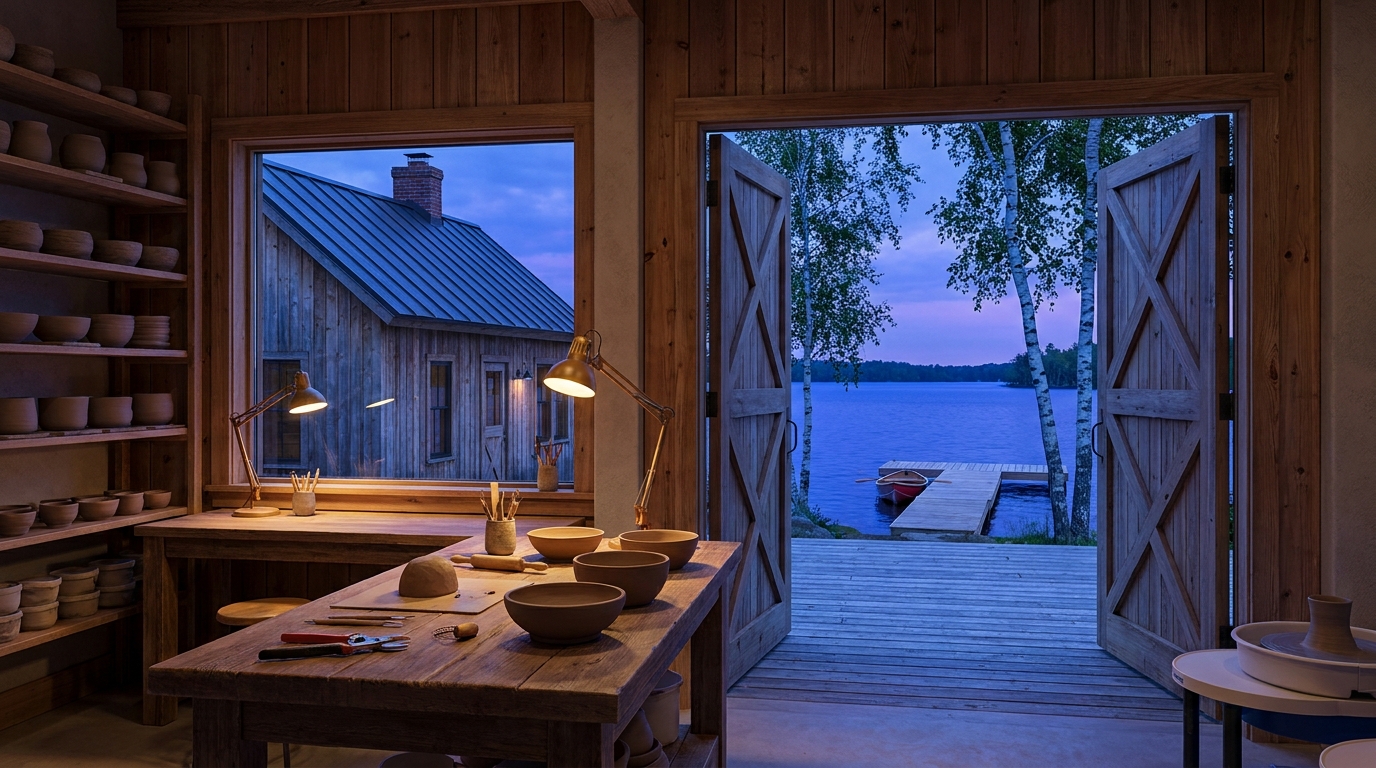
Photoreal blue-hour interior of the lakeside pottery studio: wedging workbench with clay tools, shelves of drying pots, wide window to violet lake dusk, dock and kiln chimney visible outside. Warm lamp vs cool window light. Step 3 of the Lakeside Pottery Studio workflow.
Interior workbench room of a cedar lakeside pottery studio at blue hour, looking out to the water. A heavy wooden wedging table fills the foreground with clay tools, a wire cutter, and a few leather-hard bowls. Shelves of drying pots line the left wall. Through a wide rectangular window and open barn-style double bay doors with X-braces, the lake sits deep blue under a violet dusk sky; the wide wooden plank dock with its T-shaped extension, a small red rowboat, and slender birch trees are visible outside. Warm task lamp light on the bench contrasts cool blue window light. Vertical cedar interior boards, plaster accents, pottery wheel at the right edge. Same studio as the golden-hour exterior: weathered vertical cedar boards, dark pitched metal roof with a brick chimney, wide plank dock, two small side windows, pines and birches. Photoreal, landscape 16:9. No people, no text.
