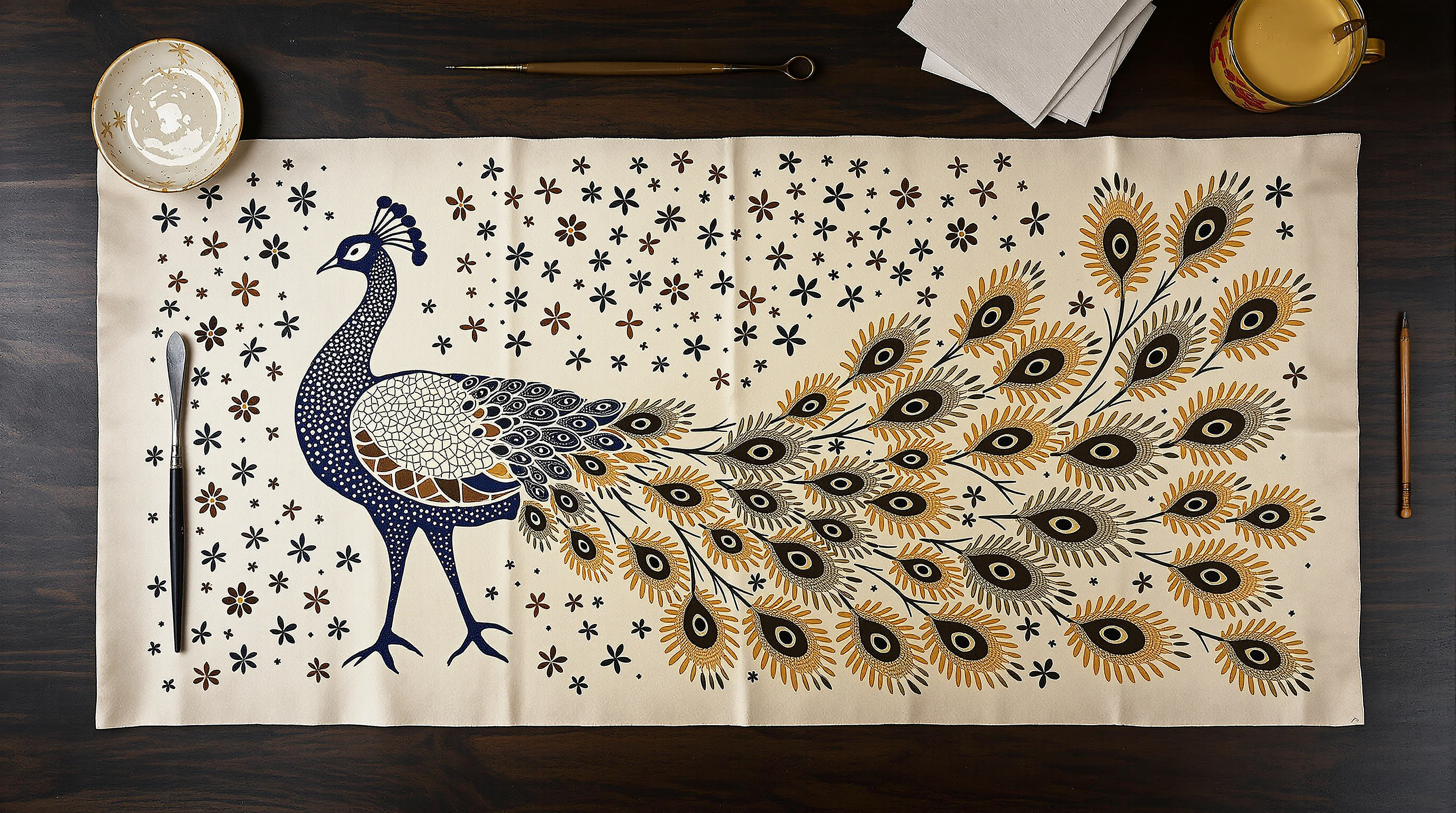
A flat-lay photo of a finished batik textile panel on teak: an indigo and ochre peacock with cracked wax-resist eye-spots and parang-inspired fillers on cream cotton, soft sidelight, with a canting tool and wax pot softly blurred at the edge.
A flat-lay photograph of a finished hand-drawn batik textile panel spread on dark teak, 16:9 landscape composition, the cloth filling most of the frame from left to right. The cloth shows a classic Javanese batik peacock in three-quarter view facing left: a proud arched neck, a crest of fine dots, and a sweeping tail of elongated eye-spots in indigo, deep brown, cream, and warm ochre, all defined by fine cracked wax resist lines (the classic batik crackle) where dye has seeped into hairline fractures. Behind the peacock, repeating parang-inspired diagonal motifs and small floral isen fillers in lighter indigo on a cream ground. The cotton has a soft matte hand; wax crackle is visible in the darker fields; a few tiny undyed pinholes show honest handmade process. Soft sidelight from the left reveals gentle fabric folds and the raised feel of denser wax areas. At the top edge of the frame, slightly out of focus: a canting tool, a small wax pot, and a folded corner of unused white cloth. Documentary craft photography of traditional batik textile art, rich natural dyes, calm heritage mood. Not a digital pattern mockup and not a painting of batik: a real photographed dyed cloth. No readable text, no letters, no logo, no watermark, no hands.
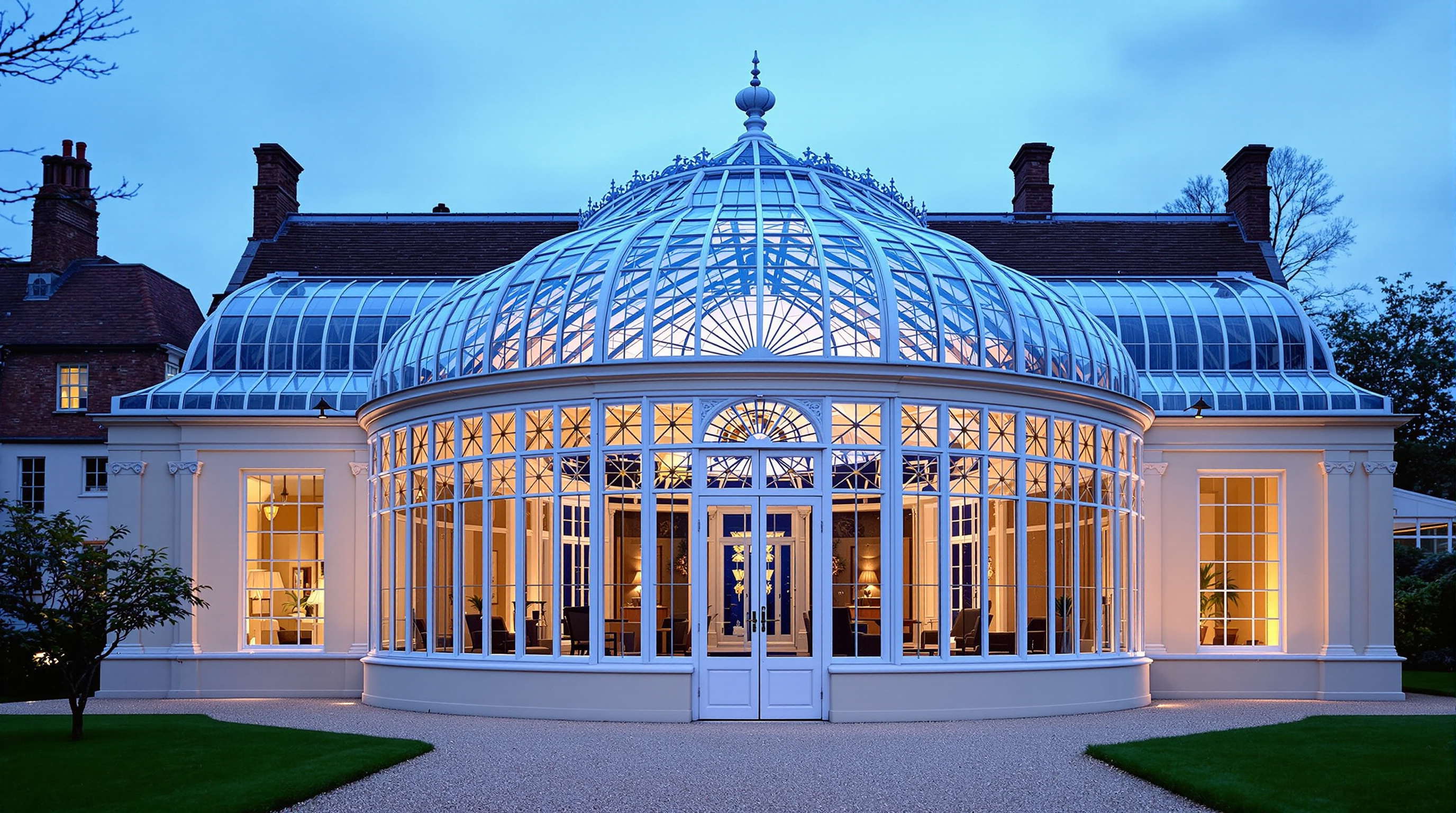
The same cream and white Victorian glass conservatory from step 2, seen from the gravel garden path at blue hour: the glazed sunburst gable with white double doors, cream pilasters and tall narrow windows, the closely ribbed barrel vault glowing amber like a lantern, two small fan palms inside the doors, and autumn trees with a brick house behind. Every fixed design detail is restated so the building stays identical.
Photoreal architectural exterior photograph of the same Victorian glass conservatory from step 2, now seen from outside at blue hour, standing on a pale gravel garden path about 15 m in front of its glazed gable end, at eye level (1.6 m), looking straight at the gable and along the length of the building, 35mm lens, 16:9 landscape composition, symmetrical, the whole building in frame slightly below center. Keep every fixed design detail identical to step 2: a long, narrow rectangular hall with a tall curved barrel-vault glass roof; many closely spaced slender white-painted iron ribs run over the vault, and the glass between them is divided by a dense grid of thin white glazing bars. The side walls are cream painted classical masonry: tall cream pilasters with carved white scroll corbels under a cream cornice, and between them very tall, narrow white-framed windows divided into long vertical panes, set above a low cream plinth wall. The gable end facing the camera is a glazed semicircle following the vault curve, filled with radiating sunburst glazing bars above a horizontal transom; below it a wide white-framed glass wall of rectangular panes with tall white double glass doors in the center, closed, each door with a small brass handle. Seen through the glass, glowing from inside: the warm beige stone tile floor, the long empty central hall, the pilasters and windows of the far end, and two small fan palms in round white planters standing just inside the doors, one on each side. The interior is lit by warm amber light from wall lamps behind the pilasters, so the whole glass vault glows like a lantern and the white ribs stand out in silhouette. Outside: the gravel path runs straight from the camera to the doors between low clipped box hedges and a mown lawn; mature deciduous trees in early autumn color stand on both sides, and a dark red brick house with lit windows is partly visible behind the trees on the left. Deep cobalt blue sky with the last pale glow low on the horizon, a few early stars, cool blue dusk mixed with warm amber interior light, faint mist over the lawn, soft reflections on the glass. Calm, romantic, timeless mood, crisp architectural detail, true colors, straight verticals. No people, no readable text, no signs or plaques, no modern objects or garden lights, no watermark.
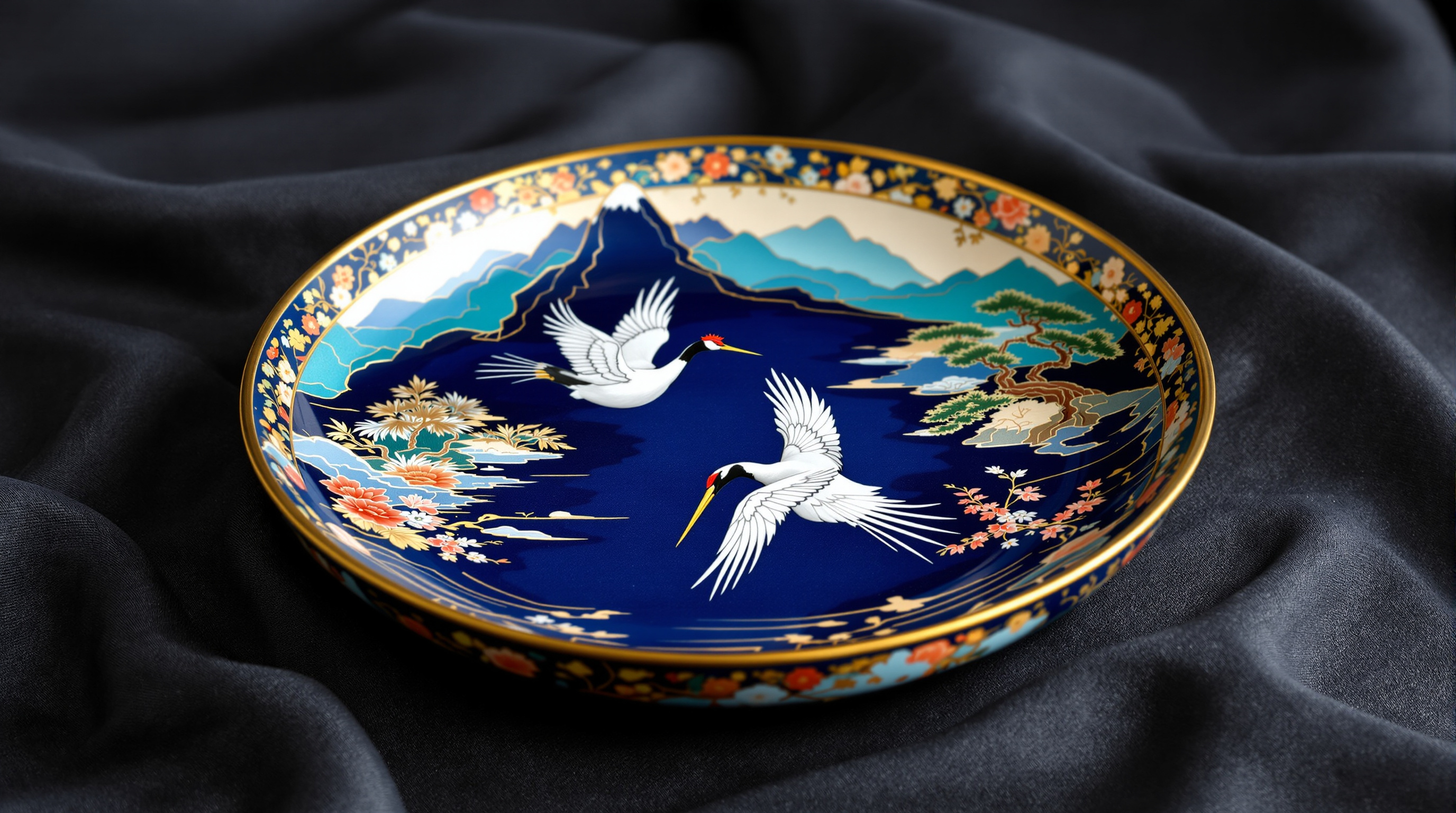
A photoreal studio shot of a round cloisonné enamel dish: two white and black cranes flying over a deep blue mountain lake, fine gold wire cells filled with saturated enamel, floral rim border, glossy kiln finish, on dark linen with soft side light.
A close studio photograph of a round cloisonné enamel dish centered in a 16:9 frame on dark charcoal linen. Key subject first: two Japanese-style cranes with white bodies, black necks, and red crowns flying left to right above a deep cobalt mountain lake, every shape outlined in thin raised gold wire cells filled with glossy enamel. Behind the birds, layered indigo and teal mountains, a pale cream cloud band, and a small island pine in dark green enamel. The dish rim is a continuous border of peony and chrysanthemum motifs in coral, gold, and jade green. Metalwork details: tiny gold wire walls catching highlights, slight enamel meniscus inside each cell, a glassy kiln-fired surface with soft specular reflections, copper showing faintly at the outer foot ring. Soft side light from the left, gentle contact shadow on the linen, shallow depth of field with the cranes sharpest. Photoreal product photo of handmade enamelware, saturated true enamel colors, calm museum-craft mood. Not a painting of enamel: a real photographed object. No text, no hallmark letters, no watermark, no hands.
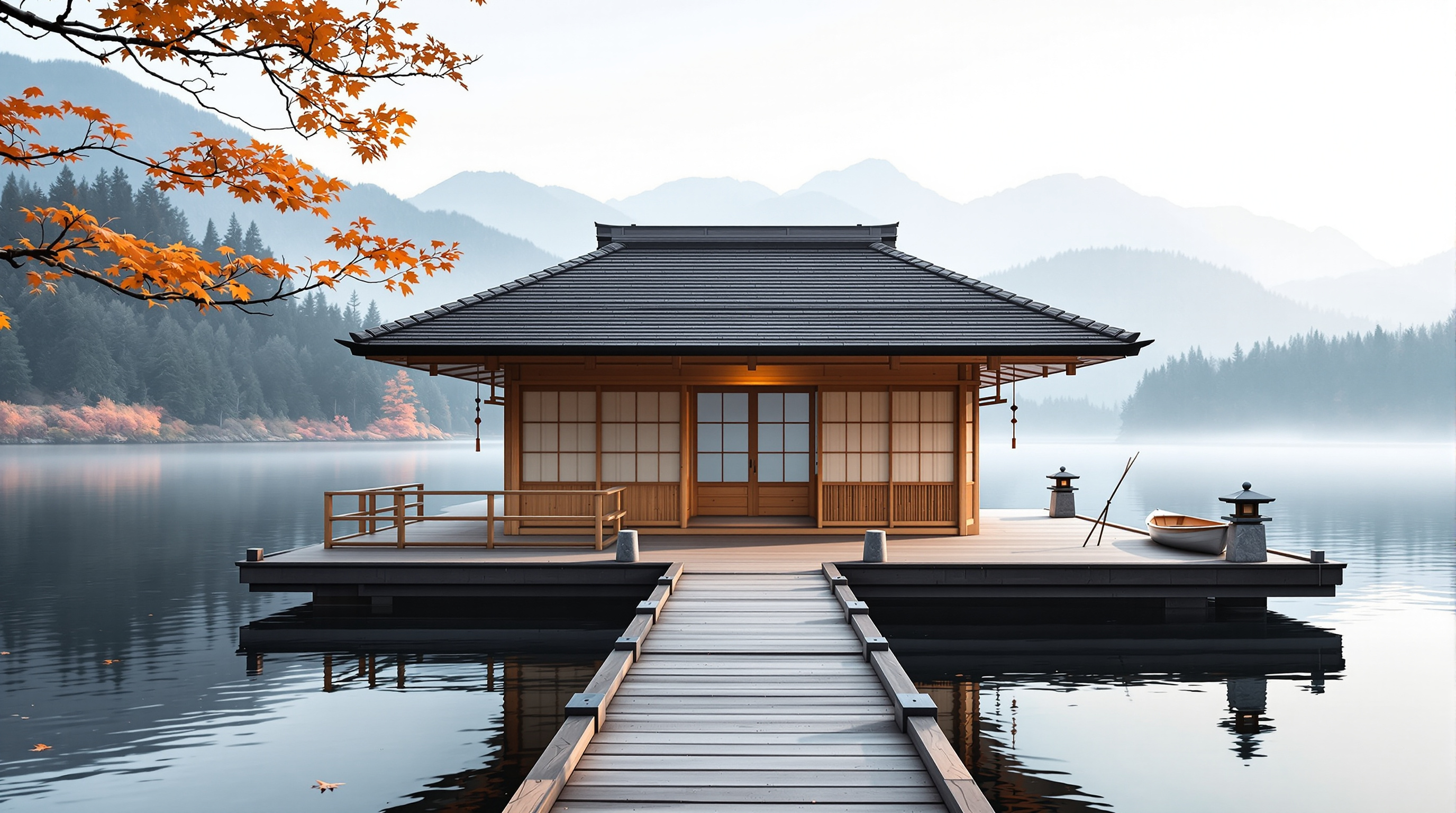
Photoreal view of a small floating cedar teahouse with a hipped shingle roof and shoji screens, approached from a shore path on a misty autumn morning, stone lanterns on the dock, a tied wooden boat, soft fog over still water, warm wood against cool blue-gray lake and mountains.
Photoreal architectural photograph of a small floating cedar teahouse on a still mountain lake in early autumn mist, 16:9 landscape, viewed from a wooden shore path approaching the dock. Key subjects first: a square one-room cedar teahouse with a dark weathered hipped shingle roof, four sliding shoji paper screens on the lake-facing side, a narrow engawa deck with simple vertical railings, two squat granite stone lanterns flanking the dock entrance, and a small tied wooden rowboat at the right side of the floating platform. The platform sits on dark timber pontoons just above the water; pale cedar walls show soft grain; copper rain chains hang at two corners. Behind the teahouse, layered blue-gray mountains fade into fog; pine forest lines the far shore; the water mirrors the roof as a soft blur. Light: low morning sun from the left, cool mist, warm wood highlights, quiet contemplative mood, crisp architectural detail, true colors. No people, no smoke plumes, no neon, no readable text, no watermark.
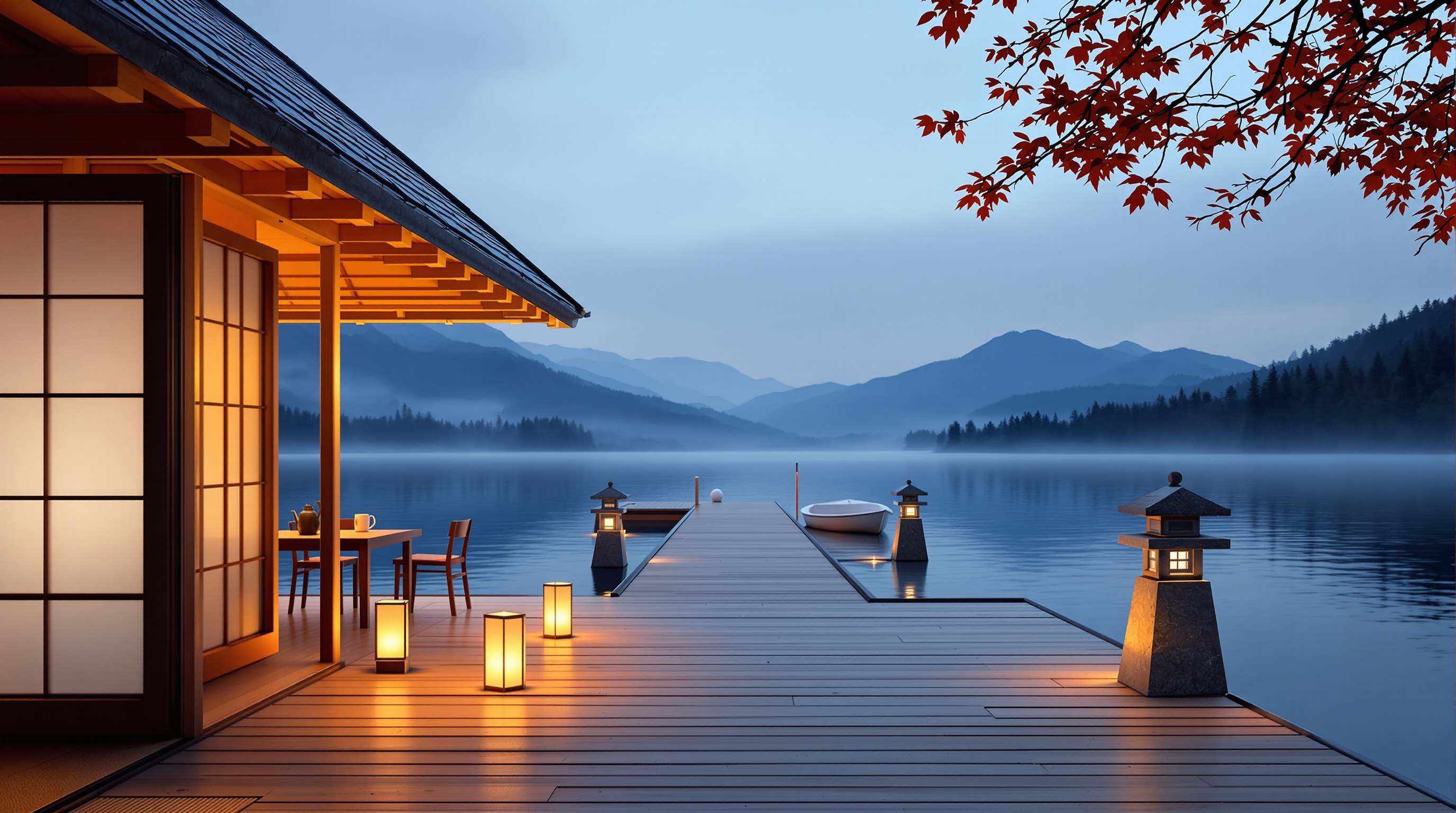
Photoreal dusk view from the deck of the same floating cedar teahouse: glowing shoji and dark tiled eaves on the left, paper and stone lanterns along the boards, a white rowboat, a long boardwalk over still blue-hour water, misty mountains and a red maple branch, restating the fixed design details of the morning view.
Photoreal photograph from the wide plank deck of a small floating cedar teahouse at lantern dusk, 16:9 landscape, camera at standing eye level beside the teahouse wall, looking out along the deck toward the lake. Key subjects first: the teahouse on the left edge with deep dark gray tiled eaves, warm honey-cedar posts and glowing pale shoji panels lit from inside, a low wooden table with two chairs on the deck, small paper lanterns glowing along the deck boards, two squat granite stone lanterns lit softly near the end of the deck, and a small white wooden rowboat resting on the far deck. Beyond, a long straight plank boardwalk runs out across still lake water at blue hour, reflecting the lantern glow, with layered blue-gray mountains in dusk silhouette, dark pine forest on the far shore, thin mist over the water, and a branch of red-orange autumn maple leaves at the upper edge. Same fixed design as the morning view: dark tiled hipped roof, cedar frame, shoji bays, stone lanterns, white rowboat, maple branch. Soft dusk light mixed with warm lantern glow, quiet contemplative mood, crisp wood grain, true colors. No people, no readable text, no neon, no watermark.
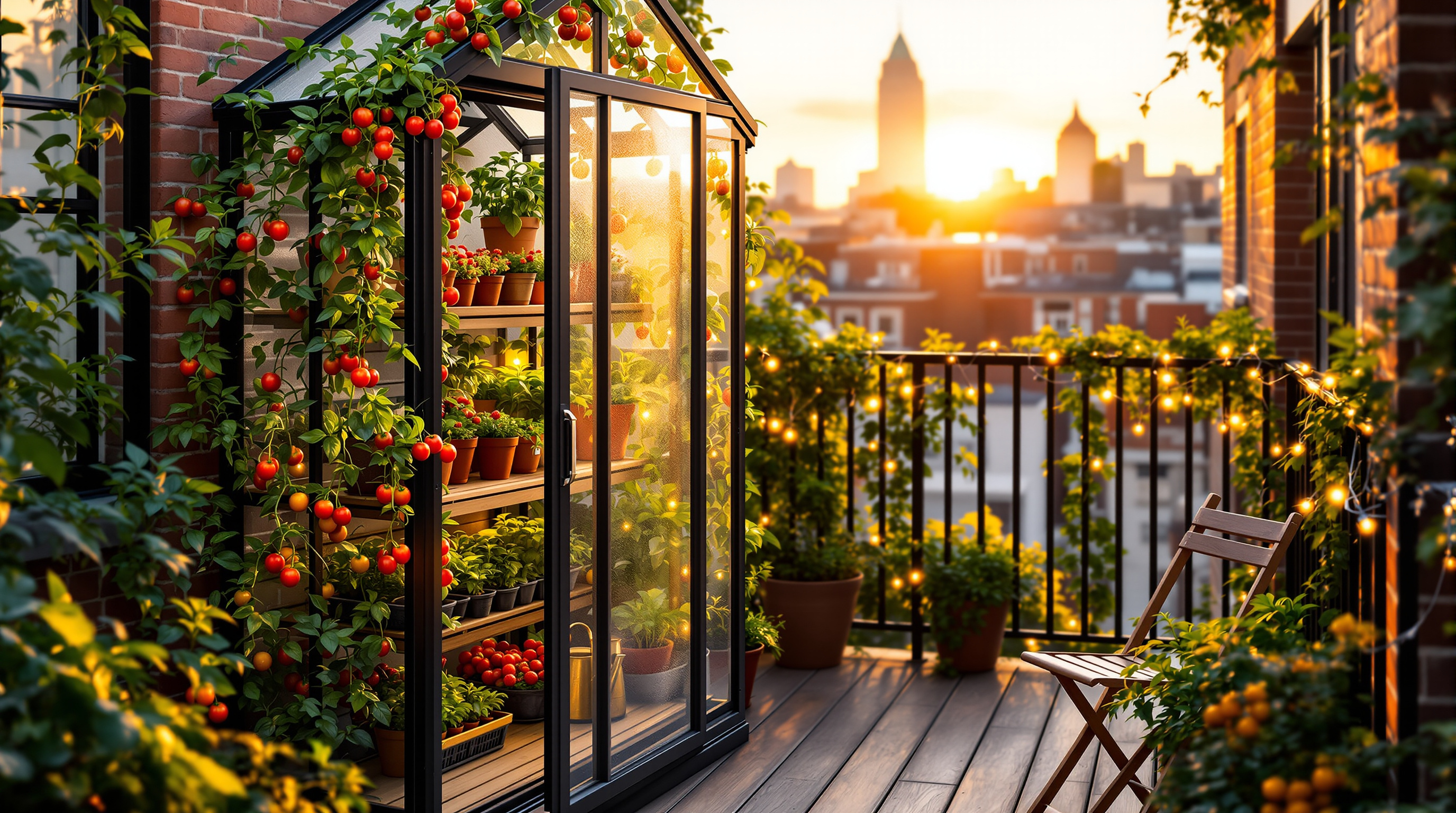
A photorealistic 35mm shot of a tiny glass lean-to greenhouse packed with cherry tomatoes, basil, chilies, strawberries, and seedlings on a narrow apartment balcony, with condensation on the glass, a teak floor, a bistro chair, and a soft-focus city skyline in golden backlight.
Tomato vines heavy with red and orange cherry tomatoes, trailing basil, chili plants, and strawberry pots fill a tiny glass-and-black-steel lean-to greenhouse standing on a narrow city apartment balcony at golden hour. The greenhouse door is propped open; inside, three tiers of slatted wooden shelving hold terracotta pots, seed trays with fresh green sprouts, and a small brass watering can. Condensation beads on the lower glass panels. Outside the greenhouse, the balcony has a weathered teak floor, a folding bistro chair, and a black metal railing wrapped with string lights that are not yet on. Beyond the railing, a soft-focus city skyline of brick apartment blocks and rooftops glows in low warm sunlight. Photorealistic, shot on a full-frame camera with a 35mm lens at f/2.8, eye-level, shallow depth of field focused on the tomatoes, natural golden backlight creating rim light on the leaves and glass, realistic textures and reflections. Calm, hopeful, lived-in mood. No people, no text, no logos.
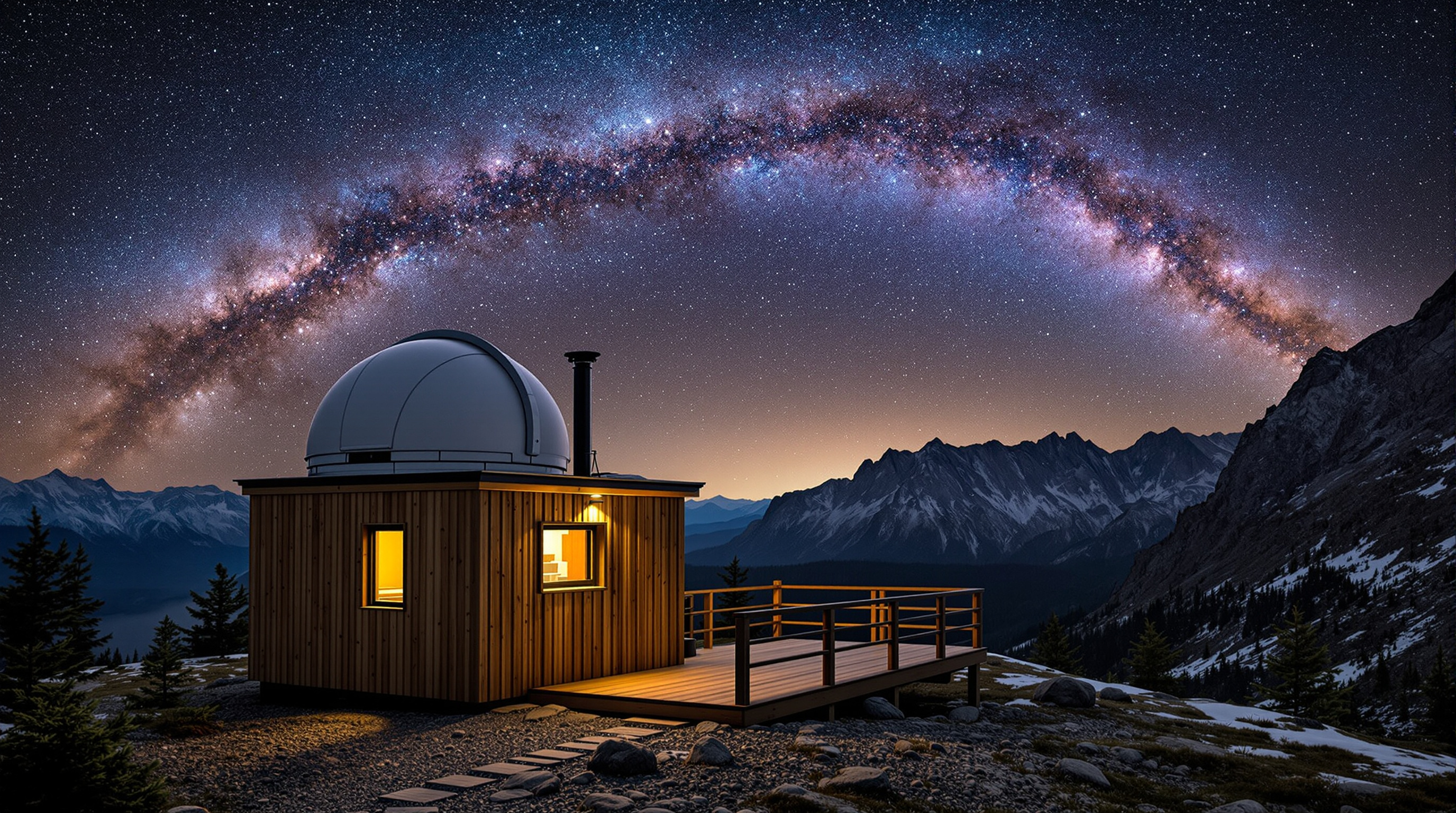
Photoreal long-exposure night view of a compact vertical-cedar cabin with a white telescope dome and steel stovepipe on a rocky mountain ridge, one warm amber window, a small deck, a stone-lined path, dwarf pines and old snow, under a vivid Milky Way core. Step 2 of the Mountain Observatory Cabin workflow.
A small cedar cabin with a white rotating telescope dome on its roof sits on a rocky mountain ridge under a vivid Milky Way arching across the night sky. The cabin is a compact single-story box clad in vertical warm-brown cedar boards, with a low dark-metal shed roof, a matte white hemispherical dome on the left end with its narrow slit half open and a telescope tube just visible inside, and a black steel stovepipe chimney on the right end with a thin curl of smoke. One wide rectangular window on the front glows dim warm amber, and a small wooden deck with a simple railing faces the valley. A narrow gravel path lined with flat stones leads up to the deck. Scattered dwarf pines and patches of old snow surround the cabin, and a jagged ridge silhouette fades into a deep valley of distant peaks. Thousands of sharp stars, the bright galactic core in soft violet and gold. Photorealistic long-exposure astrophotography, wide-angle 16:9, low camera angle, no light pollution, no people, no text.
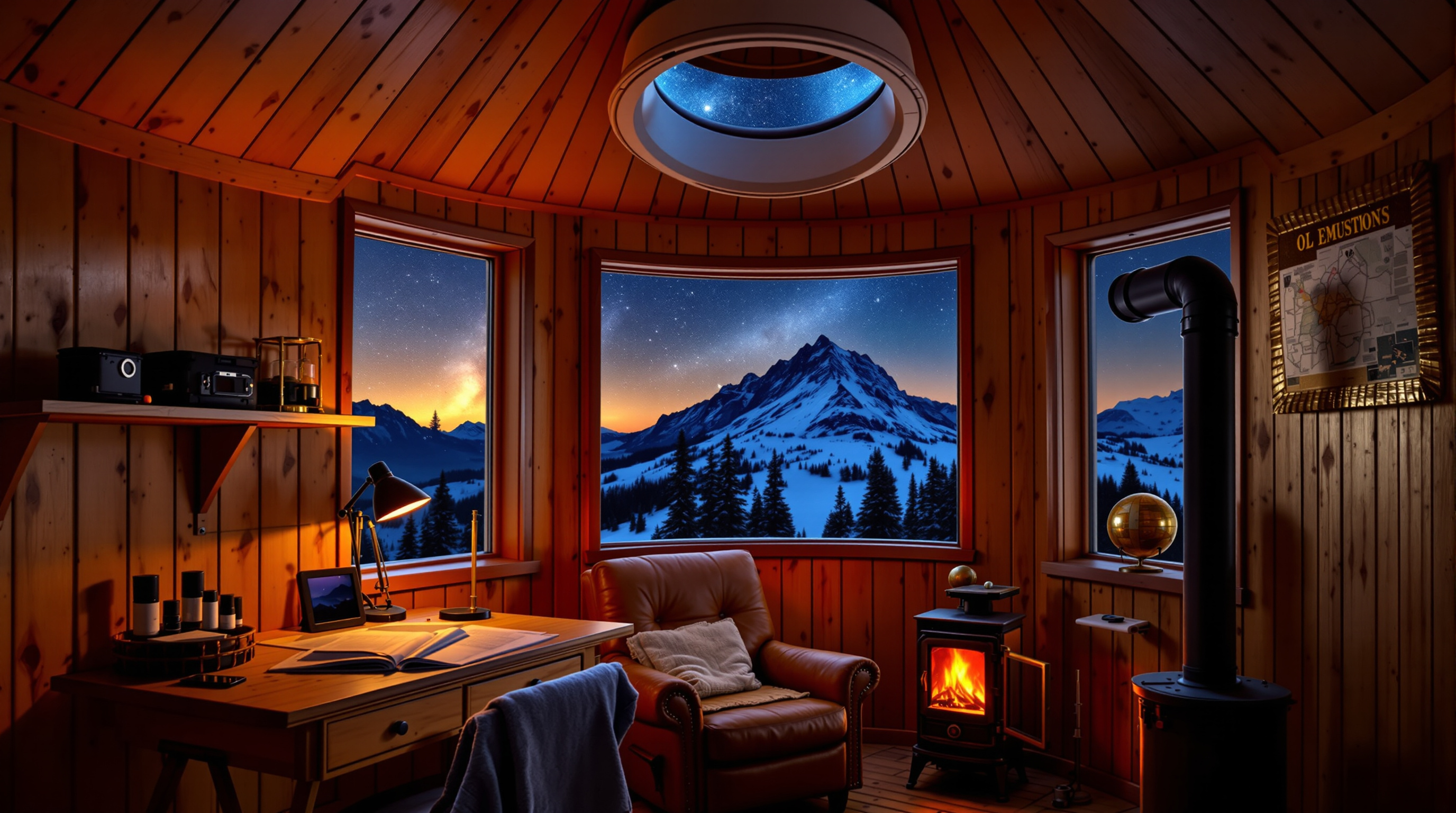
Photoreal night interior of the same cedar observatory cabin: desk with star charts and a red lamp, telescope eyepiece to the white dome hatch, cast-iron wood stove with stovepipe, leather armchair, and two amber front windows framing the mountain ridge and Milky Way. Step 3 of the Mountain Observatory Cabin workflow.
Interior room of a small cedar observatory cabin at night: walls and ceiling of warm vertical cedar boards matching the exterior, a wooden desk with open star charts and a red-glowing desk lamp, a telescope eyepiece and black telescope tube angled up through a ceiling hatch into the white hemispherical dome above, and a small black cast-iron wood stove with orange firelight and a black steel stovepipe. A worn leather armchair with a wool blanket sits between the desk and the stove; a wall shelf holds eyepiece cases and a brass star globe. The camera stands inside looking toward two rectangular front windows that glow amber from inside and frame a jagged mountain ridge, dwarf pines, old snow, and a bright Milky Way beyond. Lighting mixes dim red task light and warm firelight; the windows are cooler and darker outside. Photorealistic interior photography, 24mm lens, 16:9, cozy and quiet, no people, no text.
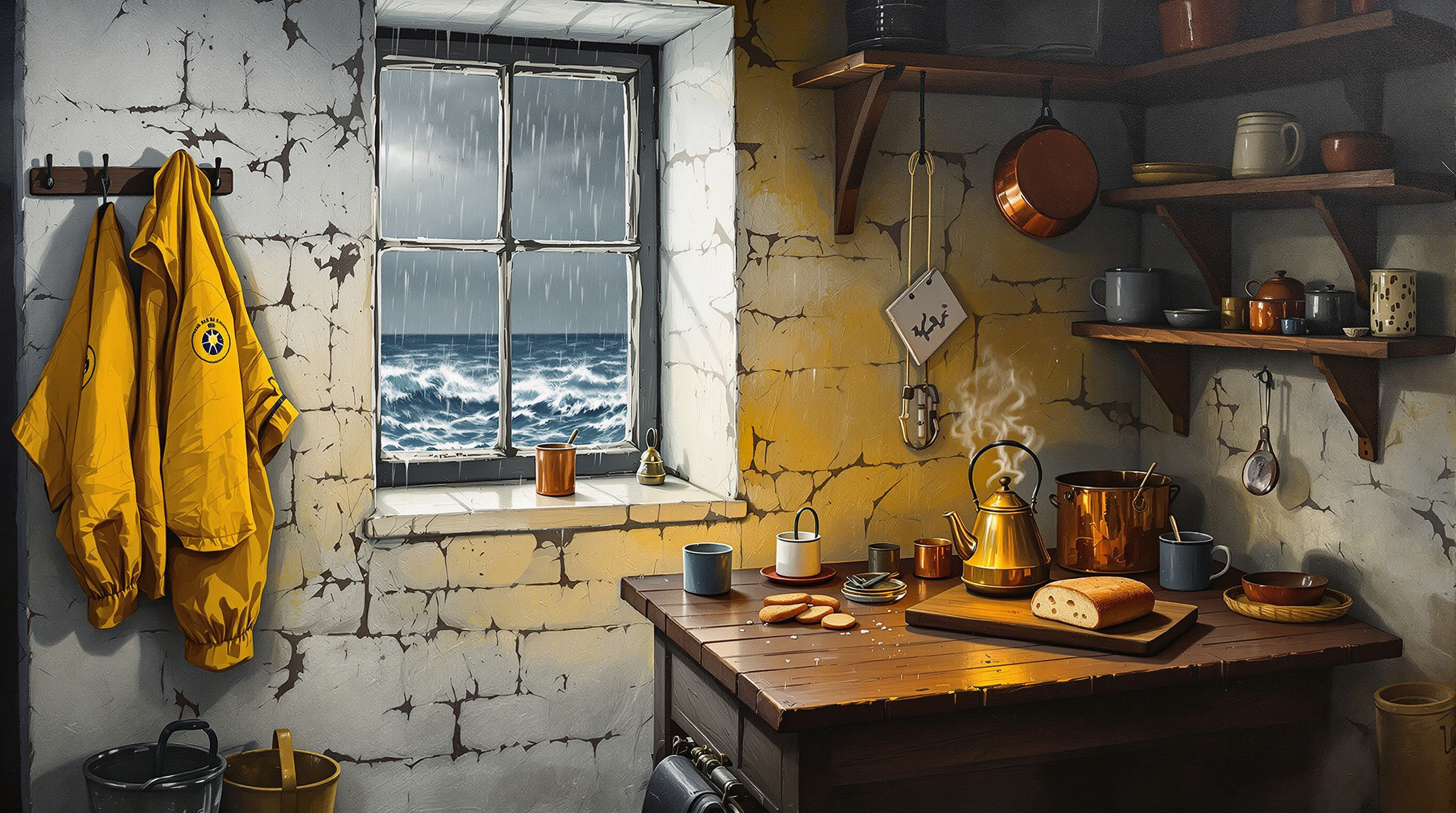
Warm oil painting of a lighthouse keeper's kitchen during a storm: brass kettle, oil lamp, wet oilskins by the door, rain-streaked window to a dark sea. Cozy amber interior versus cold spray outside; thick impasto brushwork.
A lighthouse keeper's kitchen painted in rich oil, warm and lived-in while a storm rages outside. Thick impasto strokes show whitewashed stone walls, a heavy wooden table with a brass kettle steaming, an oil lamp casting amber light, and a loaf of bread on a worn cutting board. Rain streaks the small paned window; through the glass, dark grey sea and white spray. Wet yellow oilskins and rubber boots hang dripping by the door. Copper pans and a enamel mug sit on open shelves. Cozy interior warmth contrasts with cold storm light at the window. Visible brushwork, muted ochres and deep blues, slight varnish sheen. No people, no text, no modern appliances.
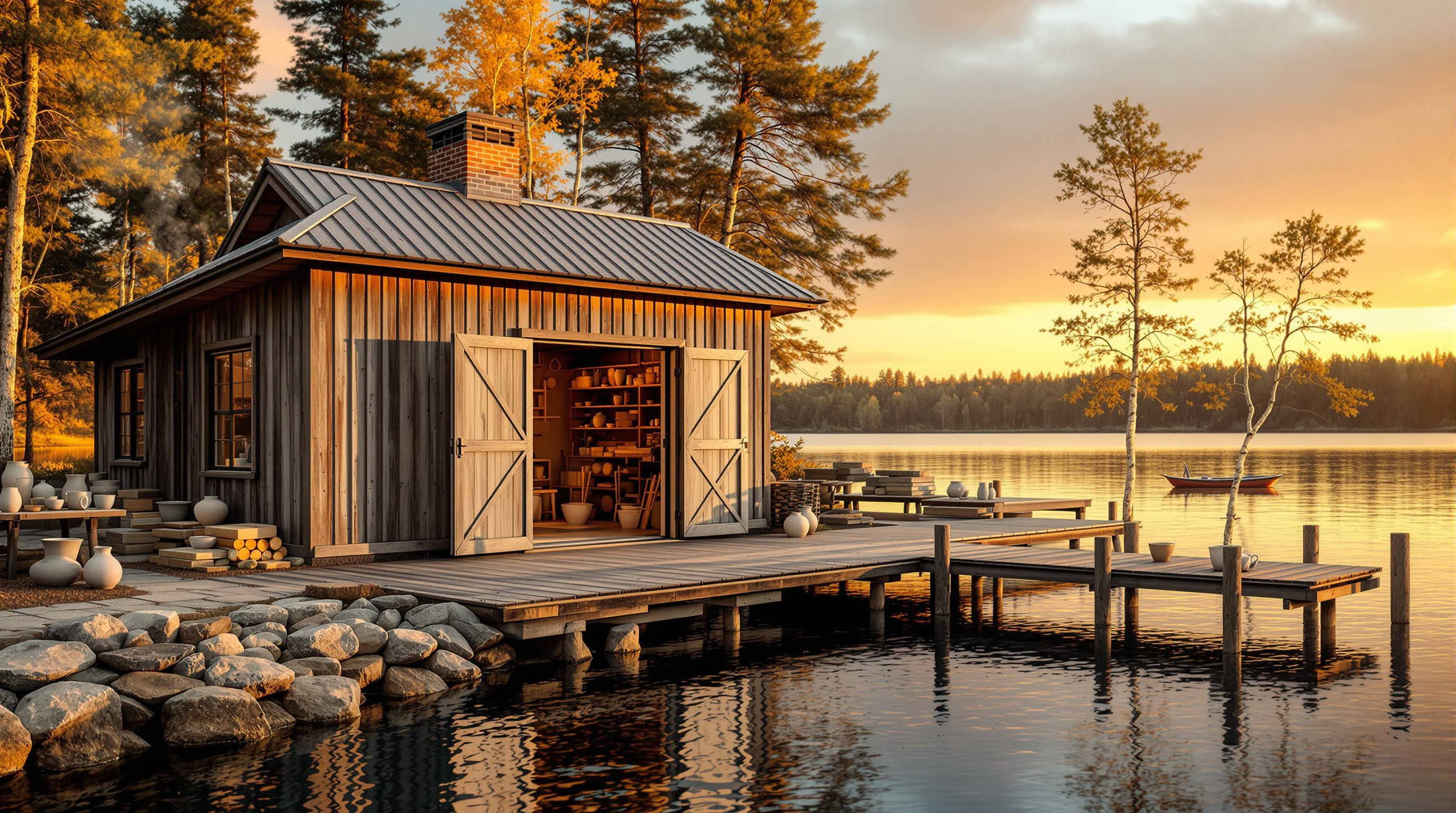
Photoreal golden-hour exterior of a weathered cedar pottery studio on a lake dock: open bay doors showing wheels, separate wood-fired kiln shed with brick chimney, stacked firewood, pines, calm water reflections. Step 2 of the Lakeside Pottery Studio workflow.
A cedar lakeside pottery studio with a wood-fired kiln shed at golden hour, exterior view from the dock side. Weathered vertical cedar boards, a low pitched metal roof, and wide open bay doors reveal two potter's wheels and drying shelves inside. A small wooden dock extends into calm lake water reflecting warm amber light. Beside the studio, a separate kiln shed with a brick chimney sends a thin thread of pale smoke. Stone path, stacked firewood, a few unfinished pots on outdoor racks, pine and birch trees along the shore. Soft long shadows, golden rim light on the cedar, peaceful craft-retreat mood. Photoreal, landscape 16:9. No people, no text, no cars.
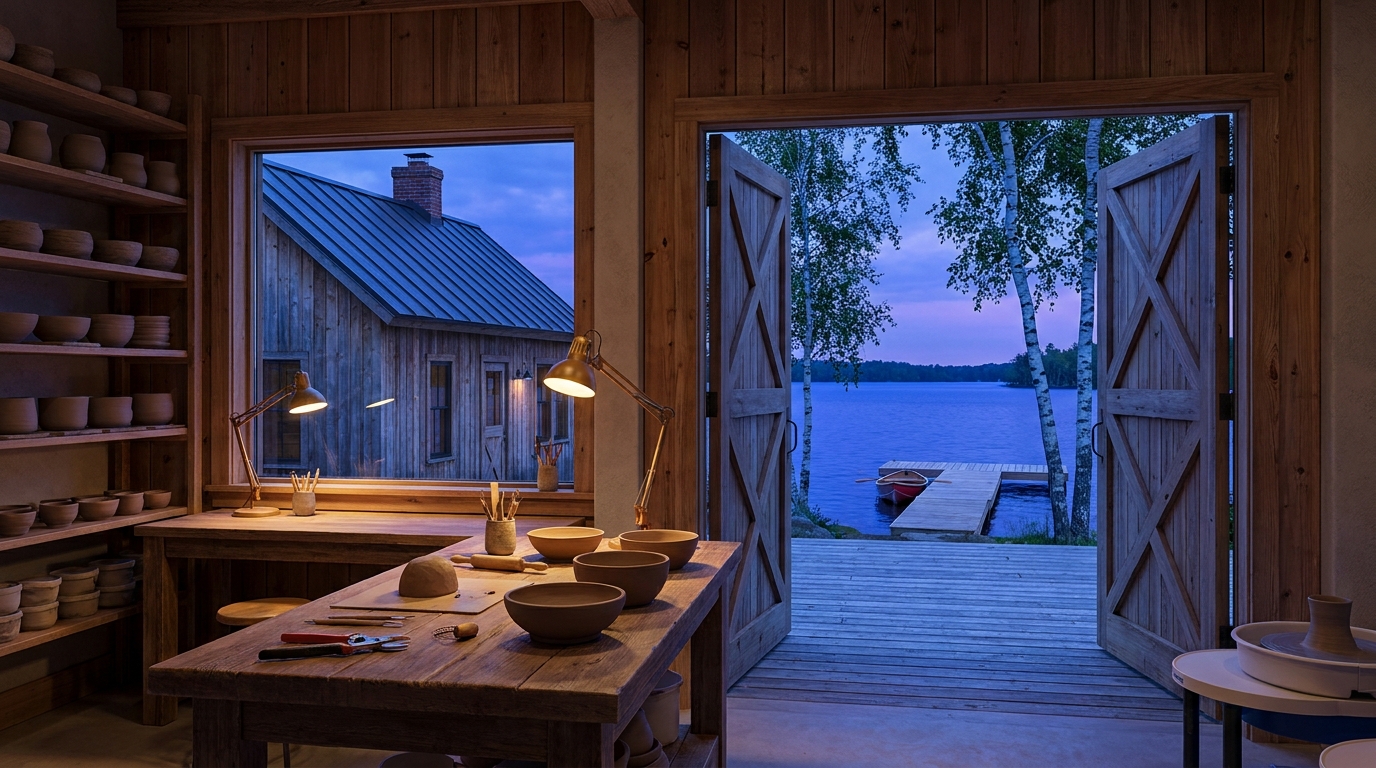
Photoreal blue-hour interior of the lakeside pottery studio: wedging workbench with clay tools, shelves of drying pots, wide window to violet lake dusk, dock and kiln chimney visible outside. Warm lamp vs cool window light. Step 3 of the Lakeside Pottery Studio workflow.
Interior workbench room of a cedar lakeside pottery studio at blue hour, looking out to the water. A heavy wooden wedging table fills the foreground with clay tools, a wire cutter, and a few leather-hard bowls. Shelves of drying pots line the left wall. Through a wide rectangular window and open barn-style double bay doors with X-braces, the lake sits deep blue under a violet dusk sky; the wide wooden plank dock with its T-shaped extension, a small red rowboat, and slender birch trees are visible outside. Warm task lamp light on the bench contrasts cool blue window light. Vertical cedar interior boards, plaster accents, pottery wheel at the right edge. Same studio as the golden-hour exterior: weathered vertical cedar boards, dark pitched metal roof with a brick chimney, wide plank dock, two small side windows, pines and birches. Photoreal, landscape 16:9. No people, no text.
