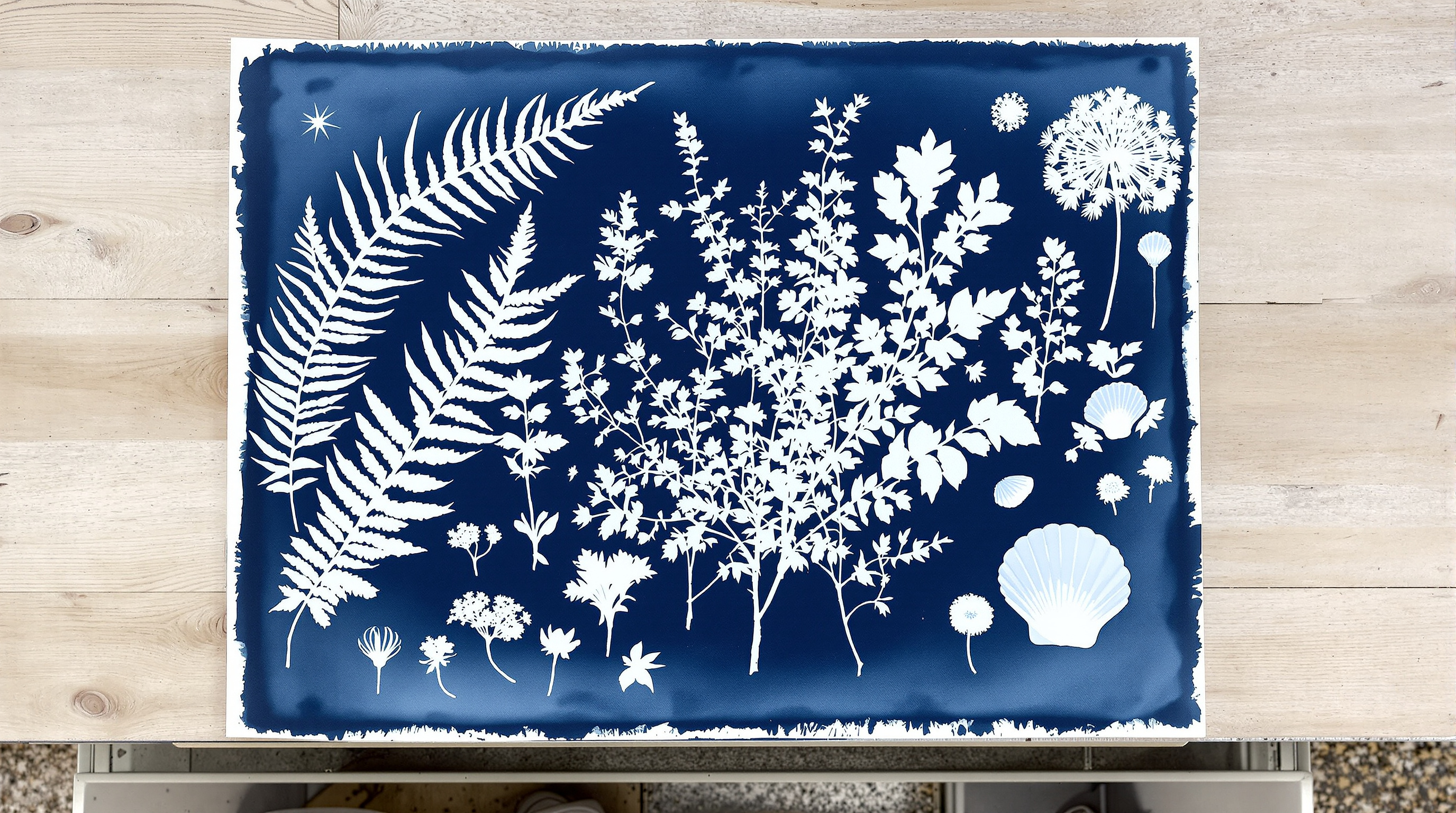
A flat-lay photo of a handmade cyanotype on cotton paper: white silhouettes of ferns, sea lavender, bladderwrack seaweed, ginkgo leaves, and a scallop shell glowing on deep Prussian blue, with brushy hand-coated borders and printmaking tools on a pale oak table.
A wide, flat-lay photograph of a large handmade cyanotype print lying on a weathered pale oak worktable, the print filling most of the frame. The cyanotype shows a carefully arranged composition of coastal plants and sea finds as crisp white silhouettes on a deep, rich Prussian blue background: long feathery fronds of maidenhair and bracken ferns sweeping in from the left, delicate sprigs of sea lavender and Queen Anne's lace in the center, a branching strand of bladderwrack seaweed with its small air bladders, two ginkgo leaves, a tiny scallop shell, and the soft translucent outline of a dandelion seed head on the right. Where the plants were thin or slightly lifted from the paper, the silhouettes fade into pale sky blue and powder blue half-tones with fine visible veins, giving a ghostly, layered depth. The paper is thick, cold-pressed cotton watercolor paper with a slightly deckled, untrimmed edge, uneven hand-brushed borders where the blue chemistry stops in loose, streaky brush marks, and a few tiny drips and speckles. Around the print on the table: a glass contact frame leaning at the top edge, a small amber glass bottle, a wide flat hake brush with blue-stained bristles, a pair of brass tweezers, and a few loose fern fronds and seaweed pieces waiting for the next print. Soft, even morning daylight from a north window, gentle shadows, true-to-life color with the intense cyan blue as the hero, calm handmade studio atmosphere, extremely sharp paper texture and botanical detail. Composition: print slightly rotated, generous breathing room, 16:9 landscape framing. No people, no hands, no text, no labels, no signature, no watermark.
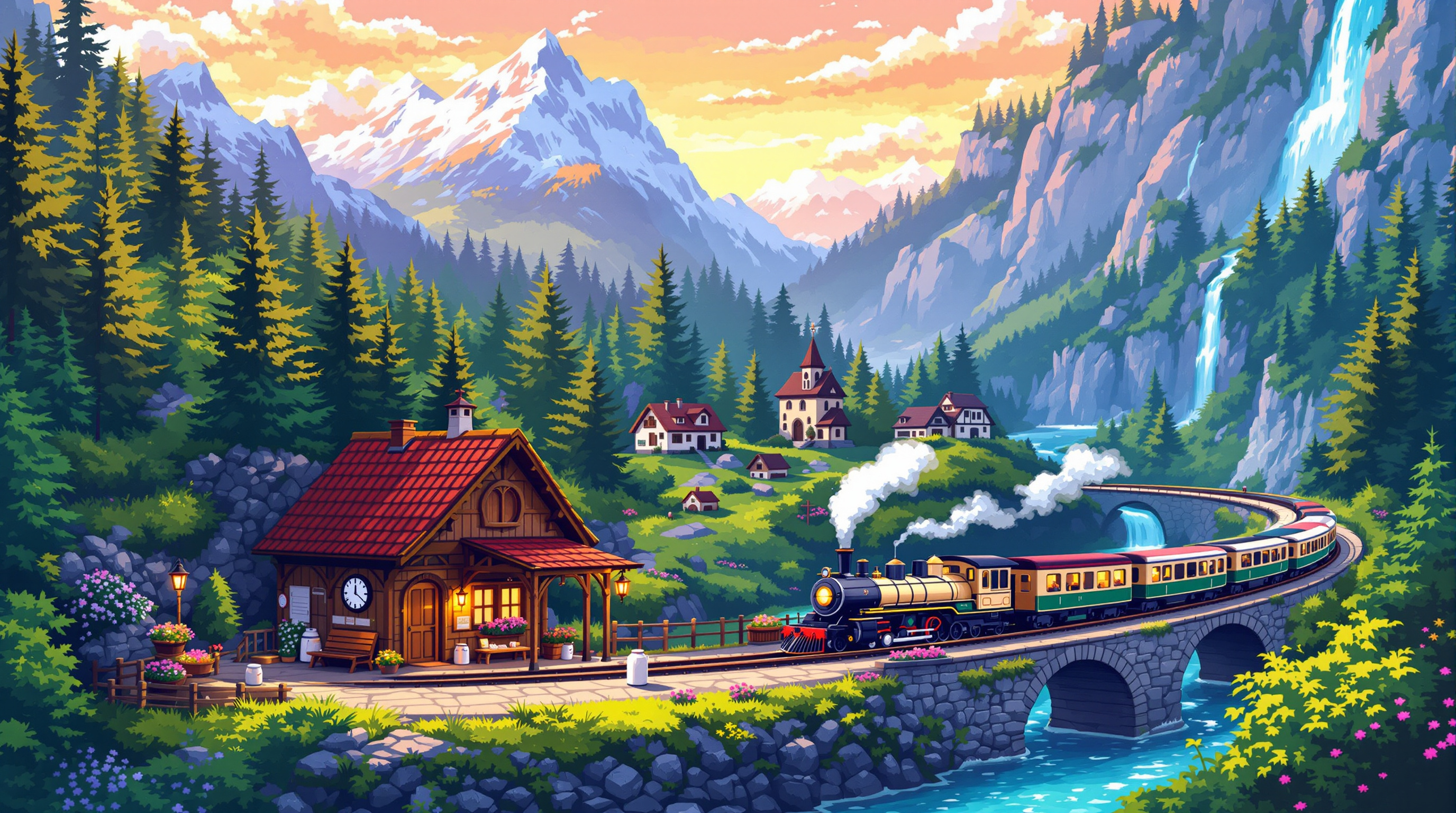
A cozy 16-bit pixel art game background of a tiny alpine station at golden hour: a cream and green steam train at a red-roofed platform, a stone viaduct over a turquoise river, chalets and a waterfall, and layered snow peaks under a dithered sunset sky.
A wide 16-bit era pixel art scene of a tiny alpine railway station in a mountain valley at golden-hour sunset, in the style of a beautifully detailed retro adventure game background, crisp hard-edged pixels with no anti-aliasing and no blur, limited 48-color palette with careful dithering in the sky. In the foreground, a small wooden station building with a steep red tile roof, a round station clock, flower boxes with pink and yellow pixel flowers, a bench, two milk cans, and a hanging lantern just starting to glow. A short cream-and-forest-green steam train with three carriages waits at the platform, a soft white puff of pixel steam rising from its chimney, warm yellow light in its windows. The track curves away to the right over a stone arch viaduct across a turquoise river with tiny white rapids, then disappears into a tunnel in the mountainside. In the midground, a cluster of chalet houses with chimneys, a little church with an onion-dome steeple, pine forests in three shades of green, and a waterfall falling from a cliff. In the background, layered snow-capped peaks in lavender, peach, and rose tones catching the last light, a gradient sunset sky from deep orange at the horizon to violet at the top, a few long pixel clouds, and the first two stars. Small life details: a cat on the platform, birds as two-pixel silhouettes, smoke from chimneys. Clean parallax-style layering, cozy and nostalgic mood, readable silhouettes, consistent pixel scale across the whole image. 16:9 landscape composition. No people, no text, no user interface, no logos, no watermark.
Describe your dream treehouse and host tree and get a buildable design concept with structure, facades, palette, and materials, a numbered list of fixed design details, and two image prompts showing the same treehouse in summer and on a snowy winter evening, plus a consistency checklist and build safety notes. Step 1 of a three-step workflow.
Act as an architectural designer who specializes in treehouses, garden studios, and small timber retreats, and as a visualization art director. I will describe a treehouse I am dreaming about. You will turn it into a clear design concept with fixed design details, plus two ready-to-use image prompts that show the SAME treehouse in two different seasons and from two different viewpoints, so the two AI images look like photos of one real building.

Host tree and site: a single huge old oak in a sloping meadow at the edge of a beech forest, trunk about 1.2 m wide, splitting into three main limbs about 5 m up
Who uses it and how: a family retreat for reading, sleepovers for two kids, and quiet evenings for the adults
Size and height: a small cabin about 3 x 4 m on a deck about 3.5 m above the ground
Style direction: warm natural timber, a little storybook but not cartoonish, simple modern details
Must have: a big window facing the forest, a covered deck, a small wood stove, a rope swing
Budget level: self-build with a carpenter's help, mid-range materials
View A: summer afternoon, full green canopy, seen from the meadow at the front left
View B: snowy winter evening, bare branches, windows glowing, seen from the front right

Please produce:

1. Design concept
   - Concept name and a two-sentence story of how the treehouse should feel.
   - Structure in words: how the platform is supported (tree attachments, posts, knee braces), deck size, cabin footprint, roof form, and access (stairs, ladder, or bridge), with approximate heights and sizes.
   - Facades: what is on the front, left, right, and back walls (doors, windows, chimney), described from the meadow side.
   - Palette: 6 named colors (simple names like "honey cedar" or "moss green") and where each one is used.
   - Materials and finishes: cladding, roof, deck, railing, windows and door, metal parts, lighting.

2. Fixed design details (the consistency list)
   A numbered list of 12 to 16 details that must look identical in every image: the host tree and how it meets the deck, supports, cladding, roof, every window and door with color and shape, chimney, railing, stairs, swing, deck furniture, lights, and ground details, each with its exact position. Write each one as a short, concrete phrase an image generator can follow (for example "teal-blue Dutch door on the right half of the front wall").

3. Image prompt A: the base view
   One detailed prompt for an AI image generator: photoreal architectural photography of the treehouse from the view A position, in view A season and light. Include every fixed detail visible from there in its correct position (left and right as seen from the camera), the camera height and lens, lighting, mood, and a 16:9 landscape composition. End with exclusions (no people, no text, no logos).

4. Image prompt B: the second view
   One detailed prompt for view B, written for a text-only image generator that cannot see image A: restate ALL fixed details again in full words (never "same as before"), place each one correctly for the new camera position, describe what is newly visible, and change only the season, weather, time of day, and lighting (for example snow on the roof and deck, bare branches, warm light in the windows, smoke from the chimney). Keep materials, colors, and proportions identical.

5. Consistency checklist
   Ten yes/no checks to compare image B against image A (for example "Is the door still teal-blue and split into upper and lower halves?").

6. Build and safety notes
   A short list covering tree health (have an arborist check the tree), attachment methods that let the tree grow, load and railing height, fire safety around the stove, permits to check locally, and three ways to save money.

Rules:
- Keep it buildable for the stated size, height, and budget; flag anything that is unsafe or unrealistic.
- Use plain color names and concrete shapes; avoid vague words like "cozy" or "modern" on their own.
- No brand names, no real people, no readable text in the images.
- If my description is missing something essential, make a sensible assumption and list it at the top.
Describe your street food idea, vehicle, trading spots, brand personality, and colors, and get a food truck concept with paint scheme, service side layout, palette, and materials, a numbered list of fixed design details, and two image prompts showing the same truck at lunchtime and at an evening night market, plus a consistency checklist and practical fit-out notes. Step 1 of a three-step workflow.
Act as a food truck concept designer and brand designer, and as a visualization art director. I will describe the street food business I want to start. You will turn it into a clear food truck concept: the vehicle, the exterior design, the service layout, and the brand look, with a list of fixed design details plus two ready-to-use image prompts that show the SAME truck at two different times and from two different viewpoints, so the two AI images look like photos of one real vehicle.

Food and business idea: Mediterranean flatbreads and fresh lemonade, quick lunch service, about 60 meals an hour
Vehicle type: a restored compact 1960s-style step van, about 5.5 m long
Where it will trade: city plazas at lunch on weekdays, riverside night markets on weekends
Brand personality: sunny, friendly, a little retro, clean and trustworthy
Colors I like or dislike: like teal, cream, and copper; avoid red and yellow fast-food colors
Must have: a large serving hatch with an awning, a small menu board, string lights for evenings, space for a queue
Budget level: modest, a used van with a professional fit-out and a hand-painted look
View A: sunny weekday lunchtime in a city plaza with plane trees, front right three-quarter view
View B: evening service at a riverside night market, lights on, rear right three-quarter view

Please produce:

1. Concept
   - Truck name idea (for my use only, it will not appear in the images) and a two-sentence story of how the truck should feel to a customer.
   - Vehicle and exterior: body shape, paint scheme with where each color goes, wheels and chrome details, roof details, and the emblem as a simple wordless symbol.
   - Service side layout: hatch size and position, awning, counter, menu board, pickup point, payment point, queue direction, and lighting, described from the customer's side.
   - Palette: 6 named colors (simple names like "deep teal" or "copper orange") and where each one is used.
   - Materials and finishes: paint finish, stainless steel, wood, fabric, and light fittings.

2. Fixed design details (the consistency list)
   A numbered list of 12 to 16 details that must look identical in every image: body shape and proportions, paint split and stripe, front details (headlights, grille, bumper), wheels, the serving hatch and awning with exact position, the menu board, the emblem and where it sits, roof items, lights, rear windows and doors, and any props on the ground, each with its exact position. Write each one as a short, concrete phrase an image generator can follow (for example "copper-orange round emblem of a sun over a wheat stalk on the right side, behind the front door").

3. Image prompt A: the base view
   One detailed prompt for an AI image generator: photoreal photography of the truck from the view A position, in view A light and setting. Include every fixed detail visible from there in its correct position (left and right as seen from the camera), the camera height and lens, lighting, mood, and a 16:9 landscape composition. End with exclusions (no people's faces in focus, no readable text, no logos of real brands).

4. Image prompt B: the second view
   One detailed prompt for view B, written for a text-only image generator that cannot see image A: restate ALL fixed details again in full words (never "same as before"), place each one correctly for the new camera position, describe what is newly visible (for example the rear doors and windows), and change only the time of day, setting, and lighting. Keep the paint, proportions, emblem, and props identical.

5. Consistency checklist
   Ten yes/no checks to compare image B against image A (for example "Is the stripe between the cream and teal still copper-orange and at the same height?").

6. Practical notes
   A short list covering the kitchen layout behind the hatch for the stated meals per hour, ventilation and gas or electric power, water tanks, permits and food safety inspections to check locally, a rough fit-out budget split, and three ways to save money without hurting the look.

Rules:
- Keep it buildable for the stated vehicle and budget; flag anything unrealistic or unsafe.
- Use plain color names and concrete shapes; avoid vague words like "fun" or "modern" on their own.
- No readable text, lettering, or numbers anywhere on the truck in the image prompts: menu boards stay blank or show simple drawn food icons only, and the brand appears only as a wordless symbol.
- No brand names, no real people, no copyrighted characters.
- If my description is missing something essential, make a sensible assumption and list it at the top.
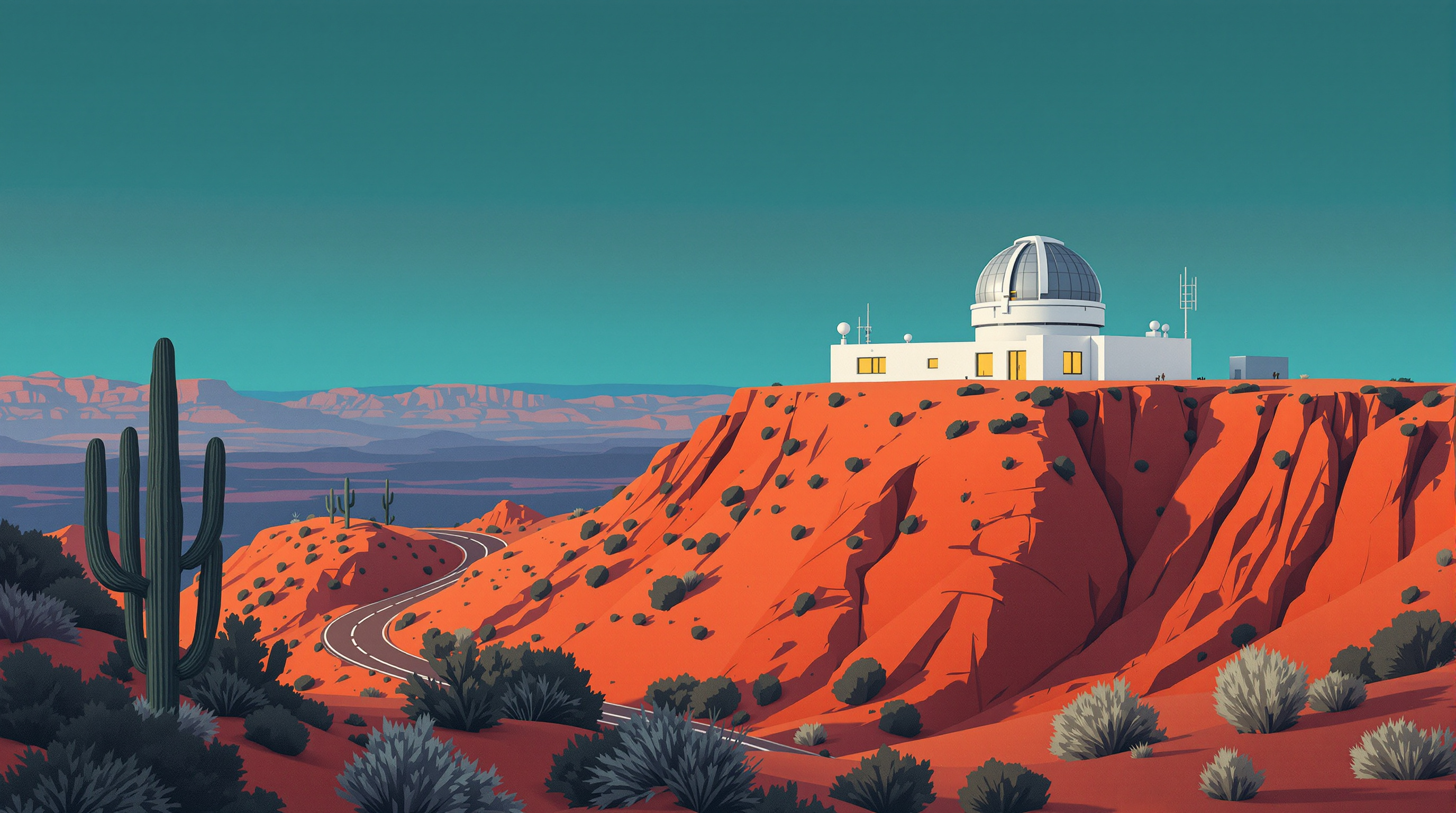
A flat, textured 1960s-style gouache painting of a white-domed observatory on a red rock mesa, with a winding switchback road, layered rust, pink, and ochre desert shapes, cactus silhouettes, and a teal-to-coral dusk sky with a crescent moon and a speckled Milky Way, in a limited retro palette.
A mid-century modern gouache illustration of a small mountaintop astronomical observatory in a red rock desert at dusk, wide 16:9 landscape composition, painted in flat, opaque gouache with visible brush texture and slightly chalky matte color. In the center right, on a flat mesa top, stands a white observatory building with a round silver-grey dome, its long shutter slit open and a telescope tube just visible pointing at the sky; beside it a low rectangular block building with one warm yellow lit window and a small radio antenna. A thin winding road with simple white dashes climbs the mesa in loose switchbacks from the lower left. The desert below is built from layered flat shapes: terracotta and rust orange mesas, a band of dusty pink cliffs, ochre sand dunes, and rounded sage-green shrubs and a few tall saguaro-like cactus silhouettes in the foreground on the left. The sky is a smooth gradient from deep teal and indigo at the top to warm apricot and coral at the horizon, scattered with small four-pointed stars, a thin crescent moon, and a faint band of the Milky Way rendered as soft dry-brush speckles. Long purple shadows stretch across the sand. Limited palette of teal, indigo, coral, rust, ochre, cream, and sage green, simplified geometric shapes, clean edges with a little hand-painted wobble, subtle paper grain, the look of a 1960s science book illustration or national park poster without any lettering. Calm, optimistic, wonder-filled mood. No people, no text, no letters, no logos, no border, no watermark.
Describe the Victorian glass conservatory or winter garden you imagine, its era, scale, iron and glass structure, plants, furniture, floor, mood, and garden setting, and get an architecture and planting concept, a palette, a numbered list of fixed design details, and two image prompts showing the same building inside on a misty morning and from the garden path at blue hour, plus a consistency checklist and practical notes. Step 1 of a three-step workflow.
Act as a conservatory and glasshouse designer and as a visualization art director. I will describe the Victorian-style glass conservatory I am imagining. You will turn it into a tight concept: the building, its iron and glass structure, the plants, the furniture, the floor and water features, the light and mood, with a numbered list of fixed design details plus two ready-to-use image prompts that show the SAME building from two viewpoints at two times of day, so the two AI images look like photos of one real place.

Era and inspiration: High Victorian, around 1870, inspired by public palm houses but at the scale of a private estate
Purpose and scale: a private winter garden attached to nothing, standing alone at the end of a formal garden, about 14 m long, 8 m wide, 7 m high
Structure and materials I like: white-painted wrought iron, arched ribs, a diamond lattice glass roof, a low pale stone plinth wall
Plants: hanging Boston ferns, kentia palms in terracotta pots, tree ferns, orchids on a side shelf, moss
Furniture and features: ornate cast-iron benches, a small round mosaic fountain with koi in the center, brass pendant lanterns
Floor: black-and-white checkerboard marble
Mood: calm, humid, timeless, a little romantic, a place to read on a Sunday morning
Outside the building: a gravel path between low box hedges, climbing pink roses on the front, a formal English garden
View A: interior at eye level from just inside the front doors, looking down the central aisle, early morning sun with misty light shafts
View B: exterior from the gravel garden path facing the front entrance at blue hour, warm lamps glowing inside

Please produce:

1. Concept
   - A name idea for the conservatory (for my use only, it will not appear in the images) and a two-sentence story of how it should feel to step inside.
   - Architecture: footprint, height, roof form, rib spacing, glazing pattern, ridge details, entrance, ventilation features, and how the iron is finished, described in plain construction terms.
   - Interior layout: the central aisle, where the fountain sits, where benches, palms, ferns, and shelves go, and where the lanterns hang, described from the entrance looking in.
   - Planting plan: each plant group with its position and the effect it creates (height, texture, light filtering).
   - Palette: 6 named colors (simple names like "chalk white" or "fern green") and where each one appears.
   - Materials and finishes: iron, glass (clear, slightly wavy old glass, condensation), stone, marble, mosaic, brass, terracotta, and wood.

2. Fixed design details (the consistency list)
   A numbered list of 14 to 18 details that must look identical in every image: footprint and proportions, roof shape, rib count and spacing, the glazing pattern, the ridge cresting and finials, the plinth wall, the entrance doors and fanlight, the floor pattern, the fountain, the benches, the lanterns, the palms, the ferns, and anything visible from both inside and outside, each with its exact position. Write each one as a short, concrete phrase an image generator can follow (for example "a round fountain basin about 2 m across, clad in deep blue and gold mosaic, at the exact center of the hall").

3. Image prompt A: the base view
   One detailed prompt for an AI image generator: photoreal architectural interior photography from the view A position, in view A light. Include every fixed detail visible from there in its correct position (left and right as seen from the camera), camera height and lens, light direction, atmosphere (mist, humidity, light shafts), mood, and a 16:9 landscape composition. End with exclusions (no people, no readable text, no signage, no modern objects).

4. Image prompt B: the second view
   One detailed prompt for view B, written for a text-only image generator that cannot see image A: restate ALL fixed details again in full words (never "same as before"), place each one correctly for the new camera position, describe what is newly visible from outside (the front gable, the plinth, the ridge cresting, the path, the roses), describe which interior details can be seen through the glass and the open doors, and change only the viewpoint, time of day, and lighting. Keep the structure, colors, and proportions identical.

5. Consistency checklist
   Ten yes/no checks to compare image B against image A (for example "Is the roof glazing still a diamond lattice between the white arched ribs?").

6. Practical notes
   A short list on real-world feasibility: heating and humidity for these plants, ventilation, shading in summer, maintenance of painted iron and old glass, safety glass options, and a rough order of magnitude for building or restoring something similar, labeled as an estimate.

Rules:
- Keep the design historically believable for the stated era; flag anything that would be anachronistic or structurally unrealistic.
- Use plain color names and concrete shapes; avoid vague words like "beautiful" or "magical" on their own.
- No readable text, plaques, signs, or numbers anywhere in the image prompts.
- No real named buildings, brand names, or real people in the image prompts.
- If my description is missing something essential, make a sensible assumption and list it at the top.
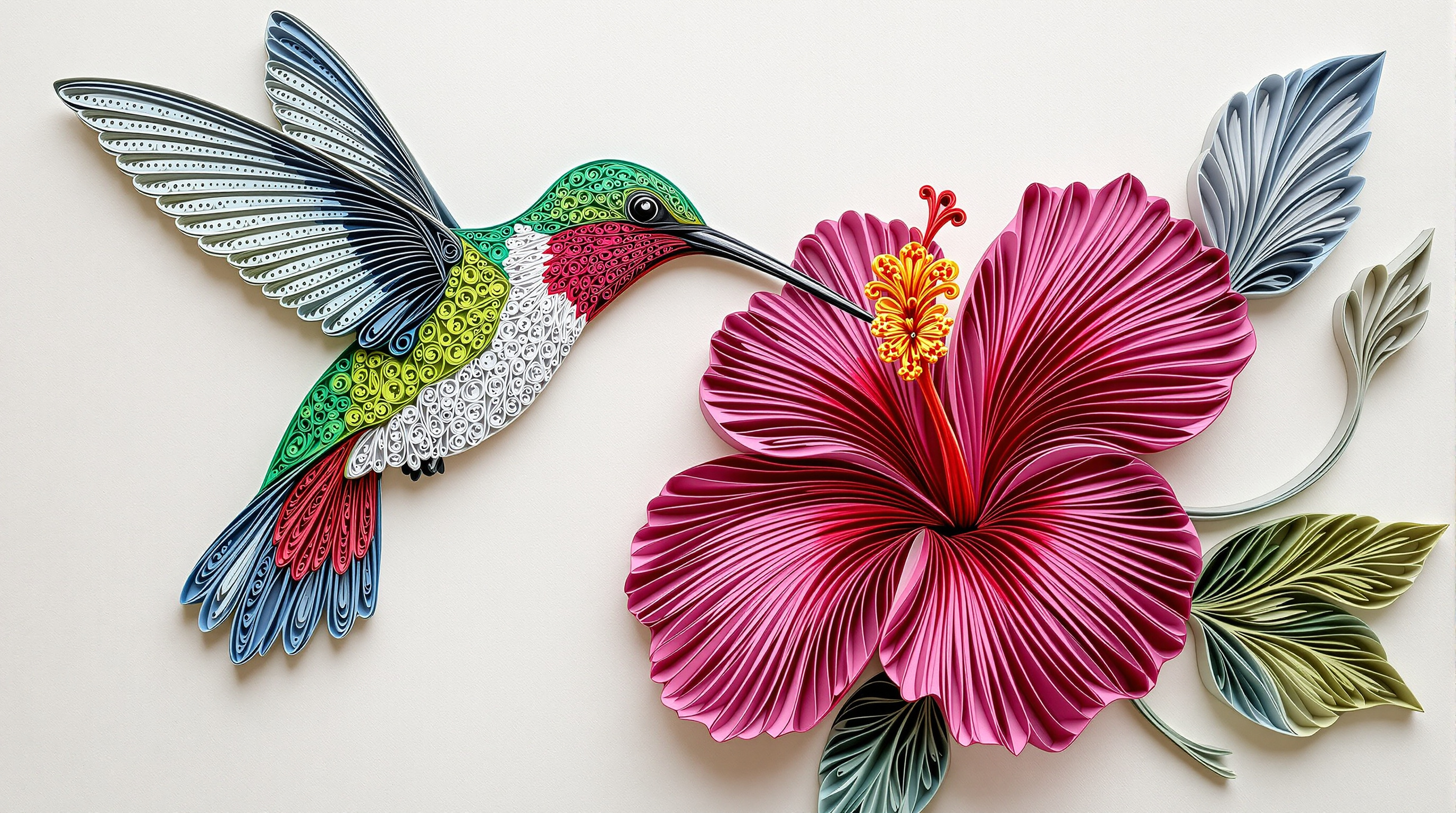
A photoreal close-up of a handmade paper quilling artwork on a craft table: an emerald and ruby hummingbird in mid-hover sipping from a magenta hibiscus, built from tightly coiled and scrolled paper strips standing on edge on a cream background, with soft window light, paper-edge shadows, and quilling tools blurred at the edge.
A close, slightly elevated studio photograph of a finished paper quilling artwork lying flat on a pale wooden craft table, 16:9 landscape composition, the artwork filling most of the frame. The piece shows a ruby-throated hummingbird in mid-hover on the left, its long thin beak dipping into a large open magenta hibiscus flower on the right. Everything is built from thousands of narrow paper strips, about 3 mm wide, rolled into tight coils, teardrops, marquise shapes, and open scrolls, glued on edge so the paper stands up from a soft cream cotton-paper background. The hummingbird's back and crown are tight coils in emerald and metallic-sheen green, its throat a patch of tiny ruby-red teardrop coils, its belly pale grey and white loose coils, its wings two fans of long fine strips in smoky grey-blue graded from dark at the base to light at the tips, suggesting motion; a small black coil for the eye with a single white dot. The hibiscus has five broad petals made of rows of magenta and hot pink strips shaped in waves, a deep crimson center, and a long yellow stamen column tipped with tiny orange coils; two glossy green leaves made of veined leaf-green strips, a curling stem, and one closed bud. A few loose spiral tendrils and three small lavender filigree flowers fill the background space. Real craft details: visible paper edges and layers, slight variations in coil tightness, tiny glue sheen at a few joints, and soft shadows cast by the raised strips onto the cream base. At the edge of the frame, out of focus: a slotted quilling tool, a small bundle of colored strips, and a pair of fine tweezers. Soft diffused window light from the upper left, gentle contact shadows, shallow depth of field with the hummingbird's head and the flower center sharpest, the far corners softly blurred. Photoreal product photography of handmade paper art, true colors, calm and delicate mood. Not a drawing or a painting of quilling: a real photographed paper object. No text, no letters, no signature, no watermark, no hands.
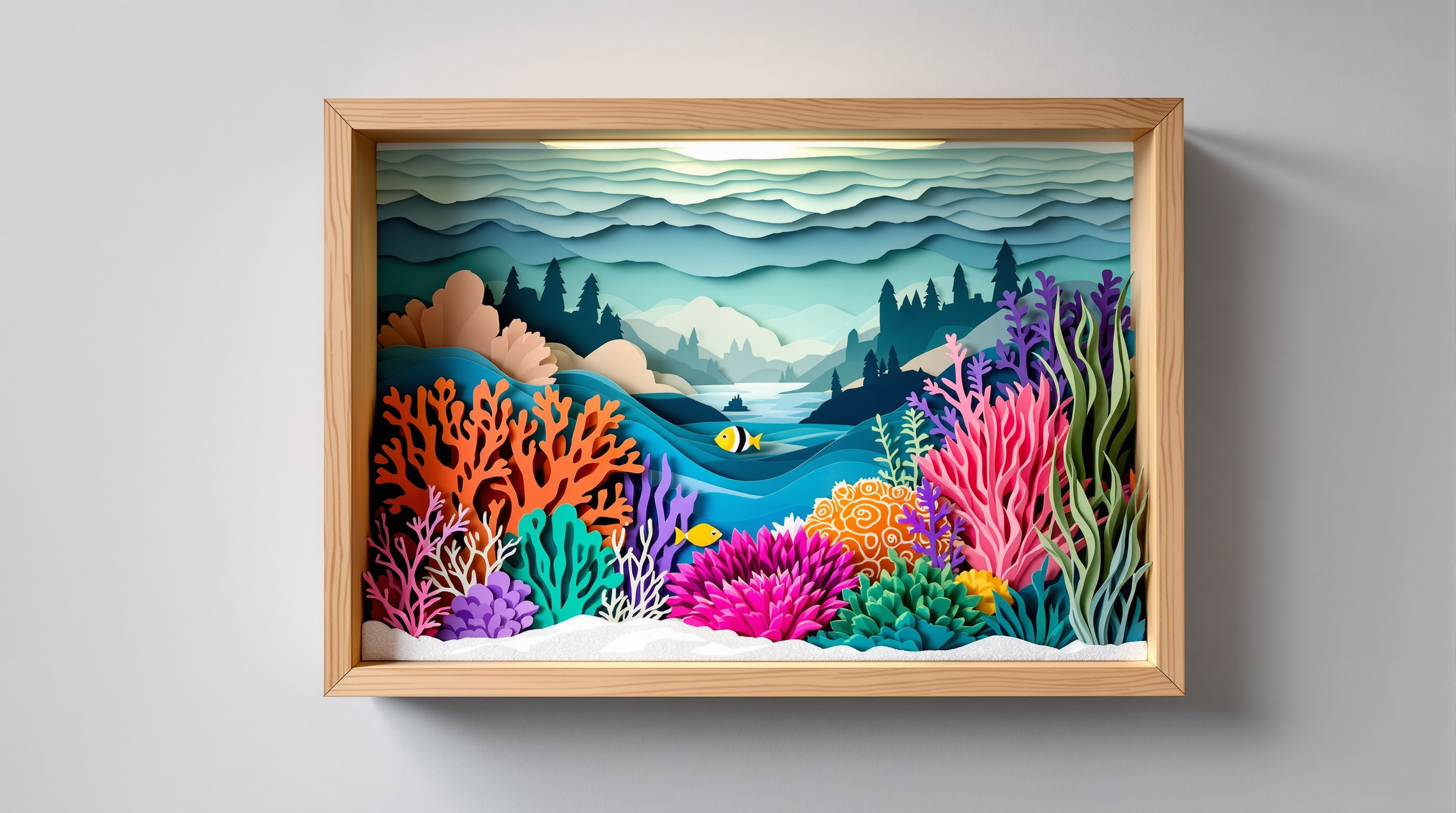
A gallery photo of a deep oak shadow box holding a layered cut-paper coral reef: turquoise water gradients, pink branching coral, an ochre brain coral, a violet lace fan coral, a magenta anemone, a small yellow fish, punched paper bubbles, and a cream sand floor, lit from the side so every paper layer casts a soft shadow.
A museum-quality photograph of a deep wooden shadow box hanging on a pale grey gallery wall, seen straight on at eye level, 16:9 landscape composition with the box filling most of the frame. Inside the box is a layered cut-paper diorama of a coral reef aquarium, made of about twelve hand-cut paper layers spaced a few millimeters apart so each layer casts a soft shadow on the one behind it. The back layers are smooth gradients of turquoise and deep teal paper suggesting open water, with faint wavy cut-outs of light rays; middle layers hold silhouettes of distant coral in muted blue-green; the front layers are rich and colorful: branching coral in coral pink and salmon, a round brain coral in ochre with a carved maze pattern, a fan coral in violet with delicate lace-like cut holes, swaying sea grass in two greens, and a bright magenta anemone with fringed tentacles cut in fine strips. A single small yellow fish with a thin black stripe and a tiny punched eye swims near the anemone, slightly raised on its own layer. Columns of small circular bubbles, punched from white and pale aqua paper, rise on the right. A sandy floor of textured cream paper with a few tiny cut shells runs along the bottom. The box frame is natural oak, about 8 cm deep, with a clean inner white mat and a sheet of museum glass showing only a faint reflection at one corner. Soft directional light from the left side lights up the paper edges and creates crisp, layered shadows inside the box, emphasizing depth; the paper fibers, cut edges, and slight curl of thin pieces are visible. Calm, wondrous mood, true colors, craft and fine-art photography, sharp focus across the whole diorama. No text, no letters, no labels, no signature, no watermark, no people.

A photoreal studio photo of a handmade needle-felted red panda sculpture on a moss-wrapped branch: rusty orange wool coat, cream muzzle, ringed tail, glass-bead eyes, soft window light, and felting tools blurred at the edge on a linen craft table.
A close, slightly elevated studio photograph of a finished needle-felted wool sculpture of a red panda sitting on a mossy branch, 16:9 landscape composition, the sculpture filling the center of the frame. The red panda is built entirely from densely poked wool fibers: rusty orange and cinnamon body, cream muzzle and ear linings, dark brown eye patches and legs, a ringed bushy tail curling around the branch. Tiny black glass bead eyes catch a soft highlight; whiskers are a few fine threads of dark wool; individual poked texture shows on the cheeks and paws so it reads as handmade felt, not fur photography. The branch is wrapped in real preserved sheet moss and a few dried fern fronds, resting on a pale linen cloth over a wooden craft table. Soft diffused window light from the upper left, gentle contact shadows under the paws, shallow depth of field with the face and front paws sharpest, the far end of the tail and table edge softly blurred. At the lower right corner, out of focus: a felting needle in a wooden handle and a small pile of dyed wool rovings in orange, cream, and brown. Photoreal product photography of handmade needle-felted fiber art, true colors, cozy and quiet mood. Not a drawing, not a painting, not a real animal: a real photographed wool sculpture. No readable text, no letters, no signature, no watermark, no hands.
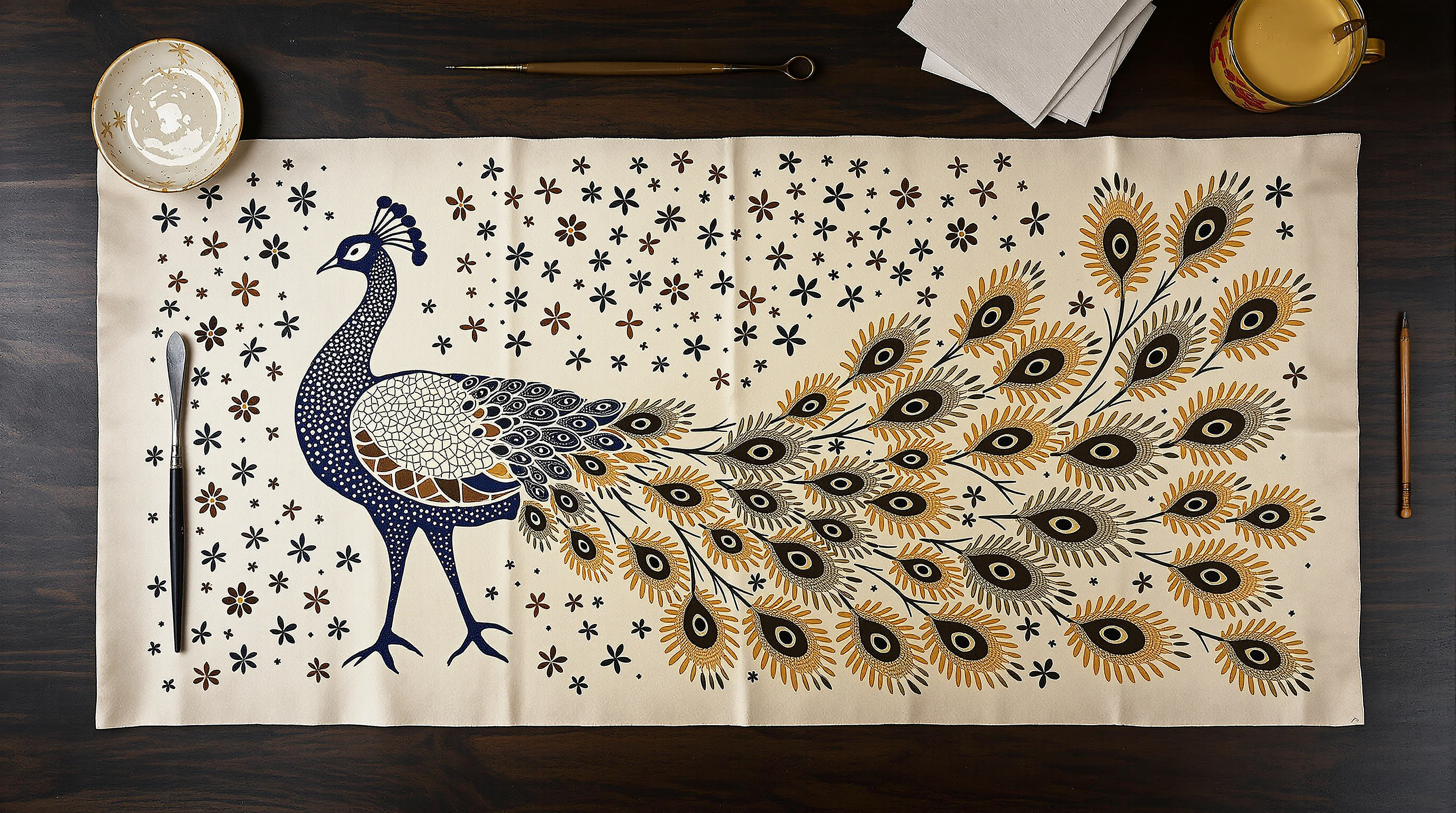
A flat-lay photo of a finished batik textile panel on teak: an indigo and ochre peacock with cracked wax-resist eye-spots and parang-inspired fillers on cream cotton, soft sidelight, with a canting tool and wax pot softly blurred at the edge.
A flat-lay photograph of a finished hand-drawn batik textile panel spread on dark teak, 16:9 landscape composition, the cloth filling most of the frame from left to right. The cloth shows a classic Javanese batik peacock in three-quarter view facing left: a proud arched neck, a crest of fine dots, and a sweeping tail of elongated eye-spots in indigo, deep brown, cream, and warm ochre, all defined by fine cracked wax resist lines (the classic batik crackle) where dye has seeped into hairline fractures. Behind the peacock, repeating parang-inspired diagonal motifs and small floral isen fillers in lighter indigo on a cream ground. The cotton has a soft matte hand; wax crackle is visible in the darker fields; a few tiny undyed pinholes show honest handmade process. Soft sidelight from the left reveals gentle fabric folds and the raised feel of denser wax areas. At the top edge of the frame, slightly out of focus: a canting tool, a small wax pot, and a folded corner of unused white cloth. Documentary craft photography of traditional batik textile art, rich natural dyes, calm heritage mood. Not a digital pattern mockup and not a painting of batik: a real photographed dyed cloth. No readable text, no letters, no logo, no watermark, no hands.
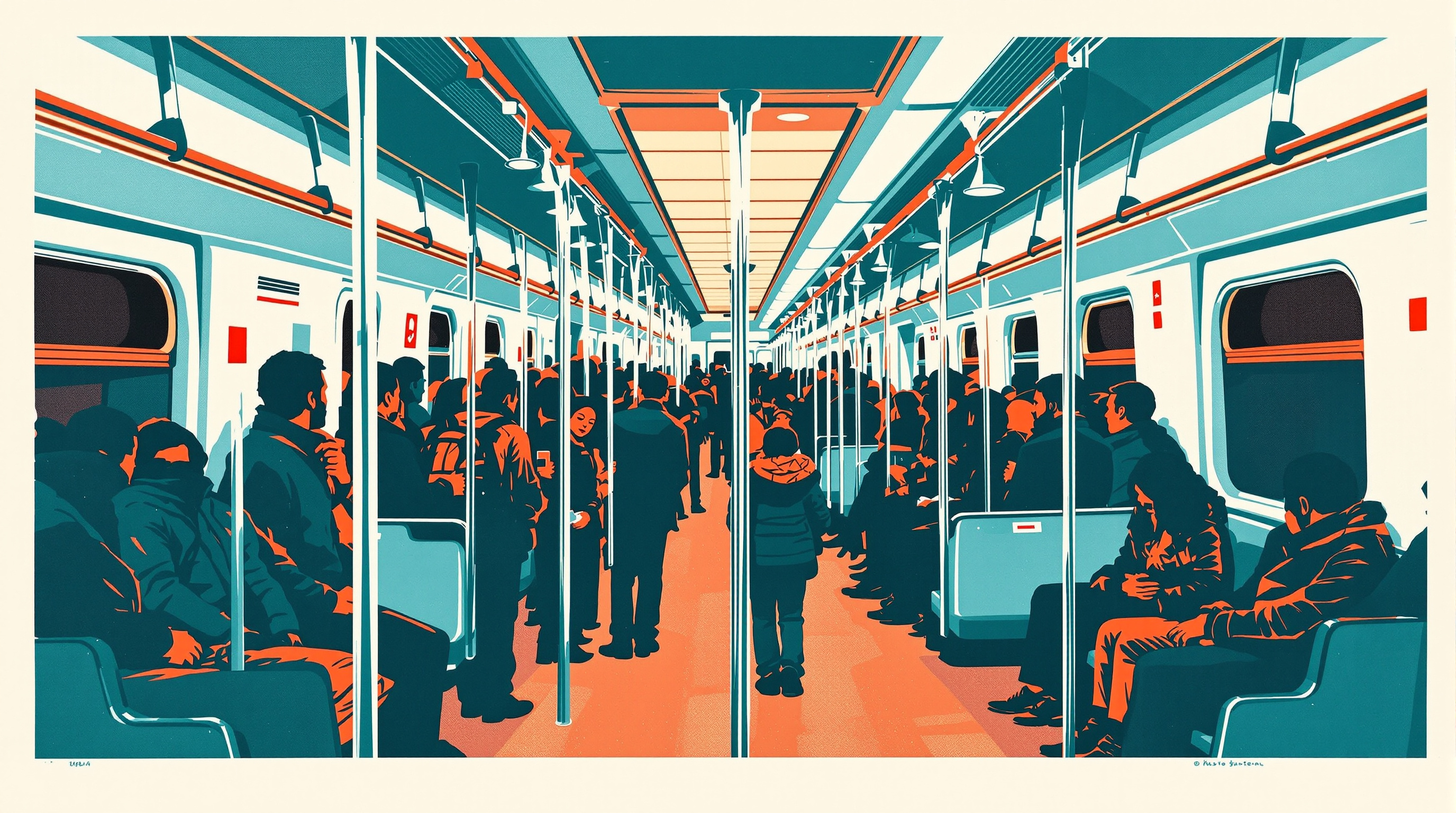
A two-color risograph print look of a packed subway carriage at night: fluorescent teal and warm red ink on cream paper, passengers as simplified shapes, overlapping misregistration, visible halftone dots, handrail reflections, and a quiet tired mood, framed as a finished print on a table.
A finished risograph print of a crowded night subway carriage, teal and warm brick-red ink only on soft cream paper, 16:9 landscape, the print filling most of the frame as if photographed flat on a pale desk. Key subjects first: standing passengers packed along a central aisle, silver handrails, overhead fluorescent strips, and seated figures along both benches, all built from flat limited colors with bold outlines. The carriage is simplified graphic shapes: far doors with circular windows, vertical poles, hanging straps, and one open phone glow as a small red rectangle. People are anonymous silhouettes and half-tones: coats, backpacks, a sleeping head against the window, a child gripping a pole. Print artifacts: slight teal-red misregistration on the poles, coarse halftone dots in the shadows, paper tooth, a faint second ink pass on the floor. Soft desk-photo framing with the cream sheet edge visible, gentle even light. Mood quiet and tired, late commute, graphic poster energy. Not photoreal, not 3D, not watercolor. No readable text, no logos, no watermark, no hands.
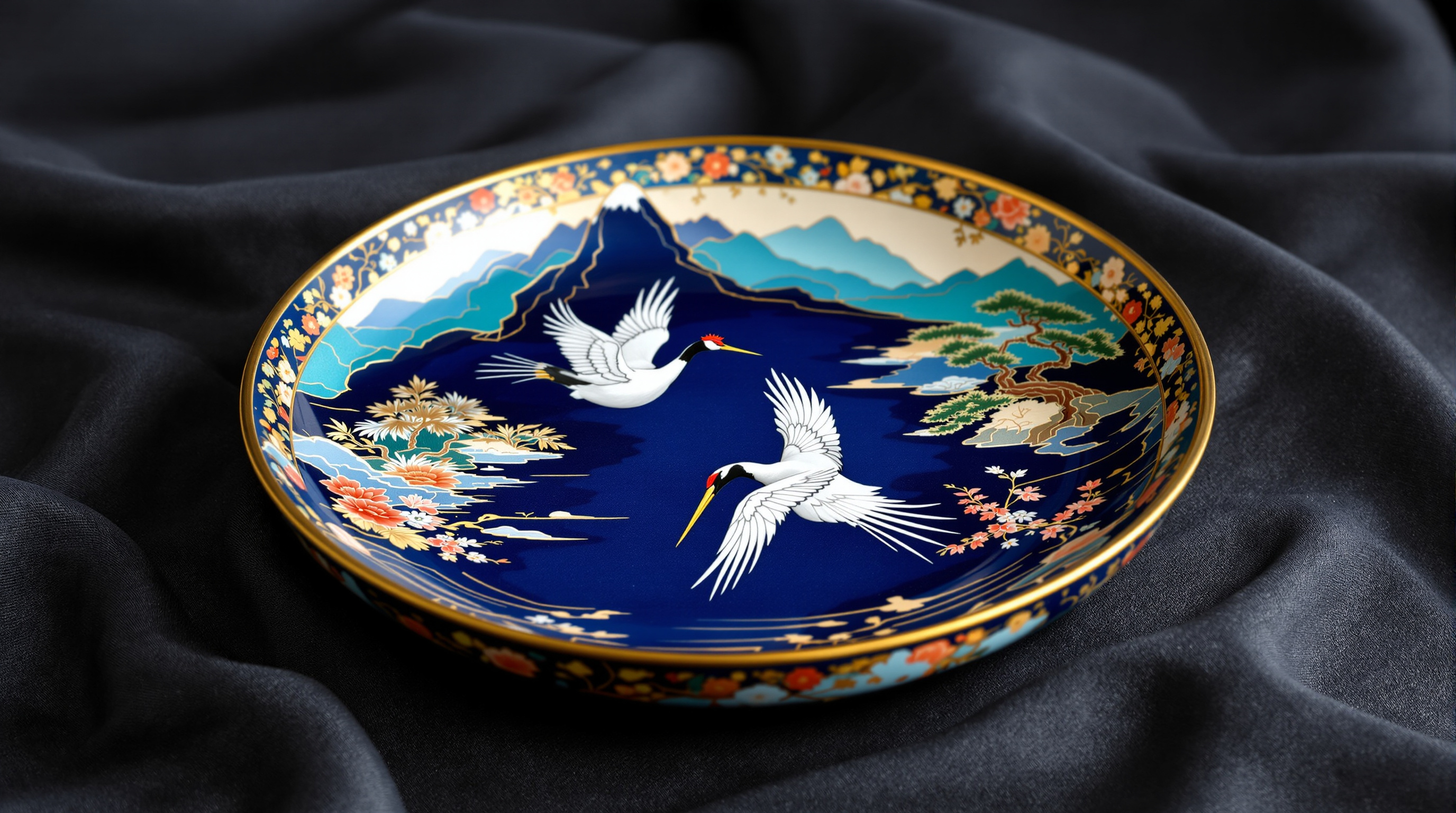
A photoreal studio shot of a round cloisonné enamel dish: two white and black cranes flying over a deep blue mountain lake, fine gold wire cells filled with saturated enamel, floral rim border, glossy kiln finish, on dark linen with soft side light.
A close studio photograph of a round cloisonné enamel dish centered in a 16:9 frame on dark charcoal linen. Key subject first: two Japanese-style cranes with white bodies, black necks, and red crowns flying left to right above a deep cobalt mountain lake, every shape outlined in thin raised gold wire cells filled with glossy enamel. Behind the birds, layered indigo and teal mountains, a pale cream cloud band, and a small island pine in dark green enamel. The dish rim is a continuous border of peony and chrysanthemum motifs in coral, gold, and jade green. Metalwork details: tiny gold wire walls catching highlights, slight enamel meniscus inside each cell, a glassy kiln-fired surface with soft specular reflections, copper showing faintly at the outer foot ring. Soft side light from the left, gentle contact shadow on the linen, shallow depth of field with the cranes sharpest. Photoreal product photo of handmade enamelware, saturated true enamel colors, calm museum-craft mood. Not a painting of enamel: a real photographed object. No text, no hallmark letters, no watermark, no hands.
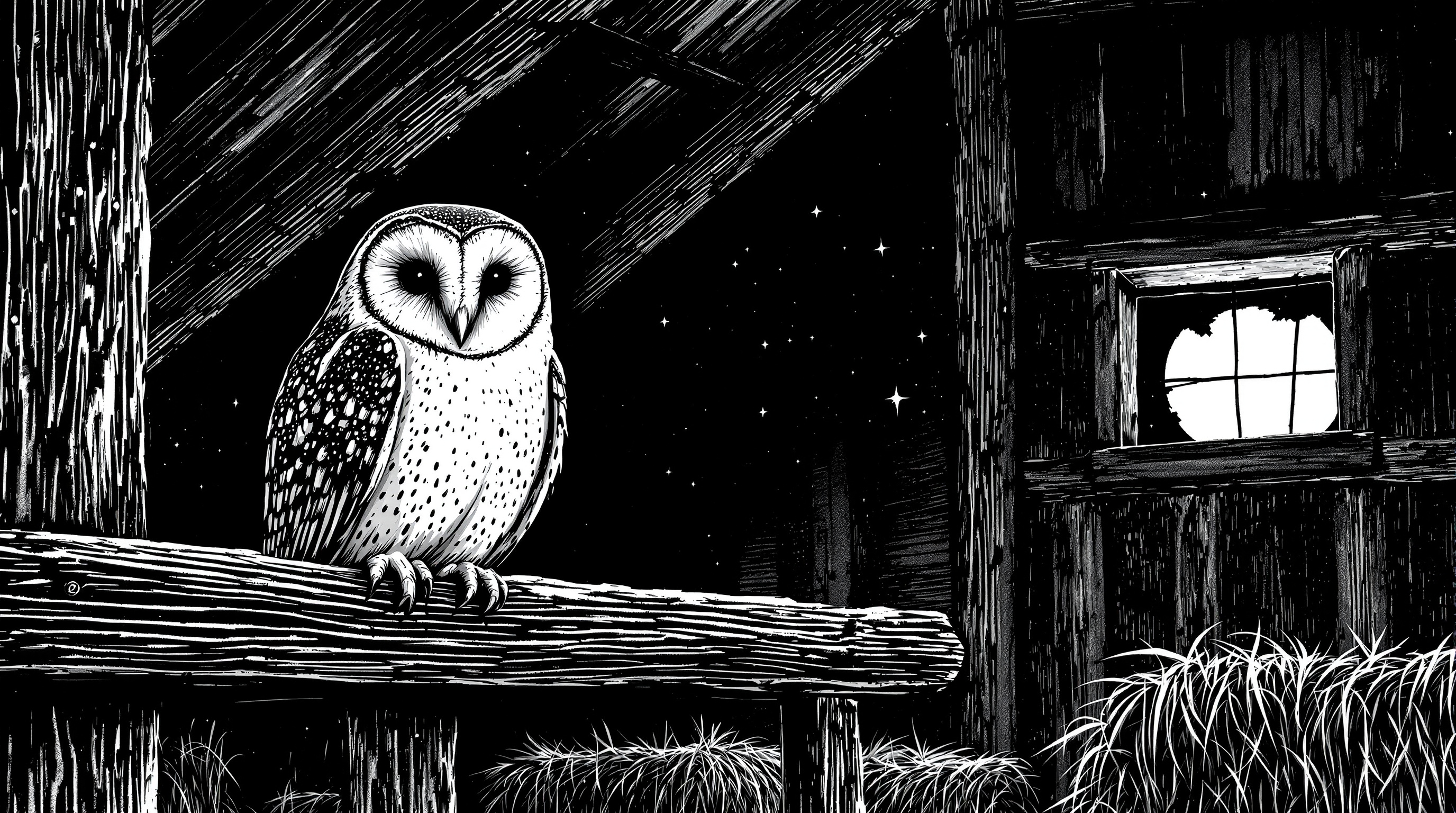
A black scratchboard illustration of a barn owl perched on a beam inside a moonlit barn: white scratched feathers against deep black ink, straw and rafters suggested with fine lines, a round moon through a broken loft window, high-contrast engraved look, no color.
A black scratchboard illustration of a barn owl perched on a rough wooden beam inside a quiet barn at night, 16:9 landscape, high-contrast white scratched lines on deep black ink board. Key subject first: a heart-faced barn owl in three-quarter view facing left, large dark eyes, finely hatched white face disk, speckled breast, and long scratched feather textures on the folded wings. Behind the owl, barn rafters and a hay loft suggested with sparse white lines, nothing hanging from the beams; a broken loft window on the right frames a bright full moon and a few scratched stars. Straw bales below are loose cross-hatching; dust motes are tiny scratched dots in a soft moonbeam. Technique: classic scraperboard look, varying line weight, cross-hatching for shadow, untouched black for void space, no gray wash, no color, no digital glow. Mood still, watchful, slightly eerie but calm. No text, no signature, no watermark, no color tint.
Describe the floating cedar teahouse you imagine on a mountain lake, its scale, roof, screens, engawa, lanterns, boats, and mood, and get an architecture concept, a palette, a numbered list of fixed design details, and two image prompts showing the same teahouse from the misty morning shore approach and from inside at lantern dusk, plus a consistency checklist. Step 1 of a three-step workflow.
Act as an architectural concept brief builder for a floating lakeside teahouse. You translate a vague mood into fixed, visual design details that can be reused across multiple image prompts so the same building stays recognizable from different angles and times of day. You are concrete about materials, dimensions, and what must not change.

About the teahouse I imagine:
- Setting: a quiet mountain lake in early autumn, forested shores, soft fog
- Scale and use: intimate, seats 6 to 8 on floor cushions, ceremonial tea for small groups
- Structure vibe: Japanese-inspired cedar, not a theme-park copy; quiet, handmade, slightly weathered
- Must include: hipped cedar shingle roof, sliding paper shoji, narrow engawa deck, two stone lanterns on the dock, a small tied wooden boat
- Must avoid: neon signs, glass curtain walls, people in the frame, readable text
- Mood words: hushed, misty, warm wood, contemplative
- Preferred views to generate later: morning approach from the shore path; dusk interior looking out across the water

Please do the following:
1. Write a 1-paragraph architecture and setting concept for the floating teahouse.
2. Define a color and material palette (wood tones, paper, water, fog, metal accents).
3. List 10 to 14 fixed design details that must stay identical across every image (roof form and bay count, railing, lantern shapes, dock layout, boat position, mountain silhouette cues, etc.).
4. Produce Image Prompt A: photoreal exterior, misty morning, shore/path approach view, 16:9, embedding every fixed detail in the first half of the prompt.
5. Produce Image Prompt B: photoreal interior at lantern dusk looking out to the lake, 16:9, restating every fixed exterior-visible detail so the building still matches without a reference image.
6. Add a short consistency checklist a human can use when comparing A and B.
7. Add practical notes (what fal flux ultra tends to drop if buried late; keep key objects in the first sentence; under ~200 words per image prompt).

Rules:
- No people, no readable text, no logos.
- Prefer specific measurable details over adjectives alone.
- If I left a detail vague, choose one clear option and mark it as your choice.
- Output in clear Markdown sections.
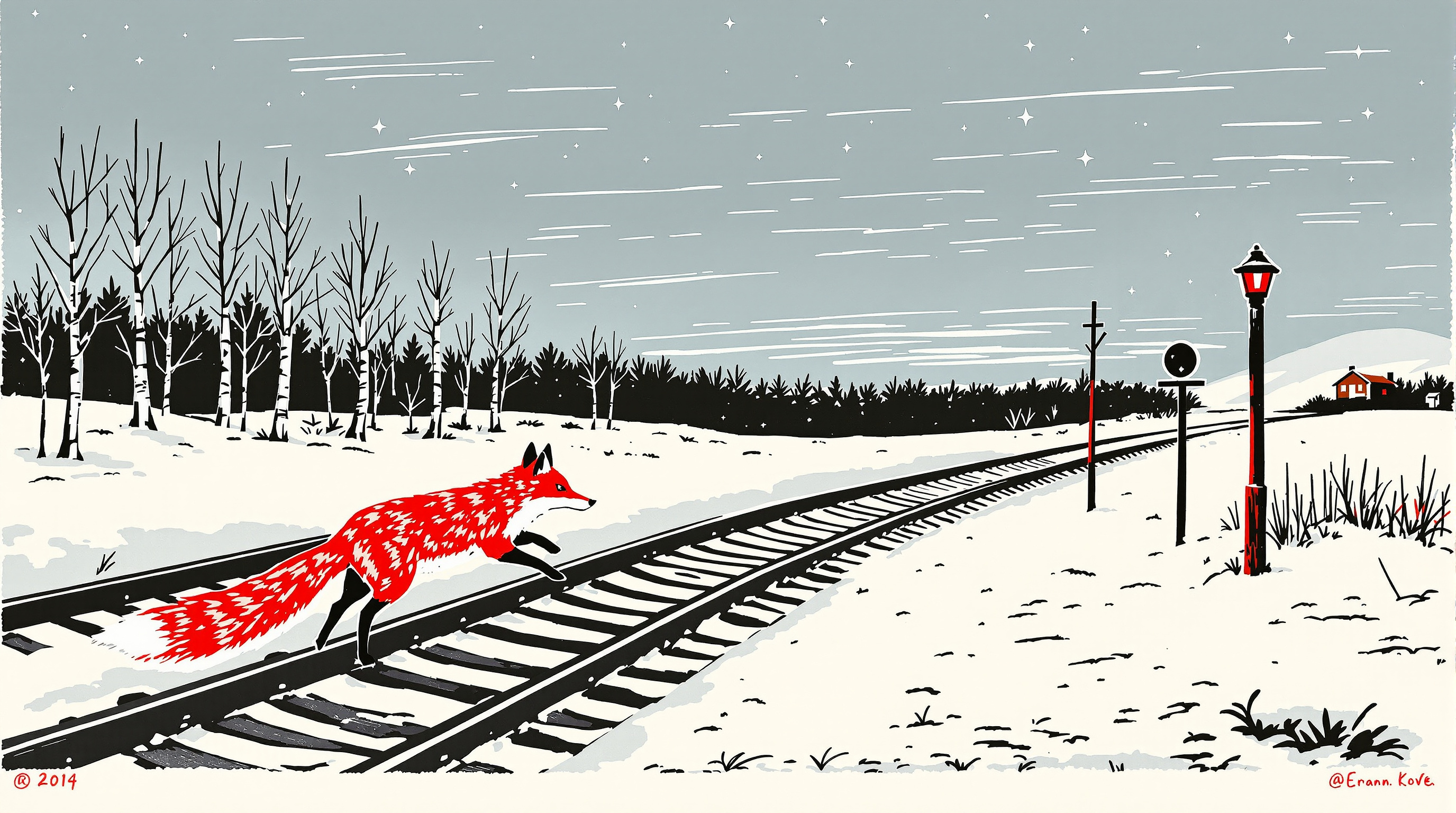
A three-color linocut print of a vermilion red fox stepping across snowy railway tracks at dusk, with bold black gouge-cut rails and sleepers, a lit signal lantern, bare birches, a slate-blue carved sky, slight registration offset, and cream printmaking paper texture.
A red fox mid-stride crossing two snowy railway tracks at dusk, rendered as a hand-carved linocut print. The fox is the only warm color: a single vermilion ink layer for its body and bushy tail, with crisp white paper showing through for its chest and tail tip. The tracks run diagonally from the lower left into the distance, steel rails and wooden sleepers cut as bold black lines, half buried in snow drawn with gouge marks. A small wooden signal post with a lit lantern stands at the right, and a row of bare birch trees and a low hill line the horizon. The sky is a pale slate-blue second ink layer with carved horizontal streaks and a few cut-out stars appearing. Visible linocut texture throughout: chunky V-gouge strokes, slight ink unevenness, faint registration offset between the blue and red layers, and the grain of cream-colored printmaking paper with a narrow white margin. Three-color limited palette (black, slate blue, vermilion). Quiet, cold, still mood. No text, no signature, no people.
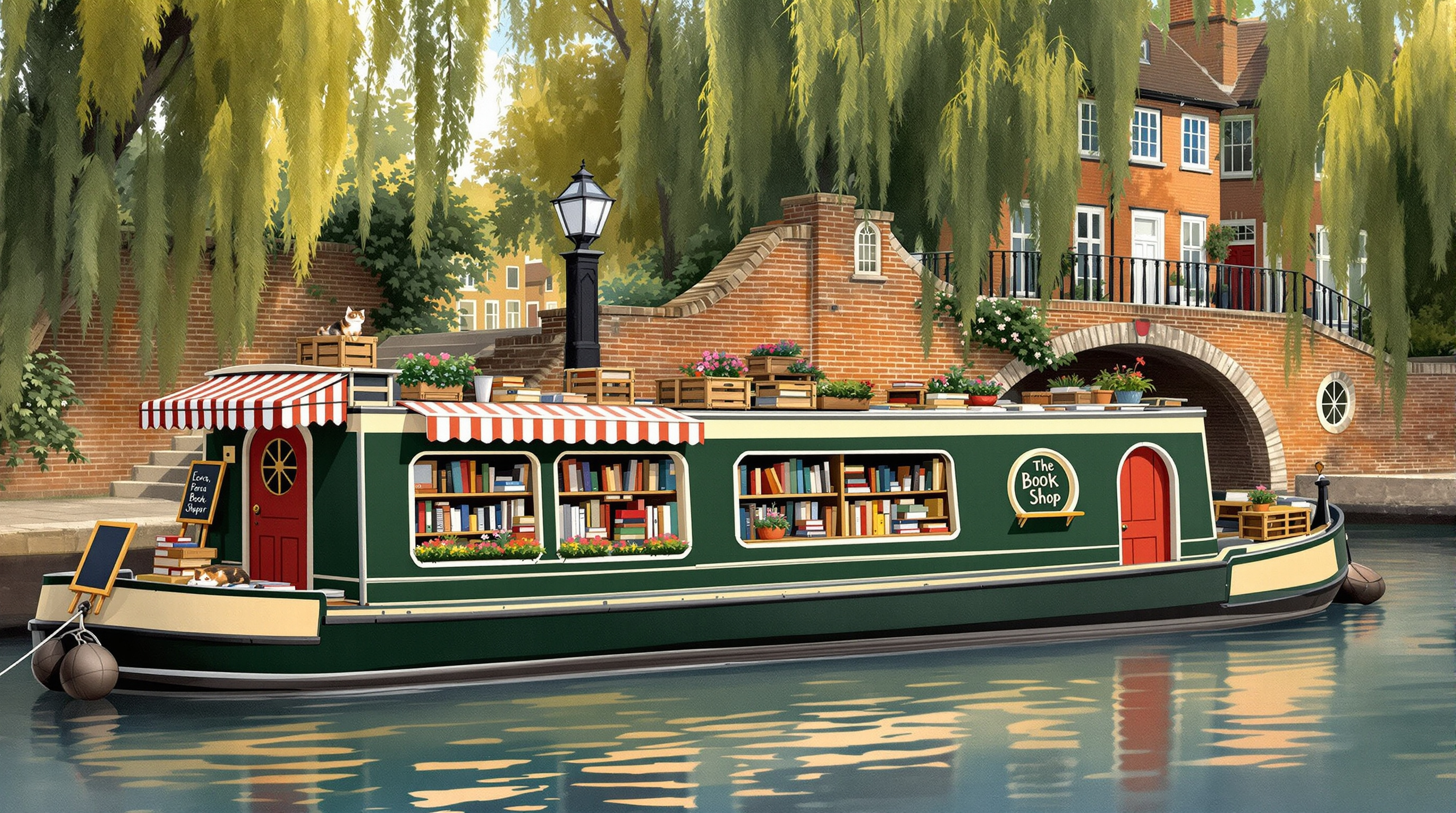
A cozy matte gouache painting of a forest-green canal barge turned bookshop, with book crates and geraniums on the roof, shelves visible through open hatches, a sleeping tabby on the bow, a brick footbridge, weeping willows, and calm late-afternoon reflections on still water.
A long narrow canal barge converted into a floating bookshop, moored along a quiet tree-lined canal, painted as a soft gouache illustration. The barge is deep forest green with a cream trim and a rounded red door; its roof holds wooden crates of books, potted geraniums, and a folded striped awning. Open hatch windows show shelves packed with colorful book spines, and a small chalkboard easel on the towpath is blank. A tabby cat sleeps on a stack of books at the bow. Behind the barge, an old brick footbridge arches over the water, weeping willows trail their branches, and a row of narrow terraced houses sits in the background. Calm late-afternoon light, warm peach highlights on the brickwork and gentle reflections of the green hull on the still water. Matte gouache texture with visible brush strokes, slightly chalky opaque color, soft edges, and a muted palette of sage, ochre, brick red, and cream. Cozy, unhurried, storybook mood. No legible text, no people.
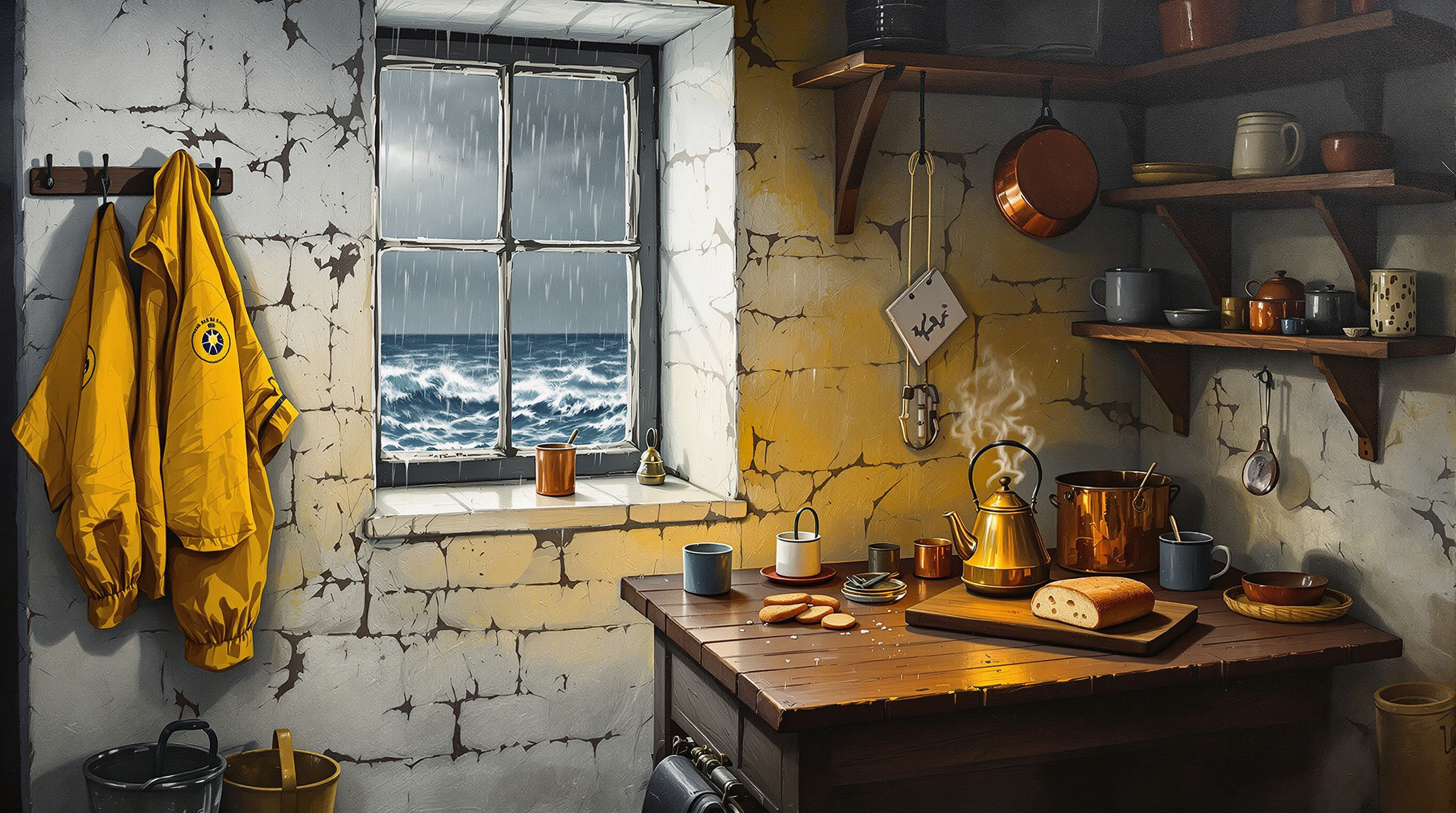
Warm oil painting of a lighthouse keeper's kitchen during a storm: brass kettle, oil lamp, wet oilskins by the door, rain-streaked window to a dark sea. Cozy amber interior versus cold spray outside; thick impasto brushwork.
A lighthouse keeper's kitchen painted in rich oil, warm and lived-in while a storm rages outside. Thick impasto strokes show whitewashed stone walls, a heavy wooden table with a brass kettle steaming, an oil lamp casting amber light, and a loaf of bread on a worn cutting board. Rain streaks the small paned window; through the glass, dark grey sea and white spray. Wet yellow oilskins and rubber boots hang dripping by the door. Copper pans and a enamel mug sit on open shelves. Cozy interior warmth contrasts with cold storm light at the window. Visible brushwork, muted ochres and deep blues, slight varnish sheen. No people, no text, no modern appliances.
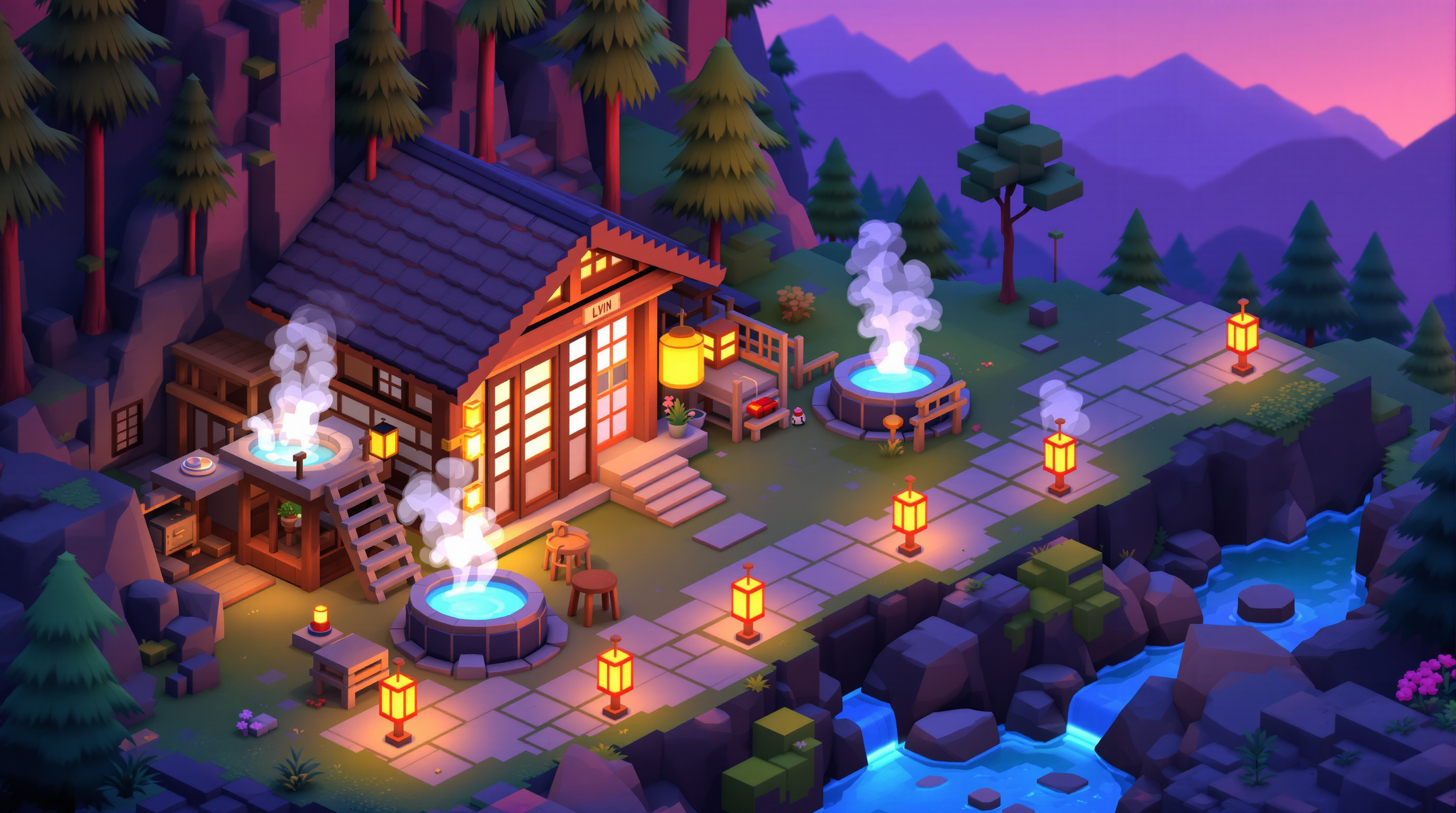
Colorful isometric voxel game scene of a wooden mountain onsen inn at dusk: steam from stone baths, pine trees, stone path, glowing paper lanterns, violet-blue sky. Clean blocky game art, no UI or characters.
An isometric voxel game scene of a mountain hot spring inn at dusk. Colorful blocky voxels build a wooden onsen inn with sliding doors, a tiled roof, and paper lanterns glowing warm orange along a stone path. Steam rises in soft white cubes from outdoor stone baths. Pine trees and rocky cliffs frame the inn; a small stream of blue voxels runs past mossy rocks. Lantern light pools on the path while the sky shifts violet to deep blue. Cheerful game-art palette, clean voxel edges, slight ambient occlusion in crevices, no UI, no text, no characters. Looking slightly down from a classic isometric angle.
Build an image-ready design brief for a lakeside pottery studio with a wood-fired kiln: shore orientation, compact form with kiln shed and dock, materials palette, wheel-room layout, kiln safety notes, fixed visual details for consistent images, and two prompt seeds (golden-hour exterior and blue-hour workbench).
Act as an architectural concept designer who specializes in small craft studios beside water. Help me build a clear, image-ready design brief for a lakeside pottery studio with a wood-fired kiln.

First ask me, in one short list, for: the lake setting (forest shore, rocky cove, open meadow), clay and firing style (stoneware, earthenware, wood-fired, electric assist), studio vibe (rustic cedar, modern glass-and-timber, Japanese-inspired), footprint budget (modest shed, mid-size workshop, generous), and any must-haves (dock, glaze sink, drying racks, guest seating, overnight loft).

Then produce the brief with these sections:

1. **Concept in One Sentence**: the feeling and purpose of the studio.
2. **Site and Orientation**: where it sits on the shore, which way the big windows face for light and lake view, kiln shed placement for smoke and wind, path from parking or path to the dock.
3. **Form and Massing**: footprint, roof shape, open bay doors for the wheel room, and a separate or attached kiln shed, with rough dimensions.
4. **Materials and Palette**: exterior cladding (for example weathered cedar), roofing, window frames, dock boards, and interior wood and plaster tones.
5. **Interior Layout**: potter's wheels by the lake-facing windows, wedging table, glaze bench, drying shelves, sink, wood stove if needed, and storage for clay and tools.
6. **Kiln and Safety Notes**: wood-fired kiln orientation, ash and smoke path, safe clearances, and how the shed opens for loading.
7. **Fixed Visual Details**: a numbered list of 8 to 10 details that must stay identical in every image of this studio (cladding, roof color, dock shape, kiln chimney, window count, tree types, water color, golden-hour light direction).
8. **Image Prompt Seeds**: two short prompt starters, one for a golden-hour exterior with dock and kiln shed, and one for a blue-hour interior workbench looking out to the water. Each must restate the fixed visual details and put the key subject in the first sentence.

Keep it concise, practical, and buildable. Avoid naming real architects or brands. Flag anything unsafe for wood firing near trees or a dock.
